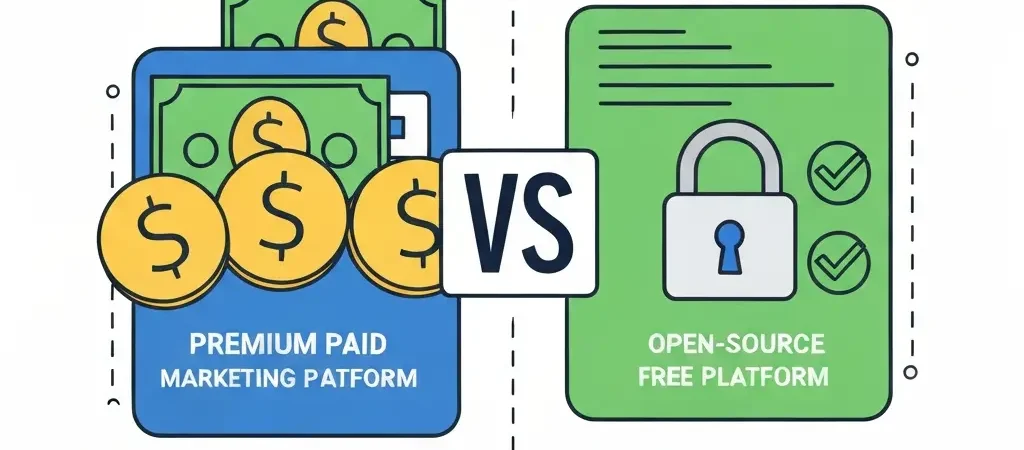
ActiveCampaign vs CampaignOS: The Open-Source Alternative That Does More for Less
ActiveCampaign is one of the most recommended marketing automation tools in the industry — and for good reason. Its automation builder is genuinely excellent, the CRM is well-integrated, and the deliverability is strong. But in 2026, teams are increasingly asking a pointed question: why pay $149–$549 per month when an ActiveCampaign alternative that’s free and open source can cover the same ground and more?
CampaignOS is that alternative. It’s open source, free to self-host, and ships with multi-channel campaign orchestration that actually exceeds what ActiveCampaign offers on channel breadth. This comparison breaks down the honest differences — where ActiveCampaign genuinely wins, where CampaignOS wins, and how to decide which is right for your team in 2026.
Pricing Reality Check
ActiveCampaign’s pricing is contact-based and scales quickly. Here’s what you’re actually paying in 2026:
| Contacts | ActiveCampaign Starter | ActiveCampaign Plus | CampaignOS |
|---|---|---|---|
| 1,000 | $15/mo | $49/mo | Free (self-host) |
| 10,000 | $99/mo | $149/mo | Free (self-host) |
| 50,000 | $299/mo | $549/mo | ~$20/mo (VPS cost) |
| 100,000+ | Custom | Custom | ~$40–80/mo (infrastructure) |
The cost savings for a 50,000-contact list are dramatic: $3,500–$6,600 per year for ActiveCampaign vs. roughly $240 per year in server costs for CampaignOS. For a growing startup, that budget difference funds additional engineers, content, or paid acquisition.
Automation Builder Comparison
ActiveCampaign’s automation builder is genuinely one of the best in the industry. The node-based visual interface is responsive, the trigger library is extensive, and the conditions system is flexible. CRM events, deal stage changes, and predictive sending add sophistication that takes years to build.
CampaignOS’s visual workflow builder is competitive on the core functionality marketing teams use most: trigger-based sequences, conditional branches, multi-channel actions, delays, and A/B splits. The canvas is modern and performant. Where ActiveCampaign edges ahead is in CRM-native automation triggers — if deal pipeline management is central to your automations, ActiveCampaign’s tight CRM integration is genuinely valuable.
For pure marketing automation without heavy CRM integration, CampaignOS’s builder handles everything most teams need. The self-hosted marketing automation approach also means you can extend the workflow engine with custom actions via webhooks and API integrations.
Channel Coverage
This is where CampaignOS clearly outpaces ActiveCampaign. ActiveCampaign is fundamentally an email platform with SMS added via integrations. CampaignOS supports:
- Email — marketing and transactional, your own SMTP
- Web push notifications — native, no third-party
- Mobile push — FCM and APNs
- Telegram bots — especially valuable for international audiences
- SMS — Twilio, Vonage
- In-app messages — for SaaS products
For companies building global audiences or serving markets where Telegram and mobile push have high engagement rates, CampaignOS’s multi-channel breadth provides real business value. The IQuitNow open-source health platform uses this kind of multi-channel approach to drive user retention across email, push, and messaging — demonstrating that the model works at scale.
CRM & Contact Management
ActiveCampaign’s CRM is a genuine strength. Deal pipelines, contact scoring, task management, and sales notifications are all tightly integrated. If your automation strategy relies heavily on sales pipeline events triggering marketing sequences, ActiveCampaign’s CRM-marketing integration is difficult to replicate without custom work.
CampaignOS has a solid contact management system with custom fields, tags, list segmentation, and lead scoring based on behavioral events. It doesn’t have a built-in sales pipeline. However, it integrates cleanly with dedicated CRM tools (HubSpot, Pipedrive, Salesforce) via webhooks and Zapier-compatible workflows.
Email Deliverability
ActiveCampaign maintains dedicated sending infrastructure with strong reputation management, which gives its cloud users a solid baseline deliverability advantage out of the box. You don’t have to think about warming up IP addresses.
With CampaignOS, deliverability is entirely in your hands — which is a double-edged sword. With a warmed-up dedicated IP via Amazon SES or Postmark and proper DKIM/SPF/DMARC configuration, you can achieve excellent deliverability. The self-hosted email marketing guide covers this setup in detail. The key metric: with proper configuration, self-hosted senders routinely achieve inbox rates that match or exceed commercial platforms.
Data Ownership & Privacy
This is an underrated consideration in 2026. With ActiveCampaign, your contact data, behavioral data, and campaign analytics live on their servers. You’re subject to their data processing agreements, their pricing decisions, and their platform availability.
With CampaignOS, your data stays on your server. You control backups, retention policies, and access. For companies handling sensitive customer data, operating in regulated industries, or building products for European audiences where GDPR compliance is non-negotiable, data sovereignty is a genuine business requirement, not just a preference.
This is also why platforms built with Authenova’s infrastructure, like this site, are built on open, self-hostable stacks — because Authenova’s AI content engine is designed around the principle that ownership and transparency matter in marketing technology.
Migrating from ActiveCampaign to CampaignOS
Migration is straightforward for the contact layer. ActiveCampaign supports CSV export of all contacts and custom fields. CampaignOS’s import tool accepts these files directly.
Automation workflows require manual recreation. Export your ActiveCampaign automations as documentation, then rebuild them in CampaignOS’s visual builder. For most organizations, this takes 1–3 days depending on automation complexity. Plan for a 2-week parallel-running period to validate campaign behavior before fully cutting over.
Which Should You Choose?
Choose ActiveCampaign if: CRM-native automation is central to your marketing, you want zero infrastructure management, or your team lacks the bandwidth to manage a self-hosted deployment.
Choose CampaignOS if: You want to eliminate $1,800–$6,600/year in platform costs, need multi-channel campaigns beyond email, want full data ownership, or are building on a modern open-source stack.
Switch to CampaignOS — Free Forever
Stop paying per-contact fees. CampaignOS is free to self-host with no contact limits. Start a free cloud trial or deploy on your own infrastructure in under two hours.
Frequently Asked Questions
Is CampaignOS really free with no hidden costs?
CampaignOS itself is free and open source under the MIT license. Your only costs are infrastructure: a VPS typically runs $10–40/month depending on your contact list size and send volume. Email sending costs depend on your SMTP provider — Amazon SES charges $0.10 per 1,000 emails, making it extremely cost-effective at scale.
Does CampaignOS have a CRM like ActiveCampaign?
CampaignOS has contact management, custom fields, tagging, segmentation, and lead scoring, but it doesn’t have a built-in sales pipeline CRM. For CRM functionality, it integrates with dedicated tools like HubSpot CRM (free tier), Pipedrive, and others via API and webhooks.
Can I use CampaignOS for transactional emails as well as marketing?
Yes. CampaignOS handles both transactional emails (order confirmations, password resets, notifications) and marketing emails from the same platform. This unification means a contact’s full communication history — both transactional and marketing — is visible in one place.
How does ActiveCampaign’s machine learning features compare to CampaignOS?
ActiveCampaign has predictive sending and win probability scoring powered by machine learning. CampaignOS’s AI features focus on content optimization and send-time optimization. If predictive deal scoring is important for your workflow, ActiveCampaign currently has the edge on ML-driven sales features.
What happens to my data if I switch from ActiveCampaign?
ActiveCampaign allows full data export before account closure. You can export all contacts, campaigns, and automation data. CampaignOS’s import tool accepts standard CSV formats. Plan for 30–60 days of parallel operation to complete migration smoothly without disrupting live campaigns.