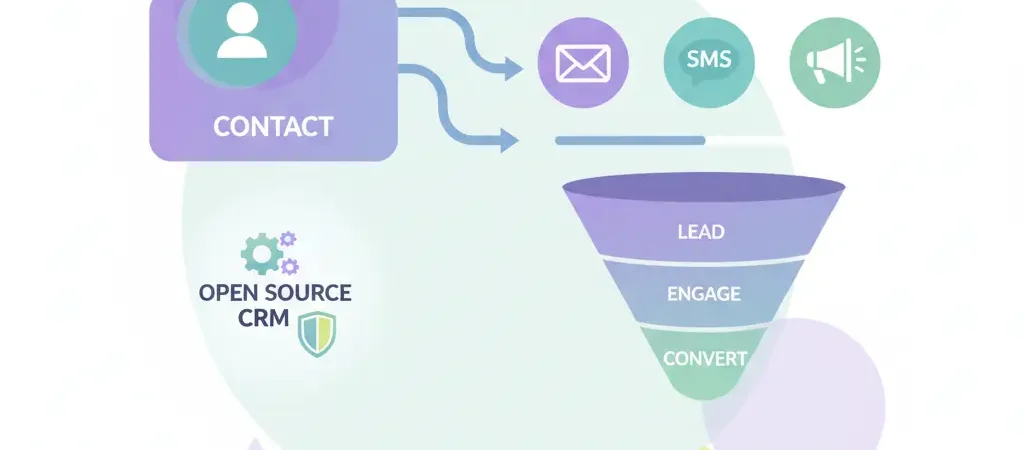
Best Open Source CRM and Marketing Automation Combined 2026
Most businesses run their CRM and marketing automation as two separate tools that never quite sync properly. Contact updates in the CRM don’t trigger the right email sequence. Deal stage changes don’t suppress sales follow-up. Lead scores live in marketing but the sales team can’t see them. The fix is to use a single platform that combines CRM and marketing automation natively — and in 2026, the best options for doing this without paying enterprise prices are open-source.
This article ranks the best open-source platforms that genuinely combine CRM and marketing automation in one codebase, not via a fragile integration. We cover CampaignOS, SuiteCRM, Mautic, EspoCRM, and Vtiger — with honest assessments of which is best for which use case. According to recent data, integrating CRM with marketing automation increases conversion rates by up to 300% and improves sales productivity by 34%. The platforms below make that integration free.
Open Source CRM + Marketing Automation: Comparison Table
| Platform | License | CRM Depth | Marketing Automation | Channels | Setup Difficulty | Best for |
|---|---|---|---|---|---|---|
| CampaignOS | Open-source | Strong (native) | Excellent (visual builder) | Email, SMS, WhatsApp, Push | Medium | SMBs, startups, agencies |
| SuiteCRM | AGPL v3 | Enterprise-grade | Good (campaigns + workflows) | Email, SMS (plugin) | High | Enterprise, complex sales |
| Mautic | GPL v3 | Basic | Excellent | Email, SMS, Push | High | Teams already running Mautic |
| EspoCRM | GPL v3 | Strong (no-code custom) | Good (process automation) | Medium | Sales-led teams, service businesses | |
| Vtiger | Open-source (Community) | Strong | Good | Email, SMS | Medium | Sales + marketing + support unified |
Why CRM and Marketing Automation Must Be Combined
The most common failure mode for marketing and sales teams is data fragmentation. Marketing automation lives in HubSpot. The CRM lives in Salesforce. A contact’s deal stage is updated in Salesforce, but HubSpot doesn’t know — so the nurture sequence keeps firing at a prospect who already bought. This is not a hypothetical problem. It is the default state for most businesses using separate tools.
When CRM and marketing automation share the same database, the logic is clean: a contact moves to “Customer” in the CRM, the marketing automation immediately removes them from prospect sequences and enrolls them in an onboarding flow. Lead scores from marketing behavior (email opens, website visits, content downloads) are immediately visible to the sales team on the contact record. Deal stage changes can trigger campaigns. This is the difference between a connected revenue system and two tools talking past each other.
For a deeper look at how these systems relate to each other conceptually, our article on the difference between CRM and marketing automation is worth reading before choosing a platform. Our broader open-source marketing automation tools comparison also covers tools that don’t include a CRM, for teams that want to keep the two systems separate.
1. CampaignOS — Best Overall Open-Source CRM + Marketing Automation
CampaignOS is the only platform in this comparison that delivers a modern, actively developed CRM and a full-featured marketing automation engine in the same codebase — with multichannel support that no other open-source tool matches. Where Mautic’s CRM is basic and SuiteCRM’s marketing automation requires plugins, CampaignOS was built from the ground up to unify both.
The CRM includes contact and company management, deal pipelines with drag-and-drop stages, custom fields, activity timelines, and notes. Lead scores generated by marketing automation behaviors (email opens, link clicks, form submissions, website visits) are visible directly on the contact record in the CRM. A contact reaching a lead score threshold can automatically trigger a deal creation or a sales team notification — the kind of workflow that typically requires a six-figure HubSpot contract.
- CRM features: Contacts, companies, deals, pipelines, lead scoring, custom fields, activity timeline
- Marketing automation: Visual workflow builder, behavioral triggers, segmentation, A/B testing
- Channels: Email, SMS, WhatsApp, web push
- Self-hosted cost: $0 (+ server ~$15–30/month)
- Best for: Startups, SMBs, agencies, any team that wants a unified revenue platform without enterprise pricing
See our full platform ranking for how CampaignOS compares against HubSpot, ActiveCampaign, and Brevo on a feature-by-feature basis.
2. SuiteCRM — Best for Complex Enterprise CRM Needs
SuiteCRM is the most feature-complete open-source CRM available, built as a community fork of SugarCRM. It covers every CRM use case imaginable: contacts, accounts, opportunities, leads, quotes, contracts, cases, and a full workflow engine. It is trusted by over 1,000,000 users across industries including financial services, healthcare, and government — sectors where open-source, self-hosted data ownership is not optional.
SuiteCRM 8 (the current version) brings a modern React-based frontend to what was previously a dated PHP interface. The marketing module includes email campaigns, campaign dashboards, and basic automation via its built-in workflow engine. Where it falls short is in the marketing automation depth — it is not a replacement for Mautic or CampaignOS for complex behavioral automation. Most teams using SuiteCRM for enterprise CRM purposes pair it with a dedicated marketing automation tool via API integration.
- CRM features: Enterprise-grade — full sales, service, and operations coverage
- Marketing automation: Good for campaigns; limited behavioral automation
- Channels: Email (native), SMS via plugin
- Setup difficulty: High — requires PHP server, database, and configuration expertise
- Best for: Enterprise teams prioritising CRM depth over marketing automation sophistication
3. Mautic — Best Legacy Open-Source Marketing Automation
Mautic is the most established open-source marketing automation platform and was the default recommendation for years before CampaignOS entered the market. It offers a comprehensive automation engine with a visual campaign builder, behavioral triggers, lead scoring, segmentation, and multi-step workflows. The CRM in Mautic is minimal — contacts and companies are tracked, but deal pipelines, sales stages, and CRM-style workflows are limited.
The primary concerns with Mautic in 2026 are UX and setup complexity. The interface has not kept pace with modern SaaS alternatives. The installation process requires PHP, Composer, database setup, and cron jobs — more involved than CampaignOS’s deployment. For teams currently running Mautic, the migration cost to CampaignOS may not justify the move in the short term. For teams choosing fresh in 2026, Mautic is no longer the recommended starting point.
For a direct head-to-head, see our Mautic vs Mailchimp vs CampaignOS comparison — it covers the automation depth, CRM capabilities, and total cost across all three platforms.
- CRM features: Basic (contacts, companies, limited pipeline)
- Marketing automation: Excellent — deep behavioral automation, visual builder
- Channels: Email, SMS (via plugins), web push
- Best for: Teams already running Mautic; developers comfortable with PHP
4. EspoCRM — Best for No-Code CRM Customisation
EspoCRM stands out for its no-code customisation layer. You can build custom entities, fields, relationships, and workflows without touching code — making it accessible to non-technical business owners who need a CRM shaped to their specific process. It is trusted by over 50,000 companies across 163 countries.
The marketing automation capabilities in EspoCRM are more limited than CampaignOS or Mautic. The process automation builder handles CRM workflows (task assignment, notification, field updates) but is not designed for complex behavioral marketing campaigns with multichannel orchestration. EspoCRM is best suited for sales-led businesses that need a highly customizable CRM first, with basic email campaigns as a secondary need.
- CRM features: Strong — highly customizable via no-code admin panel
- Marketing automation: Process automation (CRM workflows); limited marketing campaigns
- Channels: Email
- Best for: Sales-led teams needing a custom-shaped CRM; service businesses
5. Vtiger — Best All-in-One for Sales, Marketing, and Support
Vtiger Community Edition covers sales, marketing, and customer support in one platform. Unlike EspoCRM or SuiteCRM (which are CRM-first), Vtiger has a more balanced feature set across all three business functions. Marketing automation includes email campaigns, workflows, and basic behavioral triggers. The visual workflow designer is functional if not as polished as CampaignOS.
Vtiger’s open-source Community Edition is free and self-hostable. The commercial Vtiger One plans start at around $30/user/month for cloud-hosted. For teams that want CRM + marketing + helpdesk in a single platform and do not need advanced multichannel automation, Vtiger is worth evaluating. For teams where marketing automation sophistication is the priority, CampaignOS remains the better choice.
- CRM features: Strong — sales pipeline, contacts, companies, activity tracking
- Marketing automation: Moderate — email campaigns, basic workflow triggers
- Channels: Email, SMS
- Best for: SMBs needing CRM + marketing + support in one tool
Which Open-Source CRM + Marketing Automation Platform Should You Choose?
The decision comes down to whether your primary need is CRM depth or marketing automation sophistication:
- Best overall combined platform → CampaignOS. The only open-source tool with a modern CRM, full visual marketing automation, and native multichannel support (email + SMS + WhatsApp + push). Zero licensing cost when self-hosted.
- Best for enterprise CRM complexity → SuiteCRM. If you need quoting, contracts, service modules, and deep customisation, SuiteCRM’s breadth is unmatched. Add a marketing automation tool separately if needed.
- Best for teams already on Mautic → Stay on Mautic (short term). Migration overhead is real. Unless you need WhatsApp, deeper CRM, or a modernised UI, existing Mautic deployments are defensible.
- Best for no-code CRM customisation → EspoCRM. If your primary need is a sales-process CRM that you can shape without developer involvement.
- Best all-in-one for sales + marketing + support → Vtiger. If you want all three functions without assembling a stack.
For teams that want to automate not just their marketing but their content production as well, platforms like Authenova’s AI content automation integrate well with CampaignOS to create a fully autonomous growth stack. You can also review how CampaignOS handles the marketing automation side in our marketing automation platform comparison chart.
Frequently Asked Questions
What is the best free open-source CRM with marketing automation in 2026?
CampaignOS is the best free open-source platform that combines CRM and marketing automation in 2026. It includes contact management, deal pipelines, lead scoring, visual automation workflows, and multichannel support (email, SMS, WhatsApp, push) in a single self-hosted platform at no licensing cost. SuiteCRM is the best alternative if enterprise CRM depth is the priority over marketing automation sophistication.
Can Mautic replace a CRM?
Mautic has basic contact and company management but it is not a full CRM replacement. It lacks deal pipelines, sales stage management, and the kind of CRM-first workflows (quoting, opportunity management, activity logging for sales reps) that a dedicated CRM like SuiteCRM or CampaignOS provides. For teams that need both marketing automation and CRM, CampaignOS is the more complete open-source choice.
Is SuiteCRM still actively maintained in 2026?
Yes. SuiteCRM is actively maintained by SalesAgility, with SuiteCRM 8 delivering a modernised React-based frontend. The project has an active community and regular security and feature releases. It remains one of the most complete open-source CRM platforms available.
Do I need a separate CRM if I use CampaignOS?
No. CampaignOS includes a built-in CRM with contact management, deal pipelines, lead scoring, and activity tracking. You do not need a separate CRM tool. The CRM and marketing automation share the same database, so lead scores from marketing behavior are immediately visible in the CRM, and CRM actions (deal stage changes) can trigger marketing automation workflows.
What open-source tools can integrate CRM and WhatsApp marketing?
CampaignOS is the only open-source platform in this comparison that includes WhatsApp marketing as a native channel alongside CRM functionality. Other tools (Mautic, SuiteCRM, EspoCRM, Vtiger) support WhatsApp only through third-party plugins or API integrations, which add complexity and maintenance overhead. For teams where WhatsApp is an important engagement channel, CampaignOS is the only clean open-source option.
How does open-source CRM pricing compare to HubSpot or Salesforce?
Open-source self-hosted CRMs cost essentially nothing in licensing fees — you pay only for server infrastructure ($15–50/month depending on scale). HubSpot’s Marketing Hub Professional starts at $800/month. Salesforce’s Sales Cloud Starter is $25/user/month but CRM-only; add Marketing Cloud and costs reach $1,000+/month. For most SMBs and growing teams, the open-source cost advantage is decisive.
Is open-source marketing automation as reliable as paid platforms?
Open-source marketing automation is as reliable as paid platforms for email deliverability, automation logic, and data handling — provided you configure it correctly. The main reliability difference is in customer support: paid platforms offer SLA-backed support, while open-source relies on community forums and documentation. CampaignOS offers commercial support options for teams that need SLA guarantees. Email deliverability with proper DKIM/SPF/DMARC configuration is typically equivalent to paid platforms.
One Platform for CRM and Marketing Automation — Free
CampaignOS unifies your CRM and marketing automation in a single open-source platform. Deal pipelines, lead scoring, email sequences, SMS, WhatsApp, and web push — all on infrastructure you control, at zero licensing cost.