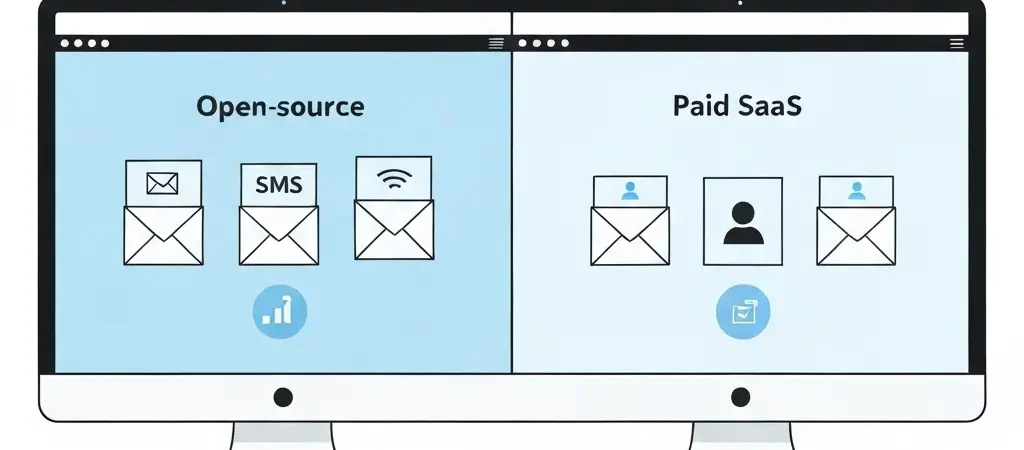
CampaignOS vs ActiveCampaign Features Comparison 2026
If you are weighing CampaignOS vs ActiveCampaign in 2026, you are comparing two platforms that occupy opposite ends of the same spectrum: one is a paid SaaS with best-in-class automation depth and a contact-based pricing model that gets expensive fast; the other is free, open-source, self-hosted, and multichannel from day one. Both are serious contenders — the right answer depends on whether you are optimizing for automation sophistication or total cost of ownership.
This comparison uses a consistent feature matrix across automation, pricing, multichannel support, GDPR compliance, self-hosting, integrations, and support. Each section ends with a direct verdict. The overall recommendation is at the bottom.
CampaignOS vs ActiveCampaign — Full Feature Comparison Table 2026
| Feature | CampaignOS | ActiveCampaign | Winner |
|---|---|---|---|
| Starting Price | Free (open-source) | $49/mo (Plus, 1k contacts) | CampaignOS |
| Pricing Model | Infrastructure only | Per contact + per seat | CampaignOS |
| Email Automation | Yes | Yes (best-in-class) | ActiveCampaign |
| SMS Automation | Native | Native (US/CA only) | CampaignOS |
| Push Notifications | Native | No native (3rd party) | CampaignOS |
| Visual Workflow Builder | Yes | Yes (industry-leading) | ActiveCampaign |
| Lead Scoring | Yes | Yes (advanced) | ActiveCampaign |
| CRM Built-in | Marketing CRM | Full sales CRM | ActiveCampaign |
| Self-Hosting | Yes (full) | No | CampaignOS |
| Open Source | Yes | No | CampaignOS |
| GDPR / Data Ownership | Full (self-hosted) | Partial (US servers) | CampaignOS |
| Multi-Client Isolation | Yes | No | CampaignOS |
| Native Integrations | API + webhooks | 900+ native integrations | ActiveCampaign |
| Support | Community + docs | Email, chat, phone | ActiveCampaign |
Score: CampaignOS 7 — ActiveCampaign 6 (out of 13 criteria)
Pricing: Where the Gap Is Widest
Pricing is the sharpest dividing line in the CampaignOS vs ActiveCampaign comparison. ActiveCampaign’s Plus plan starts at $49/month for 1,000 contacts — a reasonable entry point. But the contact-based model means costs climb steeply: 10,000 contacts runs approximately $149/month, 50,000 contacts approaches $299/month, and enterprise contact volumes can push the bill past $500/month before you factor in additional seats. For businesses or agencies managing multiple contact databases, the compounding effect is significant.
CampaignOS has no per-contact pricing. None. The cost is your hosting infrastructure — a $20-$40/month VPS can comfortably run CampaignOS for hundreds of thousands of contacts. At 50,000 contacts, the annual difference between the two platforms can exceed $3,000. At 200,000 contacts, it exceeds $12,000. For startups and growing businesses, this is not an incremental difference — it is a structural budget decision.
The one honest caveat: self-hosting carries a setup and maintenance cost in engineering time. If you have no technical staff, that cost is real. But for businesses with a developer or a technically capable marketer, the economics of CampaignOS are unambiguous. Read more about the tradeoffs in our guide on setting up self-hosted email marketing in 2026.
Automation Builder Depth
This is ActiveCampaign’s strongest argument. The platform’s visual automation builder is widely regarded as the best in the mid-market. It supports complex multi-branch workflows with conditional logic, probability splits, goal-tracking steps, and time-delay controls. You can trigger automations from virtually any event — email opens, site visits, purchase data, CRM pipeline changes, form submissions, or custom API events. Lead scoring integrates directly into workflow branches, allowing sophisticated behavioral routing without additional tooling.
CampaignOS’s automation builder covers the core use cases: drip sequences, behavioral triggers, segmentation-based branching, and multichannel delivery in a single workflow. Where it currently lacks ActiveCampaign’s depth is in advanced conditional branching — particularly in scenarios where a workflow must wait for multiple conditions to be simultaneously true before proceeding. For teams running highly complex, multi-step lifecycle automations with many conditional splits, ActiveCampaign’s builder is still more mature.
For the majority of use cases — welcome sequences, abandoned cart recovery, re-engagement campaigns, post-purchase nurture, and lead scoring — CampaignOS’s automation capabilities are fully adequate. For teams whose competitive advantage is in engineering unusually complex automation architecture, ActiveCampaign’s builder earns its premium. Our guide on setting up advanced marketing automation with triggers and lead scoring walks through what “complex automation” actually requires in practice.
Multichannel Support
CampaignOS ships with native email, SMS, push notification, and web channel support from day one. These are not bolt-on integrations — they are first-class citizens in the automation builder. You can build a single workflow that sends an email on day one, an SMS on day three if the email was not opened, and a push notification on day five with a personalized offer. This is true multichannel orchestration in a single, free platform.
ActiveCampaign covers email natively and SMS natively (for US and Canada-based sending). Push notifications require a third-party integration. For teams with a genuinely global SMS sending requirement or a web push program, CampaignOS’s native multichannel is a material advantage. The push notification channel alone — which ActiveCampaign requires a third-party tool to deliver — has meaningful reach for web-based businesses. Our guide to push notification marketing strategy in 2026 covers the channel’s conversion potential in detail.
CRM and Lead Management
ActiveCampaign has the deeper CRM, and it is not close. The platform includes a full sales CRM with deal pipeline management, sales automation (automatic deal creation from form fills, automatic task assignment to reps), sales sequencing, and revenue reporting. For businesses where marketing and sales are managed by the same platform, ActiveCampaign’s integrated CRM is a genuine productivity advantage.
CampaignOS includes a marketing CRM — contact management, segmentation, behavioral tagging, and custom attributes — but it does not replicate ActiveCampaign’s deal pipeline and sales automation depth. If your team needs a CRM that tracks deal stages, rep assignments, and revenue attribution from within the marketing automation platform, ActiveCampaign is the stronger choice. If you use a separate CRM (Salesforce, HubSpot CRM, Pipedrive) and need only a marketing-side contact database, CampaignOS covers the requirement fully.
GDPR and Data Sovereignty
This is a decisive advantage for CampaignOS in any comparison involving EU, UK, Australian, or Canadian businesses. Because CampaignOS is self-hosted, all contact data — including email addresses, behavioral data, and segmentation attributes — lives on your own infrastructure. You are both the data controller and the data processor. There are no Standard Contractual Clauses to manage, no US-EU data transfer complications, and no risk of a third party’s data breach affecting your contacts.
ActiveCampaign processes data on US-based servers. For EU-based businesses, this requires an active Data Processing Agreement (DPA) with ActiveCampaign, SCCs, and careful review of their sub-processor list. It is manageable — ActiveCampaign does provide a DPA — but it introduces compliance overhead and third-party dependency that self-hosting eliminates entirely. If GDPR compliance is a priority, review our complete GDPR compliant email marketing checklist for 2026 before committing to any cloud platform.
Self-Hosting and Infrastructure Control
CampaignOS can be deployed on any Linux server, VPS, or cloud instance. Docker deployment is supported, making setup accessible even for teams without deep server administration experience. You control your sending IPs, your SMTP configuration, and your data retention policies. If a new GDPR regulation or data residency law passes, you adapt on your own timeline — not your vendor’s.
ActiveCampaign is a cloud-only platform. There is no self-hosting option, no IP control (ActiveCampaign manages shared sending infrastructure), and no ability to customize the data storage model. For most small businesses, this is fine. For any business in a regulated industry, operating in a data-sensitive jurisdiction, or building a platform that will be sold to clients, the absence of a self-hosting option is a hard constraint. Our comparison of self-hosted marketing automation in 2026 covers the infrastructure decision in detail.
Integrations and Ecosystem
ActiveCampaign wins on integration breadth. The platform offers 900+ native integrations covering CRM tools, e-commerce platforms, form builders, webinar tools, payment processors, and more. For teams that rely on a broad SaaS stack and need reliable, maintained connectors, ActiveCampaign’s ecosystem reduces integration risk.
CampaignOS connects via API and webhooks, which means it can technically integrate with any service that exposes an API — but the integrations are not pre-built. Engineering time is required. For teams comfortable with Zapier, Make, or API work, this is a minor constraint. For non-technical marketers who need click-to-connect integrations, ActiveCampaign’s native library is a meaningful practical advantage.
Support and Community
ActiveCampaign provides email, live chat, and phone support with response times typically under a few hours. There is a dedicated customer success track for higher-tier plans. For businesses that need a vendor on the line when something breaks, this is reassuring.
CampaignOS relies on community forums, documentation, and GitHub for support. There is no paid support tier or SLA. This is the honest trade-off of open-source: you own the stack, but you also own the problem when something goes wrong. Teams with technical staff manage this well. Teams that need guaranteed vendor escalation paths will find the support model a meaningful gap.
Overall Verdict: CampaignOS vs ActiveCampaign in 2026
Choose CampaignOS if: You want zero per-contact pricing, need to self-host for GDPR or data sovereignty, manage multiple clients in isolated workspaces, need native push notifications and SMS globally, or are building a multichannel automation stack on a lean budget.
Choose ActiveCampaign if: You need the deepest visual automation builder in the mid-market, require a built-in sales CRM with deal pipeline management, depend on 900+ pre-built native integrations, or need vendor-backed support with SLA guarantees.
For businesses primarily focused on growth — where contact lists are expanding, campaigns are becoming more multichannel, and per-contact pricing is creating a growth tax — CampaignOS is the structurally better platform. For the specific scenario of a small-to-mid sales team that runs tight CRM-driven marketing automation and values pre-built integrations over cost, ActiveCampaign remains strong competition. See also how CampaignOS stacks up in the broader context of the top marketing automation software for agencies in 2026.
Get started with CampaignOS free — self-hosted, open-source, email + SMS + push natively included.
FAQ — CampaignOS vs ActiveCampaign
Is CampaignOS a direct replacement for ActiveCampaign?
CampaignOS covers the core use cases of ActiveCampaign — email automation, behavioral triggers, segmentation, list management, and multichannel campaigns — at zero per-contact cost. Where ActiveCampaign has a current advantage is in the depth of its visual automation builder and its built-in sales CRM with deal pipeline management. For teams that rely heavily on those two specific features, a complete replacement requires evaluating whether CampaignOS’s automation depth is sufficient for their workflows. For the majority of marketing automation use cases, CampaignOS is a functionally complete replacement.
How much does ActiveCampaign cost for 10,000 contacts vs CampaignOS?
ActiveCampaign’s Plus plan at 10,000 contacts costs approximately $149/month, or $1,788/year. The Professional plan at 10,000 contacts runs approximately $187/month. CampaignOS costs $0 in platform fees — only your server hosting cost, typically $20-$40/month for a VPS that comfortably handles 10,000 contacts. Over one year, the difference is approximately $1,500-$2,000 in favor of CampaignOS. At 50,000 contacts, the annual savings exceed $3,000.
Does CampaignOS have the same automation workflows as ActiveCampaign?
CampaignOS has a visual workflow builder that covers drip sequences, behavioral triggers, segmentation branching, and multichannel delivery. ActiveCampaign’s automation builder is more mature, particularly in advanced conditional branching and goal-based workflow structures. For standard marketing automation workflows — welcome series, re-engagement, abandoned cart, post-purchase nurture — CampaignOS is fully capable. For highly complex, multi-condition enterprise workflows, ActiveCampaign’s builder has more native depth.
Can I migrate from ActiveCampaign to CampaignOS?
Yes. The migration process involves exporting your contact list from ActiveCampaign as CSV, importing it into CampaignOS, recreating your automation workflows in CampaignOS’s workflow builder, and updating any form embeds or API integrations to point to the new platform. ActiveCampaign allows data export via their reporting and list management tools. The complexity of the migration scales with the number of automations you have built. Simple setups can migrate in a few hours; complex automation architectures may take a few days to rebuild and test.
Does CampaignOS support SMS marketing like ActiveCampaign?
Yes, and CampaignOS’s SMS support is broader than ActiveCampaign’s. ActiveCampaign’s native SMS sending is limited to US and Canadian phone numbers. CampaignOS supports global SMS sending through configurable provider integrations. Both platforms allow SMS steps within automation workflows. CampaignOS additionally supports native push notifications — a channel ActiveCampaign requires a third-party integration to deliver.
Is CampaignOS harder to set up than ActiveCampaign?
CampaignOS requires a server deployment — typically a $20-$40/month VPS with Docker or a standard Linux stack. The initial setup takes 30-90 minutes for someone comfortable with command-line tools. ActiveCampaign is a cloud SaaS with a sign-up-and-go experience that requires no server setup. If your team has no technical staff, ActiveCampaign’s zero-setup advantage is real. If you have a developer or a technically confident marketer, CampaignOS’s setup is a one-time investment that pays back within the first billing cycle.
Which is better for small businesses — CampaignOS or ActiveCampaign?
For small businesses on a tight budget who have any technical capability, CampaignOS is the better long-term choice — it grows without price increases, supports multichannel from day one, and gives you full data ownership. For small businesses that need a fully managed SaaS with no setup overhead and rely on a rich integration ecosystem to connect their existing tools, ActiveCampaign at the entry Plus tier is the more practical starting point. Our guide to marketing automation for small business covers the decision framework in detail.