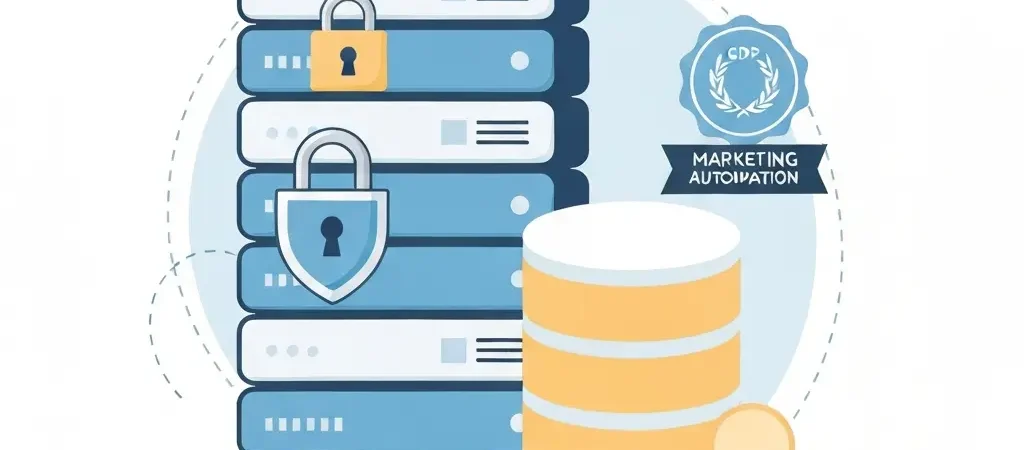
What Are the Benefits of Self-Hosted Marketing Automation?
Self-hosted marketing automation gives your business complete control over its marketing infrastructure — the data, the platform, the customizations, and the costs. The seven primary benefits are: full data ownership, GDPR and privacy compliance by design, no per-contact or per-send pricing, unlimited technical customization, no vendor lock-in, transparent infrastructure costs, and the ability to operate in air-gapped or restricted environments. The tradeoffs are real: self-hosting requires technical capacity and carries the responsibility for maintenance, uptime, and security. For businesses with the technical resources, the benefits consistently outweigh the costs at scale.
What does full data ownership mean in practice?
Full data ownership means your contact data, behavioral data, campaign performance data, and automation logic reside exclusively on infrastructure you control. No third party can access, analyze, sell, or share your data without your explicit authorization.
With major SaaS marketing automation platforms — including HubSpot, Salesforce Marketing Cloud, and Marketo — contact data is stored on US-based servers and subject to the vendor’s data processing agreements. Cross-border data transfers create regulatory complexity for EU/EEA businesses operating under GDPR’s Chapter V requirements. Self-hosting eliminates this exposure entirely: all data stays within your chosen jurisdiction.
Practical ownership also means you can run queries, exports, and analyses on raw data without going through a vendor API with rate limits or export quotas. If you need every behavioral event from the last five years, you query your own database directly.
How does self-hosting simplify GDPR and privacy compliance?
Self-hosted marketing automation simplifies GDPR compliance through three mechanisms: local data storage, granular data control, and built-in erasure capabilities.
Local data storage. Hosting your automation platform in an EU/EEA datacenter eliminates the GDPR Chapter V cross-border transfer requirement. You do not need Standard Contractual Clauses, Binding Corporate Rules, or reliance on the EU-US Data Privacy Framework — all of which require ongoing monitoring for adequacy decisions. Self-hosting in-jurisdiction removes the compliance layer entirely.
Granular data control. Self-hosted platforms like Mautic provide configurable data retention settings — you define how long behavioral data is stored. GDPR’s storage limitation principle (Article 5(1)(e)) requires data not be kept longer than necessary. With a SaaS platform, retention is governed by the vendor’s terms; with self-hosting, it is governed by your policy.
Built-in right-to-erasure execution. When a contact submits a deletion request under GDPR Article 17, self-hosted platforms allow you to execute a hard delete across all tables — contact record, behavioral log, email engagement history — without relying on a vendor’s API endpoint. This is faster, more complete, and entirely within your control.
CCPA compliance benefits follow the same logic: self-hosting ensures “selling” of personal information is technically impossible because no data leaves your environment by default.
Does self-hosting marketing automation actually save money?
Self-hosting saves money at scale — specifically, when contact list size would trigger significant tier upgrades on SaaS platforms, and when email send volume is high enough to make per-send pricing expensive.
SaaS marketing automation pricing is typically structured around contact volume. HubSpot Marketing Hub scales from $800/month for 2,000 contacts to $3,200/month for 10,000 contacts to significantly higher for enterprise volumes. Brevo charges by email send volume. ActiveCampaign charges by contact tier. Each pricing model means your costs grow automatically as your list grows.
Self-hosted infrastructure costs are fixed. A VPS capable of running a platform like Mautic for 100,000 contacts and 1 million sends/month costs $50–$200/month in infrastructure, plus staff time for maintenance. At 50,000 contacts, the breakeven versus a comparable SaaS plan typically occurs within 12–18 months.
The cost calculation must include honest accounting for maintenance time. A business without a technical team member who can manage Linux servers, database backups, and SSL certificates should factor in the cost of that resource before claiming the self-hosted cost advantage.
What customization is possible with self-hosted platforms?
Self-hosted platforms built on open-source code — such as Mautic — allow modification of any component: the data model, the workflow engine, the email builder, the API layer, and the reporting interface. SaaS platforms permit only what the vendor exposes through their configuration UI and API.
Practical customization advantages include:
- Custom contact fields without limits. SaaS platforms typically cap custom field counts or charge for additional fields. Self-hosted platforms allow unlimited custom schema extensions.
- Custom workflow actions. Any action that can be expressed in code can be added to a self-hosted workflow engine. This enables integrations with internal systems — ERP, custom CRM, proprietary databases — that SaaS platforms cannot reach.
- Custom reporting and attribution. Revenue attribution models can be built to match your business logic exactly, pulling from internal sales data without the data access restrictions SaaS platforms impose.
- White-labeling. Agencies and resellers can brand the platform, modify the UI, and offer it to clients under their own product name.
How does self-hosting eliminate vendor lock-in?
Vendor lock-in in marketing automation has two forms: data lock-in and workflow lock-in. Self-hosting eliminates both.
Data lock-in occurs when your contact database, segmentation logic, and behavioral history are stored in a proprietary format on vendor servers. Migrating requires an export, which is often incomplete — engagement history, lead scores, and custom field data are frequently unavailable in full export. With self-hosting, your data is in your database, in standard format, migrated on your schedule.
Workflow lock-in occurs when your automation workflows are built using a vendor’s proprietary flow builder with no export capability. If the vendor raises prices, discontinues your plan, or gets acquired, your workflows are inaccessible. Self-hosted platforms store workflows in open formats that can be migrated, versioned in git, and re-deployed to any compatible environment.
What are the real tradeoffs of self-hosting?
Self-hosting marketing automation carries three significant tradeoffs that businesses must weigh honestly.
Technical maintenance responsibility. Server security patches, database backups, SSL certificate renewal, uptime monitoring, and performance optimization are now your responsibility. A SaaS platform’s monthly fee covers these as a service; self-hosting means internalizing those costs in staff time or managed hosting fees.
No built-in deliverability infrastructure. SaaS platforms maintain shared IP reputation and relationships with major ISPs. Self-hosted platforms require you to manage your own sending IP reputation, set up SPF/DKIM/DMARC correctly, and monitor deliverability independently. Poor deliverability management can eliminate the revenue benefits of automation entirely.
Slower feature velocity. SaaS platforms release new features continuously. Self-hosted open-source platforms release on community-driven schedules. Specific capabilities — AI-powered send time optimization, predictive lead scoring, advanced A/B testing — may lag 12–24 months behind SaaS equivalents.
Which businesses benefit most from self-hosted automation?
Self-hosted marketing automation delivers the clearest benefit for four business types:
- EU/EEA businesses with strict GDPR compliance requirements who cannot rely on US vendor data processing agreements for their primary marketing database.
- High-volume email senders (1M+ emails/month) where per-send SaaS pricing becomes more expensive than managed infrastructure.
- Businesses with large contact lists (100K+ contacts) where contact-tier SaaS pricing creates a significant cost differential versus fixed infrastructure costs.
- Agencies and technology businesses that need to offer branded marketing automation as a service or require deep API-level integrations with internal systems.
For businesses outside these categories — particularly early-stage startups and small businesses with lists under 25,000 contacts — managed SaaS platforms typically offer better cost-efficiency when maintenance time is factored in.
How does CampaignOS compare for teams that prefer managed automation?
CampaignOS is a managed marketing automation platform that delivers the key benefits of self-hosted systems — data transparency, privacy controls, and no contact-based pricing surprises — without the infrastructure management burden. It is built for teams that want control without the overhead of maintaining their own servers.
For businesses evaluating the self-hosted vs. managed decision, CampaignOS offers a free tier where you can test full workflow automation, behavioral triggers, and multi-channel campaigns before committing to any infrastructure investment. Start at app.campaignos.site.
Related reading: Self-Hosted Marketing Automation: Is It Worth It in 2026?, Self-Hosted Email Marketing: The Complete Setup Guide for 2026, and What Is an Open Source Marketing Automation Platform? Guide for 2026.
For a broader view of the marketing automation ecosystem, see Best AI Tools for Content Marketing Automation in 2026 on Authenova.
Frequently Asked Questions
What is the biggest benefit of self-hosted marketing automation?
The biggest benefit is full data ownership. Your contact database, behavioral history, and campaign data reside exclusively on infrastructure you control. No third party can access, analyze, or process your data. This benefit is most significant for businesses in regulated industries or jurisdictions with strict data residency requirements.
Is self-hosted marketing automation cheaper than SaaS?
Self-hosting is cheaper at scale — typically for businesses with 50,000+ contacts or 500,000+ monthly sends. At smaller list sizes, the infrastructure cost plus staff maintenance time often equals or exceeds SaaS platform fees. The breakeven point is usually 12–18 months for businesses in the 25,000–100,000 contact range, depending on the SaaS platform being replaced.
Does self-hosting marketing automation help with GDPR compliance?
Yes. Hosting your platform in an EU/EEA datacenter eliminates the GDPR Chapter V cross-border transfer requirement that applies when US-based SaaS vendors process your contact data. Self-hosting also gives you direct control over data retention periods and the ability to execute hard deletes for right-to-erasure requests without depending on a vendor API.
What are the main disadvantages of self-hosted marketing automation?
The three main disadvantages are: (1) technical maintenance responsibility — server security, backups, and uptime are your problem; (2) deliverability management — you must maintain your own sending IP reputation without SaaS-provided infrastructure; and (3) slower feature velocity — open-source platforms typically lag 12–24 months behind SaaS equivalents on AI features and advanced analytics.
What is the most popular self-hosted marketing automation platform?
Mautic is the most widely deployed self-hosted marketing automation platform as of 2026. It is open-source, supports email, SMS, social media, and push notifications, and integrates with major CRM platforms. Other self-hosted options include Listmonk (email-focused), Postal (transactional email), and custom-built platforms using open-source workflow engines.
Can self-hosted marketing automation handle omnichannel workflows?
Yes, but with more integration effort than SaaS platforms. Mautic supports email, SMS, web push, and social media integrations, but connecting all channels into unified workflows typically requires custom development or third-party connectors. SaaS platforms provide these integrations pre-built. Self-hosted omnichannel is achievable but requires technical resources that managed platforms include in their subscription.
Who should not use self-hosted marketing automation?
Businesses without dedicated technical staff should not self-host marketing automation. If no one on your team can manage Linux servers, configure SMTP, handle database maintenance, and monitor for security vulnerabilities, the operational risk and hidden costs of self-hosting exceed the benefits. Managed platforms like CampaignOS are the appropriate alternative — they provide control and transparency without the infrastructure burden.
Does self-hosting eliminate vendor lock-in?
Yes. Self-hosting eliminates both data lock-in (your data is in your own database in standard format) and workflow lock-in (automation workflows are stored in open formats you control). If you decide to migrate to a different platform, you take your complete contact database, engagement history, and workflow definitions with you — no export restrictions or incomplete data transfers.
How does self-hosted automation handle email deliverability?
Self-hosted platforms require you to manage your own sending infrastructure: dedicated sending IPs, SPF and DKIM authentication, DMARC policy, bounce handling, and ISP feedback loops. Many businesses use a third-party SMTP relay (Amazon SES, Postmark, Mailgun) to offload IP reputation management while keeping contact data and workflow logic self-hosted. This hybrid approach captures most of the data ownership benefits while maintaining professional deliverability.
CampaignOS delivers data transparency and full-featured marketing automation without server management. Free to start. Try CampaignOS free today.