What Is Lead Scoring in Marketing Automation? Definition and Best Practices 2026
Lead scoring is a system within marketing automation that assigns numerical values to contacts based on their behaviors and attributes — enabling marketing teams to identify which leads are most likely to convert, route them to sales at the right moment, and prioritize their engagement efforts automatically. In 2026, what is a customer engagement platform becomes inseparable from what is lead scoring — modern platforms combine both into a unified system where engagement data directly informs scoring and scoring triggers engagement actions.
Definition: What Is Lead Scoring?
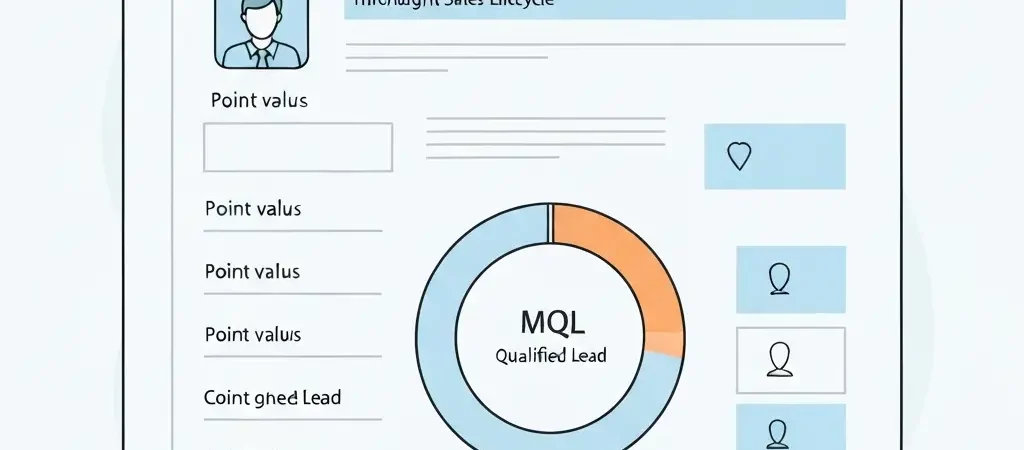
Lead scoring is a quantitative framework that ranks marketing contacts by their estimated likelihood of becoming customers. The score is calculated by assigning positive and negative point values to contact behaviors and attributes:
- Behavioral scoring: Points awarded for actions taken — email opened (+1), link clicked (+3), pricing page visited (+10), demo requested (+50)
- Demographic scoring: Points awarded or subtracted based on firmographic fit — correct company size (+10), wrong industry (-10), personal email address (-5)
- Negative scoring: Points subtracted for disqualifying actions — unsubscribed from email (-50), role is “student” or “intern” (-20)
- Score decay: Points automatically decrease over time when a lead becomes inactive — for example, score decreases by 5 points per month with no engagement
Lead scoring eliminates the manual work of sales reps reviewing every lead to determine priority. When a lead crosses the threshold score (typically 50–100 points, depending on your model), an automation triggers the appropriate sales action.
How Lead Scoring Works in Practice
Lead scoring operates within a marketing automation platform’s contact database, continuously updated as new behavioral events come in:
- A new lead downloads your pricing guide (+15 points for content download, +10 for pricing-specific content = 25 points)
- Two days later, they visit the pricing page again (+10 points = 35 total)
- They open your follow-up email (+1 point = 36 total)
- They click through to your case study (+3 points = 39 total)
- They visit the “Start Free Trial” page but don’t convert (+10 points = 49 total)
- They reach 50 points — the MQL threshold — and the automation fires: sales rep is notified, lead is moved into the “Hot Lead” nurture sequence, and a Slack notification is sent to the account executive
Without lead scoring, the sales team might review this contact three weeks later, after the purchase intent has cooled. With scoring, they’re contacted while the lead is actively evaluating. According to Marketo’s 2024 Lead Management Report, businesses using lead scoring reduce time-to-contact from an average of 72 hours to under 4 hours for high-scoring leads, resulting in a 36% improvement in close rates.
Common Scoring Models
Traditional Point-Based Scoring
The most common model — manually defined point values for each behavior and attribute. Transparent, controllable, easy to explain to sales teams. Requires ongoing calibration as you learn which behaviors actually predict conversion.
Predictive Lead Scoring
Uses machine learning to automatically identify which contact attributes and behaviors predict conversion, based on your historical closed-won data. More accurate than manual scoring but requires substantial historical data (typically 1,000+ closed deals) and a platform that supports ML-based scoring. Available in Salesforce, HubSpot, and some advanced open source configurations.
Fit + Intent Scoring (Two-Dimensional)
Combines a “fit” score (how closely the contact matches your ideal customer profile) with an “intent” score (how much purchase behavior they’ve shown). Maps contacts on a 2×2 matrix: High Fit + High Intent = immediate sales outreach; Low Fit + High Intent = pass; High Fit + Low Intent = long-term nurture.
Recommended Starting Point Values
| Action or Attribute | Points | Rationale |
|---|---|---|
| Pricing page visit | +10 | High purchase intent signal |
| Demo request | +50 | Direct expression of interest |
| Free trial signup | +40 | Product engagement initiated |
| Email clicked | +3 | Active engagement |
| Content download | +5 | Research-stage behavior |
| Company size: 50–500 employees | +15 | Ideal customer fit |
| Company size: 1–10 employees | -10 | Poor fit for product |
| No engagement for 90 days | -25 | Score decay for inactivity |
Lead Scoring Best Practices for 2026
- Start simple: Begin with 5–10 behaviors and 2–3 attributes. Complexity doesn’t equal accuracy — overly complex models are harder to maintain and explain to sales.
- Calibrate quarterly: Review which behaviors actually predicted conversions in the previous quarter and adjust point values. Pricing page visits may be a better predictor than content downloads for your specific product.
- Define MQL threshold collaboratively: Marketing and sales should agree on what score makes a lead “Marketing Qualified” (MQL) and ready for sales outreach. Without sales agreement, MQLs get ignored.
- Include negative scoring: Score decay and negative signals (student email domain, wrong company size) prevent your database from filling with false-positive MQLs.
- Combine with segmentation: Lead scoring is most effective when combined with behavioral segmentation — not just “this lead has 60 points” but “this lead has 60 points AND is in the enterprise segment AND visited the pricing page twice this week.”
Lead scoring is a cornerstone of sophisticated automated engagement systems — the principle of using behavioral signals to determine the next best action applies equally to content strategy and marketing automation.
Implement Lead Scoring with CampaignOS
CampaignOS includes contact scoring with behavioral and attribute-based rules, threshold triggers, and automated routing. Free to start on the cloud plan or self-host with no limits.
Frequently Asked Questions
What is a good lead score threshold for an MQL?
A typical MQL threshold is 50–100 points, but the right threshold depends on your model’s total achievable points and the quality bar you’ve agreed on with your sales team. Calculate the threshold by reviewing your last 50 closed deals, calculating their pre-close score, and setting the threshold at the 70th percentile of those scores. This ensures the threshold filters in your best leads while not being so high that sales misses sales-ready contacts. Revisit the threshold quarterly as you accumulate more conversion data.
What is the difference between lead scoring and lead grading?
Lead scoring measures intent and behavioral engagement — how active and interested a lead is based on their actions. Lead grading measures fit — how closely a lead matches your ideal customer profile based on attributes like company size, industry, job title, and geography. Best practice in 2026 is to use both: score for intent (to identify timing) and grade for fit (to identify priority). A high-score, high-grade lead gets immediate sales attention; a high-score, low-grade lead may be nurtured but not prioritized for enterprise sales outreach.
Can lead scoring work for small businesses?
Yes. Lead scoring works for small businesses and is often even more valuable because small sales teams have less capacity to follow up with every lead manually. A simple 5-behavior lead scoring model that routes high-score leads to immediate sales follow-up (even a solo founder’s personal email) can significantly improve conversion rates. Start with just three behaviors: pricing page visit (+15), content download (+5), and email click (+3) — with an MQL threshold of 20 points. This alone will surface the most engaged contacts for prioritized follow-up.
How does lead scoring improve sales and marketing alignment?
Lead scoring improves sales-marketing alignment by creating a shared, quantitative definition of a “qualified lead.” Without scoring, marketing and sales disagree on lead quality subjectively — marketing says leads are qualified, sales says they’re not ready. With a defined MQL score threshold agreed upon by both teams, the handoff becomes objective: a lead at 80 points is an MQL by definition. This reduces lead quality disputes, improves sales follow-up rates, and creates a feedback loop where sales results inform scoring model updates.
What marketing automation platforms support lead scoring?
Marketing automation platforms that support lead scoring include: CampaignOS (free, open source — behavioral and attribute scoring), Mautic (free, open source — full scoring suite), HubSpot (paid — predictive and manual scoring on Professional tier), ActiveCampaign (paid — contact scoring on all paid tiers), Marketo (enterprise — advanced predictive scoring), and Salesforce Pardot (enterprise — sophisticated multi-dimensional scoring). For teams starting with lead scoring without an enterprise budget, CampaignOS provides the most complete free scoring feature set in 2026.