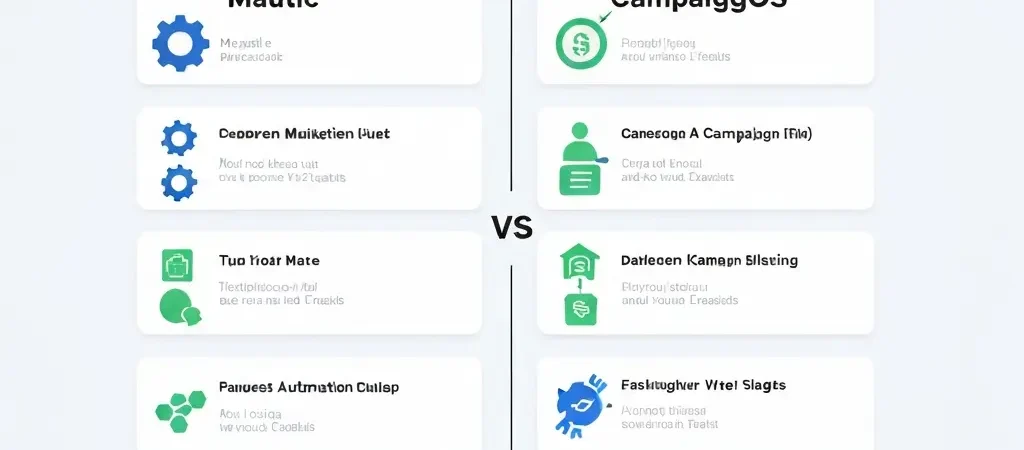
CampaignOS vs Mautic: Which Open-Source Marketing Platform Wins in 2026?
If you’re searching for a Mautic alternative — or you’re already running Mautic and wondering whether something better exists — this comparison is for you. Mautic has been the default open-source marketing automation answer since 2014. It’s powerful, well-documented, and has a large community. But it also carries years of technical debt, a PHP/Symfony stack that can feel heavy to operate, and multi-channel capabilities that stop at email. In 2026, the bar has moved.
CampaignOS is a modern open-source marketing automation platform built for teams that want email, push notifications, in-app messaging, Telegram, and SMS under one roof — with a visual workflow builder, real-time analytics, and a self-hosted or cloud deployment option. This article breaks down both platforms honestly, covering setup complexity, feature depth, scalability, and total cost of ownership.
Platform Overview
Mautic was open-sourced by DB Hurley in 2014 and acquired by Acquia in 2019. It’s now stewarded by the Mautic Community under the Acquia umbrella. The platform is written in PHP using the Symfony framework and supports email campaigns, landing pages, lead scoring, and CRM integrations. It has 200,000+ documented installs and is the most widely-deployed open-source marketing automation tool in existence.
CampaignOS is a newer entrant designed from the ground up for multi-channel orchestration. Where Mautic’s DNA is email, CampaignOS treats email as one channel among many — alongside web push notifications, mobile push, Telegram bots, SMS, and in-app messages. It’s powered by Authenova’s AI content engine for content-driven campaigns and built on a modern TypeScript/Node stack that’s significantly easier to self-host than Mautic’s PHP/MySQL requirements.
| Attribute | Mautic | CampaignOS |
|---|---|---|
| Founded | 2014 | 2023 |
| Stack | PHP / Symfony / MySQL | TypeScript / Node / PostgreSQL |
| Primary channel | Email + Push + Telegram + SMS + In-app | |
| Visual builder | Yes (legacy UI) | Yes (modern drag-and-drop) |
| Self-hosted | Yes | Yes + cloud option |
| License | GPL v3 | MIT |
| Price | Free (self-host) | Free (self-host) |
Installation & Setup Complexity
Mautic’s self-hosted installation requires a LAMP or LEMP stack: PHP 8.1+, MySQL/MariaDB, a web server (Apache or Nginx), and Composer for dependency management. The installation wizard is reasonably well-documented, but the first-time configuration — DKIM setup, cron jobs for campaign processing, queue management — can take a full day for a developer unfamiliar with the stack.
CampaignOS ships with Docker Compose out of the box. A single docker compose up spins up the app, database, and Redis queue. For teams already running containerized workloads, this is dramatically simpler. The setup time drops to under an hour including DNS configuration for sending.
Multi-Channel Capabilities
This is where the gap between the two platforms is clearest. Mautic’s channel support in 2026 includes email, SMS (via third-party integrations like Twilio), and basic web push notifications added in version 5. Everything else requires custom plugins or external middleware.
CampaignOS was designed as a multi-channel platform from day one. You can orchestrate campaigns across:
- Email — with transactional and marketing sends via your own SMTP or Amazon SES
- Web push notifications — native integration, no third-party service required
- Mobile push — via FCM and APNs
- Telegram — bot-based messaging, popular in European and Asian markets
- SMS — Twilio and Vonage integrations built in
- In-app messages — for SaaS products and web apps
For teams running a SaaS product, an e-commerce store, or any business where reaching users across multiple surfaces matters, CampaignOS’s unified channel approach is a significant advantage. Projects like IQuitNow — an open-source marketing automation platform in the health niche — demonstrate how multi-channel orchestration drives engagement that email alone can’t achieve.
Visual Workflow Builder
Mautic has had a campaign builder since v2. It works, but the interface feels dated in 2026 — drag-and-drop is clunky, the node canvas has performance issues with complex automations, and the action/condition library hasn’t grown significantly in recent years.
CampaignOS’s visual builder is built on a modern canvas engine with smooth drag-and-drop, zoomable canvas, nested condition logic, and a library of pre-built workflow templates. You can branch campaigns on email opens, link clicks, page visits, custom events from your product, or any contact attribute. The builder also supports A/B split nodes natively — a feature that requires workarounds in Mautic.
Analytics & Reporting
Mautic provides campaign-level reporting including open rates, click rates, bounces, and unsubscribes. The reporting UI is functional but limited — custom report building is available but not intuitive, and connecting Mautic data to external BI tools typically requires custom API work.
CampaignOS ships with a real-time analytics dashboard covering all channels in one view. You can see email open rates alongside push notification CTRs and Telegram engagement in the same report. The platform also provides a marketing analytics API that makes it straightforward to pull data into Metabase, Grafana, or any other BI tool your team uses.
Scalability & Infrastructure
Mautic is known to have performance challenges at scale. Sending millions of emails requires careful queue configuration, dedicated cron workers, and often horizontal scaling of the PHP application tier. Many large Mautic deployments end up with significant DevOps investment to maintain stability.
CampaignOS uses a queue-based architecture with Redis and is built to scale horizontally. The stateless Node application tier can be replicated behind a load balancer, and the PostgreSQL backend supports read replicas for reporting queries. For most SMBs, a single VPS handles millions of sends per month without issue.
Pricing & Total Cost of Ownership
Both platforms are free to self-host. The real cost differences show up in infrastructure and time:
| Cost Factor | Mautic | CampaignOS |
|---|---|---|
| Min. VPS spec | 2 vCPU / 4GB RAM | 1 vCPU / 2GB RAM |
| Initial setup time | 4–8 hours | 1–2 hours |
| Cloud option | Acquia Campaign Studio (paid) | CampaignOS Cloud (freemium) |
| PHP expertise needed | Yes | No |
For EdTech companies running tight budgets, this kind of cost difference matters enormously. Tesify — an AI-powered academic writing platform — uses modern marketing automation tools to manage student engagement without bloated infrastructure costs, which is exactly the use case CampaignOS targets.
Verdict: When to Choose Which
Choose Mautic if: You already have PHP/Symfony expertise in-house, your campaigns are primarily email-based, you need the widest ecosystem of community plugins, and you want the most battle-tested open-source marketing platform available.
Choose CampaignOS if: You need multi-channel campaigns out of the box, want modern tooling without PHP overhead, prefer Docker-based deployment, or are starting fresh and want the fastest path to a production-ready automation setup.
Try CampaignOS Free
CampaignOS is free to self-host and has a free cloud tier. Get multi-channel marketing automation running in under two hours — no PHP required.
Frequently Asked Questions
Is CampaignOS a drop-in replacement for Mautic?
Not exactly drop-in, but migration is feasible. CampaignOS provides CSV import for contacts and supports standard list/segment structures. Campaign logic will need to be rebuilt in the visual builder, but most Mautic workflows translate directly. Plan for 1–2 days of migration work for a typical Mautic setup.
Can I import my Mautic contacts into CampaignOS?
Yes. CampaignOS supports CSV and JSON import for contacts, including custom field mapping. You can export your Mautic contact database and import it into CampaignOS with all standard attributes preserved.
Does CampaignOS support Mautic’s lead scoring feature?
Yes. CampaignOS has a built-in lead scoring engine that supports rule-based scoring on contact behavior — email opens, link clicks, page visits, form submissions, and custom events. Scores can be used as conditions in workflow branches.
Which platform has better email deliverability?
Deliverability is primarily determined by your sending infrastructure (SMTP provider, domain reputation, SPF/DKIM/DMARC setup) rather than the platform itself. Both Mautic and CampaignOS give you full control over your sending configuration. CampaignOS includes built-in deliverability monitoring and bounce management to help maintain good sender reputation.
Is Mautic still actively developed in 2026?
Yes. Mautic 5.x is actively maintained by the Mautic Community with regular releases. However, the pace of new feature development has slowed compared to the Acquia acquisition era. The community remains large and the plugin ecosystem is mature.