What Is a Customer Engagement Platform: 3 KPIs to Track
Most marketing teams are drowning in data but starving for insight. They track open rates, click rates, session counts — and still can’t answer the question their CEO is asking: “Is our engagement actually working?” The problem isn’t the data. It’s the framework.
A customer engagement platform gives you the infrastructure. The right KPIs give you the signal. Get both wrong and you’re running expensive campaigns in the dark. Get both right and marketing automation becomes a revenue engine you can actually explain to a CFO.
This guide defines what a customer engagement platform is, how it connects to marketing automation, and — critically — which three KPIs separate teams that grow from teams that guess.
What Is a Customer Engagement Platform?
The distinction matters more than most people realize. A CRM stores what happened. A CEP acts on what’s happening right now. That’s why a contact who abandons a cart at 11:47 PM can receive a personalized SMS at 11:48 PM — without a human touching anything.
According to Salesforce’s State of Marketing Report (2024), 72% of customers expect companies to understand their needs and expectations. A CEP is the infrastructure that makes that expectation achievable at scale.
For a full breakdown of features, architecture, and how a CEP compares to a CRM and standalone marketing automation tools, see our complete 2026 guide to customer engagement platforms.
How Does a CEP Relate to Marketing Automation?
Marketing automation is a core function inside a customer engagement platform — not a synonym for it. Think of marketing automation as the engine; the CEP is the vehicle.
Marketing automation handles the rules-based execution: send this email when a user completes this action, trigger this SMS after three days of inactivity, update this lead score when a contact visits the pricing page. A CEP wraps that automation engine with data unification, segmentation, analytics, and channel management.
Here’s the practical implication: a standalone email marketing tool can automate a drip sequence. A CEP can detect that a contact opened your email on mobile, didn’t click, then visited your pricing page via organic search 90 minutes later — and trigger a different message through a different channel based on that full behavioral context.
McKinsey’s research on digital personalization at scale found that companies that get personalization right generate 40% more revenue than average players. That kind of personalization requires marketing automation operating within a CEP — not in isolation.
Why Do Most Teams Track the Wrong KPIs?
Open rate and click-through rate are the most commonly reported engagement metrics. They’re also the least useful for proving business value. What most people miss is that these metrics measure activity, not impact.
A 42% open rate means nothing if those openers never buy, refer, or return. A 1.2% click-through rate that drives $180,000 in pipeline is worth every decimal point. The metric has to connect to a business outcome — otherwise you’re optimizing for applause, not revenue.
The three KPIs below were selected for one reason: each one has a direct, measurable line to either retention, revenue, or customer lifetime value. They’re trackable inside any serious marketing automation platform, and they give you the language to defend your budget in a board meeting.
KPI #1: Customer Engagement Score (CES)
How Is Customer Engagement Score Calculated?
There’s no universal formula, but the most practical CES model uses weighted scoring across behavioral signals. Here’s a baseline framework:
- Assign point values to actions: Email open = 1 point, link click = 3 points, purchase = 10 points, support ticket = -2 points, 30-day inactivity = -5 points.
- Apply recency decay: Actions from the last 7 days count at 100%, last 30 days at 75%, last 90 days at 50%. This prevents stale engagement from inflating scores.
- Normalize to a 0–100 scale: Divide each contact’s raw score by the maximum observed score in your database, multiply by 100.
- Segment by score bands: 0–30 = at-risk, 31–60 = passive, 61–80 = active, 81–100 = highly engaged.
- Automate score updates: CES should recalculate in real time (or daily batch) inside your marketing automation platform — not manually in a spreadsheet.
What Does a Good Customer Engagement Score Look Like?
Benchmarks vary by industry, but a healthy engaged segment (score 61+) typically represents 20–35% of a B2C list and 15–25% of a B2B list. If your engaged segment is below 15%, your marketing automation workflows need immediate review.
For industry-specific benchmarks and measurement frameworks, our 2026 customer engagement metrics and benchmarks guide covers median CES thresholds across SaaS, e-commerce, retail, and financial services.
CES is also your best early-warning system for churn. Contacts whose CES drops 20+ points in a 14-day window are significantly more likely to cancel or go dormant. Automating a win-back sequence triggered by score drop is one of the highest-ROI workflows any marketing automation platform can run.
KPI #2: Retention Rate
((Customers at End of Period – New Customers Acquired) / Customers at Start of Period) × 100. It directly measures the long-term effectiveness of your customer engagement strategy.
Why Retention Rate Is a Marketing Automation KPI (Not Just a Product KPI)
Most teams assign retention to the product or customer success team. That’s a mistake. Marketing automation drives retention through lifecycle campaigns, behavioral triggers, re-engagement sequences, and personalized milestone communications — all of which run through your CEP.
Bain & Company research (frequently cited in HubSpot’s marketing automation guide) established that a 5% increase in customer retention produces 25–95% more profit. That range is wide, but the direction is unambiguous: retention is where marketing automation earns its keep.
How to Improve Retention Rate With Marketing Automation
The mechanism is straightforward: identify the behavioral signals that precede churn, then automate interventions before churn happens. Common pre-churn signals include: login frequency dropping below weekly, feature usage declining month-over-month, support tickets increasing, and email engagement score dropping.
A well-configured marketing automation platform detects these signals, segments contacts into a churn-risk cohort, and triggers a personalized retention campaign — without human intervention at each step. This is where CEP capabilities (cross-channel data + automation rules) separate high-performing teams from average ones.
What Is a Good Retention Rate by Industry?
| Industry | Average Retention Rate | Top Quartile Benchmark |
|---|---|---|
| SaaS / Software | 85–90% | 95%+ |
| E-commerce | 25–40% | 50%+ |
| Financial Services | 75–85% | 92%+ |
| Media / Publishing | 25–45% | 60%+ |
| Healthcare | 75–85% | 90%+ |
Source: Compiled from Salesforce State of Marketing (2024) and industry analysis. Compare your retention rate against these benchmarks — then trace gaps back to specific lifecycle stages where your marketing automation coverage is weak.
KPI #3: Revenue Per Engaged Contact
RPEC = Total Revenue from Engaged Contacts / Number of Engaged Contacts. It quantifies the direct monetary value of your engagement strategy.
Why Revenue Per Engaged Contact Outperforms ARPU
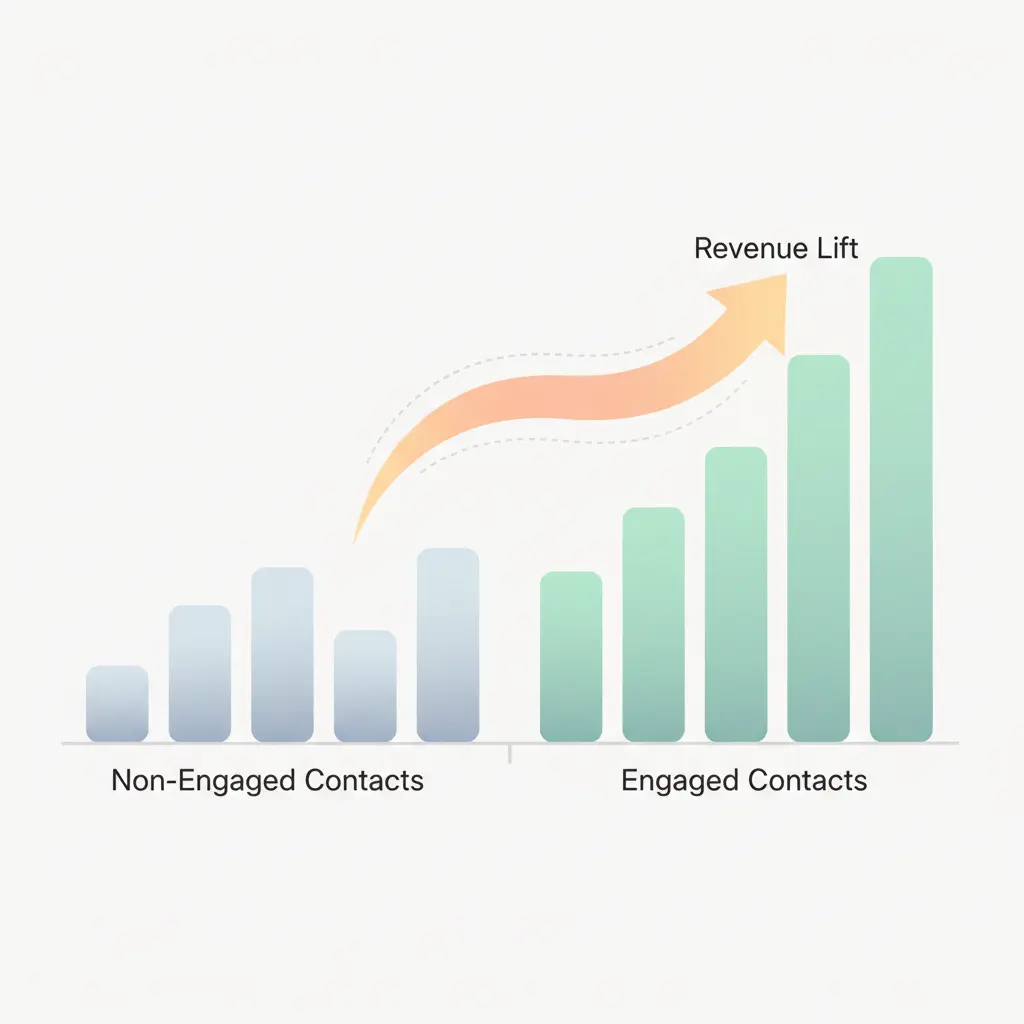
Average Revenue Per User (ARPU) is calculated across your entire customer base. RPEC is calculated only across your engaged segment. The gap between those two numbers is one of the most revealing data points a marketing team can surface.
Here’s an example: if your ARPU is $84/month but your RPEC is $210/month, that 2.5× multiplier is the business case for investing more in engagement automation. It answers the question “what happens when we actually engage someone properly?” with a dollar amount.
How to Attribute Revenue to Engagement in a Marketing Automation Platform
- Define your engagement threshold: Set a minimum CES (e.g., score ≥ 60) that qualifies a contact as “engaged.” Document this definition so it’s consistent across teams.
- Tag engaged contacts in your CEP: Use dynamic segmentation to auto-tag any contact meeting the threshold. This segment updates in real time as scores change.
- Connect revenue data: Sync your e-commerce platform, CRM, or billing system with your marketing automation platform. Map purchase events to contact records.
- Run the calculation monthly: Pull total revenue from engaged-tagged contacts, divide by count. Track the trend — a rising RPEC signals your engagement programs are working.
- Run an A/B test as validation: Split a segment into “receives engagement automation” vs. “control group.” Measure RPEC for both after 60 days. This is your engagement lift proof point.
How Does RPEC Connect to CEP ROI?
RPEC is the input metric that feeds your ROI calculation. Once you know what an engaged contact is worth monthly, you can project the revenue impact of moving X% of your passive contacts into the engaged segment — which is exactly the case you need to justify your CEP investment.
For the full ROI calculation framework — including payback period, retention lift modeling, and revenue projection templates — see our customer engagement platform ROI calculator and measurement framework.
CEP KPIs vs. Vanity Metrics: Side-by-Side Comparison
Here’s where most teams get stuck: they report metrics that look good in a weekly dashboard but don’t actually measure engagement effectiveness. This table separates signal from noise.
| Metric | Type | Business Outcome Link | Actionability |
|---|---|---|---|
| Customer Engagement Score | CEP KPI ✅ | Predicts churn, upsell readiness | Triggers automated workflows |
| Retention Rate | CEP KPI ✅ | Direct LTV and profitability impact | Guides lifecycle campaign investment |
| Revenue Per Engaged Contact | CEP KPI ✅ | Quantifies engagement program value | Justifies CEP and automation spend |
| Email Open Rate | Vanity Metric ⚠️ | Indirect; distorted by Apple MPP | Limited; optimize subject lines only |
| Page Views | Vanity Metric ⚠️ | No direct revenue correlation | Content strategy only |
| Social Media Followers | Vanity Metric ⚠️ | Minimal unless tied to conversions | Brand awareness only |
| List Size / Subscriber Count | Vanity Metric ⚠️ | No value if contacts are disengaged | Watch relative to active segment % |
How to Implement KPI Tracking in a Marketing Automation Platform
Tracking these three KPIs requires your marketing automation platform to do four things well: collect cross-channel behavioral data, unify it at the contact level, calculate composite scores automatically, and surface the results in actionable reports. Here’s the implementation sequence:
Step-by-Step KPI Implementation Checklist
- Audit your data sources: List every channel where contacts interact — email, SMS, website, in-app, push, support. Confirm your CEP receives event data from each source.
- Define engagement events and weights: Document which actions earn which point values for your CES model. Get marketing and product to agree on this — misalignment here breaks everything downstream.
- Configure real-time segmentation: Build dynamic segments for each CES band (at-risk, passive, active, highly engaged). These update automatically as scores change.
- Connect revenue data: Integrate your billing or e-commerce system with your marketing automation platform. Map purchase and renewal events to contact IDs.
- Build lifecycle automation workflows: Create automated sequences for each lifecycle transition: new contact onboarding, passive-to-active re-engagement, churn-risk intervention, high-CES upsell trigger.
- Set up a KPI dashboard: Track CES distribution, retention rate by cohort, and RPEC month-over-month. Review weekly; act on anomalies within 48 hours.
- Run monthly A/B tests: Continuously test engagement interventions. CES, retention rate, and RPEC are your primary test outcome metrics — not open rate.
Fair warning: this takes real configuration effort upfront. Most teams can get a basic version running in 2–4 weeks with a capable CEP. Trying to build this in a spreadsheet or across disconnected tools usually collapses within a quarter.
How CampaignOS Tracks These KPIs in One Place
CampaignOS is an open-source marketing automation and customer engagement platform built specifically for teams that want full control over their data and automation logic — without the six-figure enterprise contracts.
Here’s how CampaignOS maps directly to the three KPIs covered in this guide:
Customer Engagement Score in CampaignOS
CampaignOS includes a built-in lead scoring engine that assigns point values to behavioral events across every channel it manages — email, SMS, WhatsApp, Telegram, push notifications, and on-site personalization. Scores update automatically, and contacts are dynamically segmented by score band. You can configure the scoring model without writing code.
Retention Rate Tracking in CampaignOS
CampaignOS’s visual workflow builder lets you construct multi-step retention sequences triggered by behavioral signals — login inactivity, score drops, or product usage gaps. The analytics module tracks cohort-level retention across campaigns, so you can see which automated sequence is actually moving the needle on retention rate.
Revenue Per Engaged Contact in CampaignOS
CampaignOS integrates with external data sources via native connectors and n8n for heavy orchestration. This means you can pipe purchase and revenue events from your e-commerce platform or billing system into CampaignOS, tag contacts by CES band, and calculate RPEC directly in the reporting interface. A/B testing is built in, so you can run controlled experiments to measure engagement lift on revenue.
CampaignOS is self-hosted on Vercel with PostgreSQL — meaning your contact data never leaves your infrastructure. For teams in regulated industries or those with data residency requirements, this is a material advantage over cloud-only alternatives.
Frequently Asked Questions
What is a customer engagement platform?
A customer engagement platform (CEP) is software that unifies multi-channel communication, behavioral data, and marketing automation into a single system. It lets teams send personalized messages across email, SMS, push, WhatsApp, and web — triggered by real-time customer behavior — and measure the results at the contact level. CEPs differ from CRMs in that they focus on automated interaction rather than static record management.
What is the difference between a CEP and a marketing automation platform?
Marketing automation is a capability — the rules-based execution of campaigns and workflows. A customer engagement platform is the broader system that includes marketing automation plus data unification, cross-channel messaging, segmentation, lead scoring, and analytics. All CEPs include marketing automation; not all marketing automation tools are full CEPs.
What KPIs should I track for customer engagement?
The three most business-critical KPIs for customer engagement are Customer Engagement Score (CES), Retention Rate, and Revenue Per Engaged Contact (RPEC). These three metrics connect engagement activity directly to churn prevention, customer lifetime value, and revenue — making them defensible in both marketing reviews and executive presentations.
How do I calculate Customer Engagement Score?
Customer Engagement Score is calculated by assigning weighted point values to behavioral events (e.g., email click = 3 points, purchase = 10 points, 30-day inactivity = -5 points), applying a recency decay factor so recent activity weighs more, and normalizing the result to a 0–100 scale. Most marketing automation platforms and CEPs can calculate and update CES automatically based on rules you configure.
What is a good retention rate for a SaaS company?
A good annual retention rate for SaaS companies is 85–90%, with top-quartile performers exceeding 95%. Monthly churn rates above 2% typically signal a product or engagement problem requiring immediate lifecycle automation intervention. Retention rates below 80% annually make customer acquisition cost recovery extremely difficult regardless of growth rate.
Is marketing automation worth it for small businesses?
Yes — marketing automation delivers measurable ROI for small businesses by replacing manual, repetitive communication tasks with automated sequences triggered by customer behavior. The key is starting with high-value workflows (welcome sequences, abandoned cart recovery, re-engagement campaigns) rather than trying to automate everything at once. Open-source platforms like CampaignOS make marketing automation accessible without large upfront software costs.
How does marketing automation improve customer retention?
Marketing automation improves retention by detecting pre-churn behavioral signals (reduced login frequency, declining engagement score, increased support contacts) and automatically triggering personalized intervention campaigns before the customer disengages. Automated lifecycle sequences — onboarding, milestone emails, win-back campaigns — maintain consistent contact with every customer segment without requiring manual effort from your team.
What channels does a customer engagement platform support?
Modern customer engagement platforms support email, SMS, push notifications (web and mobile), WhatsApp, Telegram, in-app messaging, and on-site personalization. The key differentiator is whether the platform coordinates these channels from a single behavioral data source — so each message reflects the contact’s real-time engagement context across all channels, not just the most recent one.
How do I connect engagement KPIs to revenue and ROI?
Connect engagement KPIs to revenue by calculating Revenue Per Engaged Contact (RPEC) — the average revenue generated by contacts above your engagement threshold. Then model the revenue impact of moving a percentage of passive contacts into the engaged segment. This projection, combined with your CEP and marketing automation costs, gives you a documented ROI framework suitable for budget justification.
What to Read Next
The three KPIs in this guide — Customer Engagement Score, Retention Rate, and Revenue Per Engaged Contact — give you the measurement framework for your marketing automation strategy. The next step is understanding what to build and how to interpret the numbers you collect.
- What Is a Customer Engagement Platform? The Complete 2026 Guide — Full architecture breakdown, feature comparison, and buying framework for teams evaluating CEPs.
- Customer Engagement Metrics and Benchmarks: The 2026 Data Guide — Industry-specific benchmark data for CES, retention rate, and 12 other engagement metrics.
- Customer Engagement Platform ROI: The 2026 Calculator and Measurement Framework — Step-by-step ROI model that connects your KPI data to revenue projections and payback period calculations.
If you found this guide useful, share it with your marketing or growth team — especially anyone who’s been asked to “prove the ROI of engagement.” That’s exactly the conversation this framework is built to support.