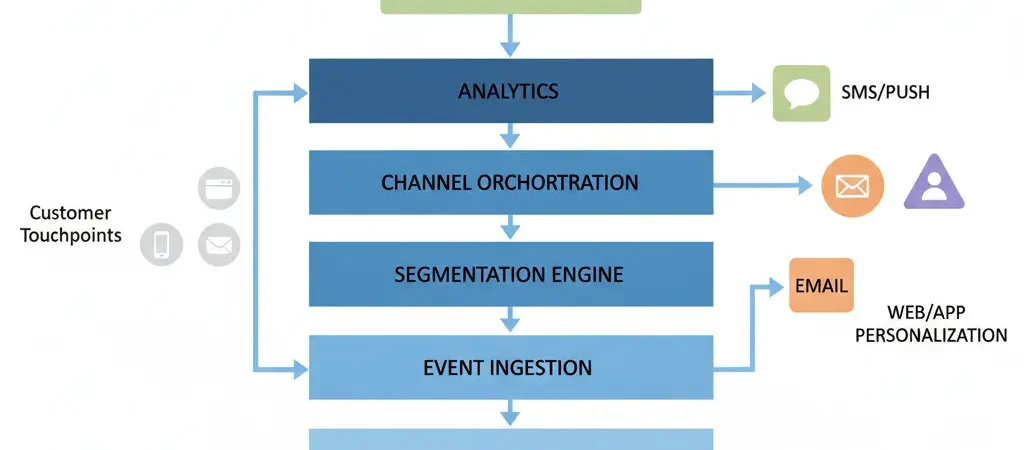
Customer Engagement Platform Architecture: The 2026 Technical Guide
A customer engagement platform is the central nervous system of your marketing operation. It ingests behavioral events from your product, maintains a real-time profile of every contact, executes multi-channel messaging workflows, and feeds performance data back into the loop. Most teams treat it as a purchase rather than an architectural decision — they buy HubSpot or ActiveCampaign and accept whatever architecture those vendors have chosen. This guide is for teams who understand that architecture is strategy, and who want to build a customer engagement platform that compounds advantage over time rather than accumulating technical debt.
The global customer engagement platform market is growing at 8.9% CAGR through 2028. The platforms capturing that growth are not the ones with the most features — they are the ones with the cleanest event models, the most flexible segmentation engines, and the tightest integration with the rest of the marketing stack.
The Five-Layer Architecture
Every production-grade customer engagement platform, whether proprietary or open source, operates on five distinct architectural layers. Understanding each layer — and the design decisions within it — lets you evaluate any platform objectively and build your own with confidence.
The layers are not independent. Decisions in the contact data model constrain what the segmentation engine can do. Segmentation engine design determines what the channel orchestration layer can express. Analytics quality depends on instrumentation decisions made in the event ingestion pipeline. Architecture is interconnected, and the best platforms were designed with these dependencies in mind from day one.
Layer 1: Contact Data Model
The contact data model is the foundation. Every segmentation decision, every personalization token, and every behavioral trigger depends on the quality of data stored at the contact level.
Core Contact Schema
A minimal viable contact schema requires:
- Identity fields: email (primary), phone, external_id (your system’s user ID), anonymous_id (pre-identification cookie)
- Profile fields: name, company, job_title, location, timezone, language
- Consent fields: email_opted_in, sms_opted_in, push_opted_in, consent_timestamp, consent_source
- Lifecycle fields: lifecycle_stage, first_seen_at, last_seen_at, created_at
- Custom properties: schema-less store for product-specific attributes
The Identity Resolution Problem
The hardest contact data problem is identity resolution: connecting anonymous pre-signup behavior to identified post-signup profiles. The standard solution is a two-phase model: anonymous_id tracks behavior before identification, user_id after. At the identification event (signup, login, email submission), the two IDs are merged into a single contact record with the full behavioral history.
Platforms that do not handle this correctly show inflated contact counts, broken attribution, and welcome sequences that fire for returning users who signed up on a different device. This is not a theoretical edge case — it is the normal experience for 20–40% of your contacts.
GDPR-Compliant Data Architecture
GDPR compliance is not a feature layer — it is a data model requirement. Your contact schema must support:
- Consent recording with timestamp and source for every channel
- Data export (right of access) at the individual contact level
- Data deletion (right to erasure) that cascades through all downstream systems
- Data portability (machine-readable format on request)
- Processing records for any data shared with third-party processors
Layer 2: Event Ingestion Pipeline
Events are what transform a contact database into a customer engagement platform. Without events, you have a CRM. With events, you have a behavioral engine capable of responding to what customers actually do.
Event Schema Design
Every event should follow a consistent schema: event_name (string, present tense verb + noun), user_id or anonymous_id, timestamp, and a properties object for event-specific context. Example: {"event": "workflow_activated", "user_id": "usr_123", "timestamp": "2026-03-27T09:15:00Z", "properties": {"workflow_name": "welcome_sequence", "contact_count": 450}}
Event naming consistency matters more than naming convention — teams that change event names break segmentation and trigger logic silently. Treat your event schema like a public API: version it, document it, and deprecate carefully.
Ingestion Methods
| Method | Latency | Best For |
|---|---|---|
| SDK (browser/mobile) | <100ms | Client-side behavioral events |
| Server-side API | <200ms | Transactional events (purchase, cancellation) |
| Webhook | <500ms | Third-party system events (Stripe, Shopify) |
| Batch import | Minutes to hours | Historical data backfill, data warehouse sync |
Event Queue Architecture
High-volume event ingestion requires a queue to decouple ingestion rate from processing rate. Without a queue, a traffic spike (product launch, press coverage) can overwhelm your processing pipeline. Standard pattern: events write to a queue (Redis Streams, AWS SQS, or Kafka for enterprise scale), workers consume from the queue and process events, and the database is only written after processing completes.
Layer 3: Segmentation Engine
Segmentation is where the customer engagement platform earns its keep. The segmentation engine’s job is to answer one question at millisecond speed: “Given everything we know about this contact right now, which segments do they belong to?”
Static vs. Dynamic Segments
Static segments are lists: you add contacts manually or via one-time import. Dynamic segments evaluate rules in real time: a contact automatically enters when their properties satisfy the conditions and exits when they don’t. For any serious automation, dynamic segments are the only option worth building on. Static segments belong in one-time campaign targeting, not workflow triggers.
Segment Condition Types
- Property conditions: lifecycle_stage = “trial”, company_size > 50, country = “DE”
- Event conditions: performed event X in last N days, has not performed event Y since event Z
- Computed conditions: lead_score > 75, total_purchases > 3
- Segment membership: is in segment A and not in segment B
Performance Requirements
Segment membership evaluation must be fast enough to support real-time trigger decisions. The industry standard is under 100ms for segment membership lookups. Achieving this requires careful index design, materialized view caching for complex segment conditions, and a segmentation architecture that separates read (trigger evaluation) from write (segment membership updates).
Layer 4: Channel Orchestration Layer
The channel orchestration layer is the visual workflow builder — the component that translates marketing intent (if user does X then send Y on channel Z) into executable logic.
Workflow Node Types
A complete orchestration layer needs at minimum:
- Trigger nodes: Segment entry, event, API, schedule, webhook
- Action nodes: Send email, send SMS, send push, update contact property, add/remove from segment, create CRM task
- Logic nodes: Conditional branch (if/else), A/B split, random split, time delay, wait-for-event
- Exit nodes: Goal achieved, unsubscribed, condition met
Multi-Channel Coordination
The orchestration layer must handle channel coordination: not just sending on multiple channels, but making intelligent decisions about which channel to use based on contact preferences, previous engagement, and message priority. A omnichannel marketing automation system sends the right message on the right channel, not the same message on every channel simultaneously.
Workflow State Management
Each contact’s position in each workflow is state that must be persisted. The state model supports pausing (contact is mid-workflow, waiting for a time delay or event), branching (contact has taken path A, not path B), and completion (contact has reached a terminal node). This state data is critical for analytics and for preventing duplicate messages.
Layer 5: Analytics Engine
The analytics engine closes the loop: it transforms raw event data and workflow execution records into the performance insights that drive optimization decisions. A production-grade marketing analytics dashboard requires:
- Workflow analytics: Entry rate, completion rate, conversion rate, revenue attribution, and exit reason breakdown per workflow
- Channel analytics: Deliverability rate, engagement rate, conversion rate, and unsubscribe rate per channel
- Contact analytics: Lifecycle stage distribution, segment sizes, engagement scores, and churn risk scores
- Revenue analytics: Attributed revenue per workflow, per channel, and per segment
Attribution Modeling
Multi-touch attribution is more accurate than last-touch but requires more instrumentation. At minimum, tag every outbound link with UTM parameters and track conversion events at the server side. For full attribution modeling, instrument an event for every significant touchpoint and apply a weighted model (linear, time-decay, or position-based) to credit multiple interactions.
Scalability Patterns
Horizontal scalability requirements vary by layer. Contact data scales with database sharding or read replicas. Event ingestion scales with queue-based decoupling and worker horizontality. Segmentation scales with materialized caches and lazy evaluation. Channel delivery scales with provider APIs that handle their own distribution at scale.
The practical scalability ceiling for a well-architected open source platform on modern cloud infrastructure is in the tens of millions of contacts and hundreds of millions of events per month — well beyond the needs of 99% of businesses that will read this guide.
Integration Architecture
No customer engagement platform operates in isolation. The integration architecture determines how cleanly data flows between your engagement platform and the rest of your stack: CRM, data warehouse, payment processor, support platform, product analytics.
Best practice is bidirectional sync with explicit conflict resolution rules: the CRM is the source of truth for account-level data; the engagement platform is the source of truth for individual contact behavioral data. Conflicts are resolved in favor of the more recently updated record, with exceptions for manually curated fields (account owner, strategic tier) that should never be overwritten by automated sync.
How CampaignOS Implements This Architecture
CampaignOS implements all five architectural layers in a single deployable unit built on Next.js with a PostgreSQL data store. The design philosophy is deliberate: a monolithic architecture that is easy to understand, debug, and extend beats a microservices architecture that requires an ops team to maintain.
Key implementation decisions that differentiate CampaignOS from legacy open source alternatives:
- Event-first contact model: Contact properties are derived from events, not manually managed — ensuring the engagement system always reflects current reality
- n8n integration for heavy orchestration: Complex workflow logic delegates to n8n, keeping the core platform lean while enabling unlimited workflow complexity
- Edge deployment: Vercel edge functions for global low-latency event ingestion and trigger evaluation
- Open schema custom properties: JSONB columns for custom properties with indexed querying — no schema migrations needed for new contact attributes
Start building your customer engagement platform at app.campaignos.site. For teams evaluating AI-powered content workflows alongside engagement infrastructure, Authenova offers complementary tools for content automation at scale.
Frequently Asked Questions
What is the difference between a customer engagement platform and a CRM?
A CRM (Customer Relationship Management) system is primarily a record-keeping system for sales — it stores deal stages, contact history, and account data, and it is operated by sales teams. A customer engagement platform is an event-driven automation system — it captures behavioral signals, segments contacts dynamically, and executes multi-channel messaging workflows. They are complementary, not competing: CRM manages the sales relationship, the engagement platform manages automated touchpoints at every stage of the lifecycle.
How many events per second can an open source customer engagement platform handle?
A properly architected open source platform with queue-based event ingestion (Redis Streams or similar) can handle thousands of events per second on modest infrastructure. Most businesses generate fewer than 100 events per second even at peak traffic. At millions of monthly active users, you need queue autoscaling and worker horizontality, but this is well within the capacity of modern cloud infrastructure without custom engineering.
What database is best for a customer engagement platform?
PostgreSQL is the best choice for most teams: it handles relational contact data, JSONB for custom properties, and with proper indexing it queries segment conditions at sub-100ms latency up to tens of millions of contacts. For very high event volumes (billions per month), supplementing PostgreSQL with a columnar store (ClickHouse, BigQuery) for analytics is a proven pattern. Redis is essential as a cache layer for hot segment membership lookups.
How should I handle anonymous visitors in a customer engagement platform?
Assign an anonymous_id via first-party cookie on first visit. Track behavioral events against this ID (page views, feature interactions, form starts). When the visitor identifies (email submission, login), merge the anonymous_id history into the identified contact record. This gives you full behavioral context at identification time, enabling more relevant onboarding sequences than platforms that start tracking only after identification.
What is the minimum viable customer engagement platform for an early-stage startup?
A minimal viable customer engagement platform needs: contact storage with basic properties and consent fields, email as a channel (at minimum), three trigger types (signup, purchase, inactivity), and basic segmentation (lifecycle stage, engagement recency). CampaignOS covers this at zero licensing cost. Avoid over-engineering at the start — a simple platform you actually use beats a sophisticated one that runs on defaults.
How do customer engagement platforms handle multi-channel frequency capping?
Frequency capping prevents a single contact from receiving too many messages across channels in a given time window (e.g., no more than three messages per 24 hours across all channels). Implementing this requires a centralized message history that all channel senders consult before dispatching. Most open source platforms support per-channel frequency caps; cross-channel caps require custom configuration or a dedicated message coordination layer.
Architecture That Scales With You
CampaignOS implements all five engagement platform layers in an open source codebase you can read, modify, and deploy on your own infrastructure. No black boxes. No vendor ceilings.