Marketing Automation Platform Selection Framework for 2026
Selecting a marketing automation platform is one of the most consequential decisions a growth team makes. The platform you choose shapes your architecture, constrains your capabilities, determines your costs at scale, and creates switching costs that compound over time. Made well, this decision compounds advantage for years. Made poorly, it produces an expensive migration project at the worst possible moment — when your team is growing and can least afford the disruption.
This framework removes the subjectivity from platform selection. Instead of comparing feature lists (which every vendor optimizes to look favorable), it evaluates platforms on the dimensions that predict long-term success: architectural fit, total cost of ownership, team capability requirements, and integration depth. Work through this framework before any vendor demo, and you will arrive at demos knowing exactly what you need to see — not what the vendor wants to show you.
Before You Evaluate: Define Your Requirements
Requirements definition is the step most teams skip. They go straight to demos, get impressed by polished interfaces, and select platforms based on features they noticed rather than requirements they defined. This produces selection regret.
Current State Assessment
- How many contacts do you have today? What is your projected count in 12 months? 36 months?
- Which channels are you actively using? Which do you plan to add?
- How many automation workflows do you run today? How many do you plan to run in 12 months?
- What systems does your marketing stack currently include (CRM, analytics, payment processor, data warehouse)?
- What is your current marketing automation spend, all-in?
Team Capability Assessment
- Do you have engineering resources available for platform setup and maintenance?
- What is your team’s comfort level with technical configuration (DNS records, webhooks, API integration)?
- How many people will operate the platform daily? What are their technical backgrounds?
- What is your tolerance for infrastructure management vs. fully managed SaaS?
Non-Negotiable Requirements
List your hard requirements before evaluating any platform. These are conditions the platform must meet to be considered at all. Common non-negotiables: GDPR compliance, minimum uptime SLA, specific channel support, self-hosted option, API access, a particular integration (Salesforce, Shopify, Stripe). Any platform that does not meet your non-negotiables is disqualified regardless of other attributes.
The Five Evaluation Dimensions
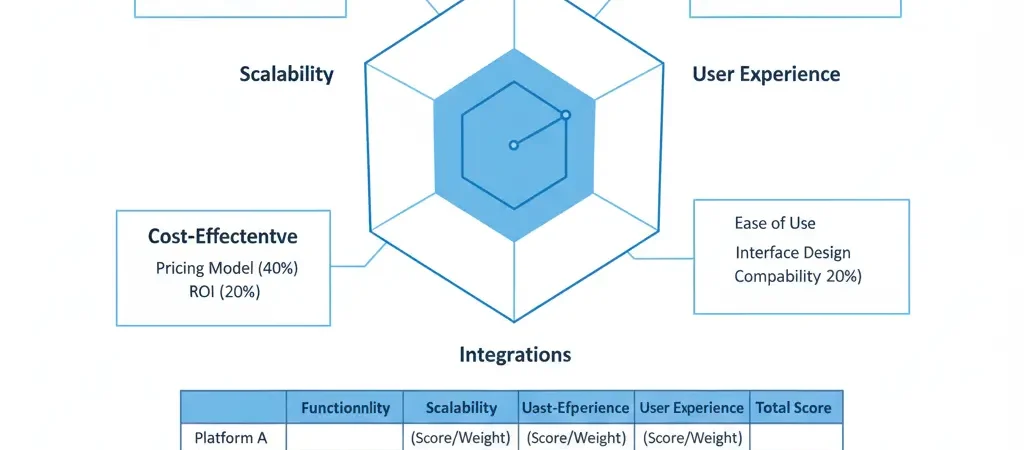
Rate every platform you evaluate on these five dimensions on a 1–10 scale. Weight the dimensions according to your organization’s priorities.
1. Capability Fit (Weight: 25–35%)
Does the platform do what you need it to do today, with reasonable fidelity? Evaluate against your actual use cases, not the vendor’s use case library.
2. Scalability Ceiling (Weight: 15–25%)
What are the platform’s architectural limits? Contact limits. Send rate limits. Workflow complexity limits. API rate limits. What does pricing look like at 10x your current scale? Platforms with low scalability ceilings create expensive migrations at the worst possible moment.
3. Total Cost of Ownership (Weight: 20–30%)
All-in cost at your projected scale: licensing, infrastructure, implementation, ongoing maintenance, and staff time. Proprietary platforms often look cheap at small scale and become expensive at mid-scale. Open source platforms have low licensing costs but non-zero infrastructure and maintenance costs.
4. Team Fit (Weight: 15–20%)
Can your team actually run this platform effectively? A platform that requires dedicated DevOps is wrong for a two-person marketing team. A platform that cannot be extended via code is wrong for an engineering-led growth team. Match the platform to your team, not your aspirational team.
5. Data Ownership and Portability (Weight: 10–20%)
Who controls your contact data? Can you export everything, at any time, in a machine-readable format? What happens to your data if you cancel your subscription? What data does the vendor use to train their AI models? These questions determine your switching costs and your data risk exposure.
Capability Scoring Framework
Score each platform on each capability category (1 = missing, 3 = partial, 5 = excellent):
| Capability | Weight | What to Evaluate |
|---|---|---|
| Email automation | High | Behavioral triggers, sequence depth, deliverability tooling |
| Multi-channel support | Medium–High | Native channels, coordination logic, unified contact profile |
| Segmentation engine | High | Dynamic segments, behavioral conditions, real-time updates |
| Workflow builder | High | Visual builder, branching, A/B splits, goal exits |
| Analytics and attribution | Medium | Workflow analytics, revenue attribution, retention metrics |
| API and integrations | Medium–High | REST API quality, webhook support, native integrations |
| GDPR and compliance | High (for EU) | Consent management, data export, deletion workflows |
Total Cost of Ownership Calculation
TCO calculation is the most frequently underestimated evaluation step. Build this spreadsheet before comparing any platforms:
Year 1 costs (per platform):
- Licensing: Annual subscription cost at your current contact count
- Implementation: One-time setup cost (your team time, any consultant fees)
- Infrastructure: Hosting, database, email delivery provider (for open source platforms)
- Migration: Data migration cost from current platform
- Training: Time to get team proficient on the new platform
Year 3 costs (at 3x contact scale):
- Licensing at projected contact count
- Infrastructure at projected scale (for open source)
- Maintenance and updates (staff time or managed service)
For most teams evaluating open source vs. proprietary platforms, the crossover point — where open source becomes cheaper than proprietary — occurs between 10,000 and 50,000 contacts, depending on the platform. Below that, the implementation and maintenance time cost may offset the licensing savings. Above it, open source is typically 70–90% cheaper on a pure TCO basis.
Team Fit Assessment
Team fit is the most honest and most frequently ignored dimension. Technical platforms require technical teams. Non-technical platforms sacrifice flexibility. Matching the platform to your actual team prevents a common failure mode: purchasing a technically capable platform that sits largely unconfigured because no one on the team knows how to use it.
| Team Profile | Best Platform Type | Example |
|---|---|---|
| Non-technical marketing team | Managed SaaS, fully visual | Mailchimp, Brevo |
| Marketing-developer hybrid | Open source or open-core, visual builder + API | CampaignOS |
| Engineering-led growth team | API-first, composable open source | n8n + specialized senders |
| Enterprise marketing ops | Full-featured SaaS or self-hosted enterprise | HubSpot, Mautic (enterprise) |
Data Ownership and Portability
Data ownership is a dimension that becomes critically important at the worst possible time: when you are unhappy with your current platform and want to switch. By then, switching costs are maximized. Evaluate data portability before you are in that situation.
Questions to ask every vendor:
- Can I export all contact data, including behavioral history, at any time?
- In what format is the export? (CSV is acceptable; proprietary formats are a warning sign)
- What happens to my data if I cancel? Is it deleted immediately or retained for how long?
- Does the platform use my contact data to train AI models or for any purpose other than running my campaigns?
- Where is my data stored geographically? Can I specify EU-only storage?
Open source platforms deployed on your own infrastructure have the clearest data ownership story: you own the server, you own the database, there is no vendor relationship at the data layer. This is the strongest possible answer to every data portability question, which is why data sovereignty is a primary driver for open source adoption in the open source marketing automation space.
The Major Platform Categories in 2026
The marketing automation platform landscape in 2026 organizes into four distinct categories, each with different strengths and trade-offs.
Enterprise Proprietary (HubSpot, Salesforce Marketing Cloud, Adobe)
Best for: Large organizations with dedicated ops teams, enterprise security requirements, and budget. Pricing is typically $1,000–$10,000+/month at mid-enterprise scale. Deep feature sets, strong support, significant lock-in.
Mid-Market SaaS (ActiveCampaign, Brevo, Klaviyo)
Best for: Growing companies with non-technical marketing teams who need a managed solution. Pricing from $100–$1,000/month at mid-market scale. Good feature coverage, some integration limitations, moderate lock-in.
Open Source Self-Hosted (CampaignOS, Mautic)
Best for: Technical teams, companies with data sovereignty requirements, and organizations where TCO optimization matters. Zero licensing cost, infrastructure costs of $50–$300/month at most scales. Full control, requires technical operation, no lock-in. For a detailed comparison, see our platform selection guide and the future of marketing automation.
Composable/API-First (n8n-based stacks, custom builds)
Best for: Engineering-led growth teams who need maximum flexibility and accept maximum complexity. Cost varies widely. Maximum flexibility, highest maintenance burden.
The Evaluation Process
A structured evaluation process prevents vendor-driven decisions and ensures you are selecting based on your requirements, not their sales capabilities.
- Week 1: Complete requirements definition and build the scoring framework with your team. Agree on dimension weights before seeing any vendor.
- Week 2: Longlist phase — identify 5–8 platforms that pass your non-negotiable filters.
- Week 3: Shortlist phase — score all longlist platforms against your capability framework using publicly available information (documentation, pricing pages, case studies). Shortlist to 2–3.
- Week 4: Trial phase — deploy a free trial or sandbox of your shortlisted platforms. Execute three specific test scenarios that represent your actual use cases.
- Week 5: Final evaluation — calculate TCO for each shortlisted platform, score team fit, and make the final selection.
Do not shortcut week 4. The trial phase reveals capability and UX gaps that documentation never does. A platform that scores 8/10 on paper but takes four hours to configure a simple onboarding sequence in practice is a different platform than the documentation suggests.
Frequently Asked Questions
How long should a marketing automation platform evaluation take?
A thorough evaluation takes 4–6 weeks: 1 week for requirements definition, 1 week for longlisting, 1 week for shortlisting, 1–2 weeks for trials, and 1 week for final decision and contract negotiation. Rushing this process to 1–2 weeks produces selection regret almost universally. The cost of a rushed evaluation that leads to a wrong platform selection is months of migration work 12–18 months later.
What is the biggest mistake companies make when selecting a marketing automation platform?
Selecting based on the vendor’s demo rather than their own use case requirements. Vendor demos are optimized to impress, not to evaluate fit. The platform will look capable of everything in a demo — what you need to see is whether it handles your specific scenarios efficiently, scales to your projected contact counts at an acceptable cost, and can be operated by your actual team. Define your scenarios first, then ask vendors to demonstrate them specifically.
Should small teams use enterprise marketing automation platforms?
Rarely. Enterprise platforms are built for enterprise operations teams, not lean startup teams. They have more features than small teams will use, are priced for enterprise budgets, and have complexity that requires dedicated marketing operations professionals to manage effectively. Small teams are better served by platforms designed for their scale — simpler interfaces, lower operational overhead, and pricing that matches early-stage budgets. CampaignOS, for example, is specifically designed for the marketing-developer hybrid teams common at growth-stage companies.
How do you negotiate a marketing automation platform contract?
Negotiation leverage is highest before you sign. Key negotiation points: annual commitment discount (typically 15–20% off monthly pricing), contact count overage rates (get them in writing), price lock for contract term, free migration assistance, and SLA terms with financial penalties for uptime violations. For platforms with per-contact pricing, negotiate a block structure (fixed cost for up to X contacts) rather than per-contact pricing, which creates unpredictable costs as your list grows.
What integrations should a marketing automation platform have?
At minimum, your platform must integrate natively with your CRM, payment processor (Stripe, Shopify, or equivalent), and website analytics. Beyond these, evaluate the integration quality, not just the integration list — a shallow Salesforce connector that only syncs contacts one-way is less valuable than a documented webhook API that lets you build exactly the integration you need. Open source platforms with good REST APIs give you maximum integration flexibility, even for systems the vendor hasn’t built native connectors for.
How important is customer support when choosing a marketing automation platform?
Support quality matters most during implementation and when something breaks in production. Evaluate support by: maximum response time commitment in your tier, quality of documentation (can you solve most problems yourself?), community size for open source platforms (can the community answer your questions?), and onboarding support quality. Open source platforms with active communities can provide faster problem resolution than proprietary platforms with formal support queues — but this depends on the community’s health and activity level.
Start Your Evaluation with CampaignOS
CampaignOS is free to trial with no contact limits or feature restrictions. Deploy it, run your specific use case scenarios, and see exactly how it performs against your requirements before committing to anything.