Nonprofit Marketing Automation: The Donor Engagement Guide for 2026
The average nonprofit loses 60–70% of its first-time donors — they give once and never return. That’s not a donor problem; it’s a stewardship problem. Donors who give and then hear nothing meaningful from the organization have no compelling reason to give again. They gave, they felt good for a moment, and then life moved on. Nonprofit marketing automation breaks this cycle by ensuring every donor receives consistent, personalized, impact-focused communication — at scale, without burning out your development team.
The stakes are high. Nonprofit email delivers an average $36–$40 return on investment per dollar spent, and a single automated welcome series has been shown to increase second-gift rates by 29% when a donor’s email is on file. One in three donors cites email as the reason they gave. These numbers mean that an under-automated nonprofit development operation isn’t just leaving time on the table — it’s leaving donations there too.
This guide covers the automation workflows that improve donor retention, build recurring giving programs, and let small development teams manage large donor relationships without sacrificing personalization.
The Donor Retention Problem Automation Solves
Nonprofits typically spend 5–10x more acquiring a new donor than retaining an existing one. Yet most development operations focus the majority of their effort and budget on acquisition — appeals, events, grant writing — while donor stewardship is handled inconsistently or only when a staff member has capacity. The result: a leaky bucket where acquisition is constantly fighting retention losses.
Marketing automation addresses the stewardship gap by creating consistent touchpoints that run regardless of staff bandwidth. In 2026, the best nonprofit development teams use automation for stewardship (keeping existing donors warm) while reserving staff time for major gift cultivation and event coordination.
The Donor Lifecycle
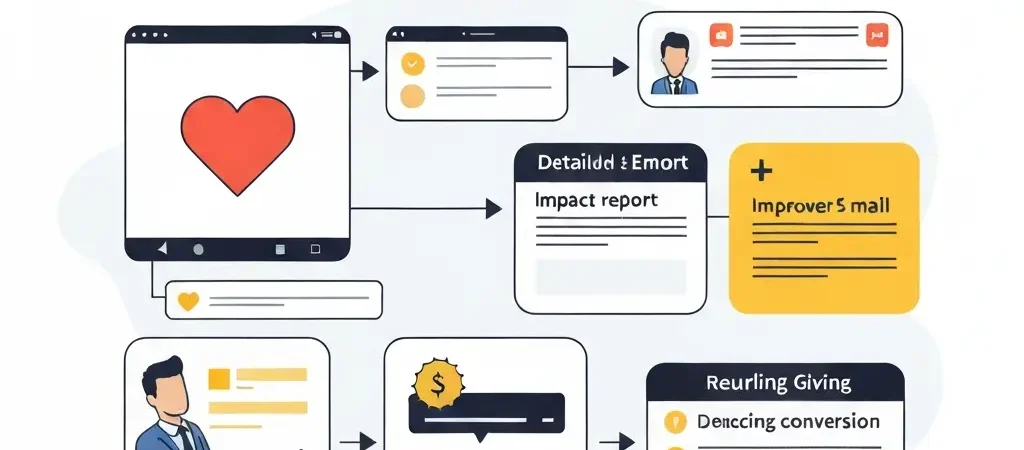
Every donor moves through a predictable lifecycle: first gift → acknowledgment → impact update → ask → lapse or second gift. Automation ensures that each stage of this lifecycle is handled promptly and consistently, with messages that feel personal even when sent to thousands.
New Donor Welcome Sequence
The 72 hours after a first donation is the most critical window in the donor relationship. Donors who receive a prompt, specific, impact-focused thank-you are significantly more likely to give again. A 4-message welcome sequence over the first 30 days sets the stage for a long-term relationship.
| Timing | Message | Key Element |
|---|---|---|
| Immediate (within minutes) | Tax receipt + warm thank you | Personalized gift amount, specific program |
| Day 3–5 | Impact story | A specific beneficiary story tied to their donation |
| Day 10–14 | Introduction to the team / mission | Behind-the-scenes content, faces of the work |
| Day 28–30 | Invitation to engage further | Volunteer, share, or consider monthly giving |
Critical rule: do not make a second donation ask in the welcome sequence. The goal is to deepen the relationship and communicate impact — the ask comes later, once the donor feels like a valued partner rather than a transaction.
Impact Reporting Automation
Regular impact reporting is the single most effective retention tool for mid-level donors ($500–$5,000/year). These donors want to know their gift is making a difference — not in abstract terms (“we fed thousands of families”) but in specific, concrete terms tied to their donation amount and preferred program.
An automated quarterly impact report sequence delivers segmented content based on giving level and program interest. A donor who gave to a youth education program receives stories and statistics about that program. A donor who gave to general operations receives a financial transparency update. This segmentation — easily set up in CampaignOS audience segments — increases click-through rates by 40% compared to single-version impact reports.
Recurring Giving Conversion
Monthly donors have dramatically higher lifetime value than one-time donors — often 5–10x higher over a 3-year period. Converting a one-time donor to a recurring donor is one of the highest-ROI activities in nonprofit fundraising, and automation makes it systematic.
The recurring giving conversion sequence triggers 60–90 days after a first gift, when the donor has received impact reporting and has a positive association with the organization. A 3-email sequence making the case for monthly giving — with specific impact framing (“$25/month = 3 meals per week for a family”) — converts 8–15% of targeted one-time donors to recurring status.
Lapsed Donor Reactivation
A lapsed donor (one who gave in a previous year but hasn’t given in 12+ months) is 2–3x more likely to give again than a cold prospect. Reactivation automation targets these contacts with a sequence that acknowledges the gap, reminds them of their impact, and makes a specific ask.
Effective lapsed donor reactivation: (1) “We miss you” with an honest acknowledgment that you haven’t been in touch as much as you’d like, (2) a specific impact story from the past year showing progress, (3) a direct ask tied to a current need or campaign. This sequence reactivates 12–18% of lapsed donors who haven’t given in 12–24 months.
Donor Segmentation: Treating Each Donor Right
Not every donor should receive the same messages. A $50 first-time donor and a $5,000 mid-level donor have different expectations, motivations, and appropriate touchpoint frequencies. CampaignOS’s audience segmentation lets nonprofits create distinct tracks without managing separate platforms.
| Donor Segment | Definition | Automation Focus |
|---|---|---|
| New donors | First gift in last 90 days | Welcome, impact, relationship building |
| Recurring donors | Monthly or annual committed gifts | VIP updates, upgrade prompts, retention |
| Mid-level donors | $500–$5,000 cumulative last 12 months | Program-specific impact reports, stewardship |
| Lapsed donors | No gift in 12+ months | Reactivation sequence, current need framing |
| Prospects | On email list, never given | Cultivation sequence, mission content |
Case Study: Community Foundation — 40% Improvement in Donor Retention
Challenge: First-time donor retention was 31% — well below the sector average. The development team was spending 60% of their time on acknowledgment and stewardship tasks that could be automated.
Solution: CampaignOS with a 4-message new donor welcome sequence, quarterly impact report automation by donor segment, and a lapsed donor reactivation campaign for the 800-person lapsed file.
Result: First-time donor retention improved from 31% to 52% in the first year. Lapsed donor reactivation recovered 14% of the lapsed file ($47,000 in recovered gifts). The development team reclaimed 12 hours per week from manual stewardship tasks.
The most unexpected insight: the automated impact report emails outperformed the manually written newsletter by 2x on click-through rate. “We thought personal was better,” the development director said. “But what donors actually wanted was specific, relevant content — and the segmented automation delivered that better than our one-size-fits-all newsletter ever could.”
Choosing the Right Tool on a Nonprofit Budget
Nonprofits operate under unique budget constraints — every dollar spent on overhead is a dollar not going to mission. The good news is that nonprofit marketing automation doesn’t require enterprise pricing. CampaignOS offers a free tier that covers email automation, donor segmentation, and multi-channel workflows — everything a development team needs for a full stewardship automation stack.
When evaluating platforms, prioritize: contact segmentation (essential for donor lifecycle management), automation workflows with behavioral triggers, and email deliverability. For the broader landscape of free and low-cost tools, see our contact management software free guide. For comparison with other automation platforms, see best free HubSpot alternatives.
Frequently Asked Questions
What is nonprofit marketing automation?
Nonprofit marketing automation is the use of software to automatically send donor acknowledgments, impact reports, reactivation campaigns, and recurring giving asks — based on donor behavior and lifecycle stage. It allows small development teams to maintain consistent, personalized communication with hundreds or thousands of donors without proportionally increasing staff time.
How does automation improve nonprofit donor retention?
Automation improves retention by ensuring every donor receives timely, relevant communication at each stage of the lifecycle — welcome, impact reporting, recurring giving invitation, and reactivation. Organizations that use automated welcome sequences see second-gift rates increase by 29%. Consistent stewardship is the primary driver of retention, and automation makes consistency possible at scale.
Is marketing automation appropriate for small nonprofits?
Yes — small nonprofits benefit the most because they have the least staff bandwidth for manual stewardship. A 1–2 person development team can use CampaignOS to run a full donor stewardship automation stack (welcome sequence, impact reports, reactivation) for free, effectively multiplying their capacity without adding headcount.
How do you convert one-time donors to recurring donors with automation?
A recurring giving conversion sequence triggers 60–90 days after a first gift, after the donor has received welcome and impact communications. The 3-email sequence frames monthly giving in terms of specific, recurring impact (“$25/month provides X every week”) and addresses the top hesitation (flexibility to cancel). This approach converts 8–15% of targeted one-time donors to recurring status.
Can automation handle major gift donor relationships?
Automation handles stewardship for all segments, but major gift cultivation (typically $10,000+) requires genuine human relationship-building. The best practice is to use automation to handle acknowledgment, impact reporting, and event invitations for major donors — saving staff time for the conversations, meetings, and personalized cultivation that automation can’t replace.
What’s a good nonprofit email open rate?
The average nonprofit email open rate in 2026 is 28.59%, significantly higher than commercial email averages. Automated welcome emails and impact reports consistently outperform this average, often reaching 40–60% open rates due to high relevance and timely delivery. If your nonprofit email open rates are below 20%, list segmentation and behavioral triggers are the fastest fix.
Automate Your Donor Stewardship with CampaignOS
CampaignOS is free for nonprofits — email automation, donor segmentation, and multi-channel workflows with no budget required. Start your stewardship stack today.