Nonprofit Marketing Automation: How Nonprofits Drive Donor Retention on a Tight Budget
Nonprofits face a unique marketing challenge: the mission demands impact, donors expect stewardship, and the budget to achieve either is always constrained. The average nonprofit loses 60% of its donors every year — not because the mission isn’t compelling, but because follow-up, acknowledgment, and relationship maintenance fall through the cracks of an under-resourced development team.
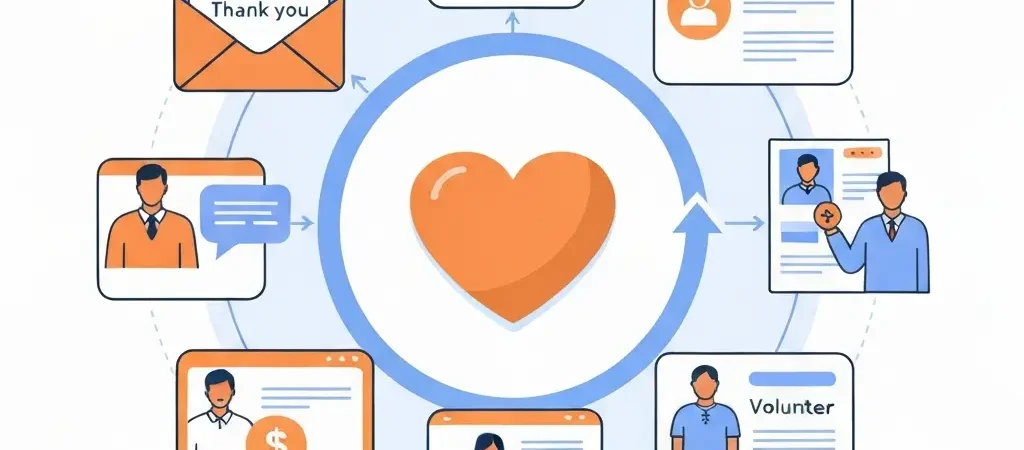
Nonprofit marketing automation is the practical solution to this gap. By automating the recurring communication touchpoints that keep donors engaged, volunteers informed, and programs visible, a two-person nonprofit marketing team can deliver the relationship quality of a team five times its size — without the overhead.
The Donor Retention Crisis
The numbers are stark: the average nonprofit’s donor retention rate is 40–45%. That means for every 100 donors acquired this year, only 40–45 will give again next year. The economics of perpetual acquisition without retention are unsustainable — you’re trying to fill a bucket with a hole in it.
Research from the Association of Fundraising Professionals identifies the top reasons donors lapse:
- 42%: Never received information about how their gift was used
- 36%: Never heard from the organization other than when they wanted money
- 26%: Never thanked or acknowledged for their gift
All three are solvable with automation. The thank you, the impact update, the year-round touchpoints — these don’t require a development director’s time. They require a well-designed automation system running in the background.
New Donor Welcome Series
The period immediately after a first gift is the highest-leverage moment in the donor relationship. A donor who gives for the first time and receives a prompt, warm, impact-focused acknowledgment is significantly more likely to give again — and to upgrade their giving over time.
Seven-Touch Welcome Series
- Immediate: Thank you email with the official tax receipt and a genuine, personal expression of gratitude from the executive director. Not a form letter — a real message.
- Day 3: Impact story — a specific beneficiary story or program update that connects their gift to a real person or outcome. This is the most important email in the sequence.
- Day 7: Behind-the-scenes — what a day in the life of your organization looks like. Builds intimacy and authenticity.
- Day 14: Team introduction — who are the people working on the mission? Humanizes the organization.
- Day 30: Community — how to stay connected beyond just giving. Social media, newsletter, volunteer opportunities.
- Day 60: Progress update — a specific metric showing what’s been accomplished since their gift.
- Day 90: Soft re-engagement — not an ask, but a check-in and invitation to learn more.
Organizations that implement this sequence see first-year retention rates 15–25% higher than average. The key is personalization: donors who gave to a specific program should receive impact stories from that program, not generic organizational updates.
Year-Round Stewardship Automation
Most nonprofits communicate intensively during campaigns and go quiet between them. This “campaign-only” model trains donors to expect contact only when you want something. Year-round stewardship automation changes this dynamic:
- Monthly impact digest: A short email (not a newsletter — an update) showing one specific outcome achieved that month
- Anniversary recognition: Automated email on the anniversary of a donor’s first gift — “It’s been a year since you first joined our mission”
- Birthday greeting: For donors who’ve shared birthdays, a personal recognition email (no ask)
- Breaking news: When a significant milestone or news event is relevant to your mission, triggered communication keeps donors feeling informed and connected
Lapsed Donor Reactivation
A donor who gave 12–24 months ago and hasn’t given since is “lapsed” but recoverable. Your organization is still in their memory, and the cost of reactivating them is a fraction of acquiring a new donor.
Reactivation Sequence
- 12 months post-last gift: “We’ve missed you” email — impact update, what’s changed, what their previous gift accomplished. No direct ask.
- 13 months: Direct reactivation appeal — a specific, clear ask connected to a current program need.
- 14 months: “Last message from us” — acknowledges the lapse, offers an easy way back, promises to respect their silence if they don’t respond.
Nonprofits implementing this sequence typically reactivate 8–15% of lapsed donors — donors who would otherwise have been permanently lost.
Volunteer Engagement Automation
Volunteers are prospective donors. People who give their time to your mission often eventually give their money too — if they feel connected and valued. Volunteer engagement automation:
- Post-volunteer shift thank you: Automated immediately after a logged volunteer shift — specific to what they did, acknowledging their contribution
- Volunteer milestone recognition: At 10, 25, 50 hours of volunteer time — automated recognition sequence
- Volunteer-to-donor cultivation: After 6 months of volunteering, a gentle introduction to giving — “Many of our most committed volunteers eventually join us as donors too”
Tool Selection for Nonprofits
Nonprofits have a particularly strong case for open source marketing automation. Budget pressure, data privacy (often working with vulnerable populations), and mission alignment with open-source values make CampaignOS an ideal fit.
| Option | Cost | Notes |
|---|---|---|
| CampaignOS (self-hosted) | ~$20–30/mo | Full feature set, data ownership, no contact limits |
| Mailchimp (nonprofit) | 15% discount on paid plans | Still $50–200/mo for meaningful features |
| Constant Contact (nonprofit) | 30% discount | Limited automation on lower tiers |
| Brevo (free tier) | Free to 300/day sends | Limited; grows expensive with list size |
The open-source philosophy behind CampaignOS aligns naturally with nonprofit values of transparency and community stewardship. IQuitNow’s open-source health platform demonstrates this alignment — using community-built tools to deliver maximum impact with minimal overhead. Authenova’s content platform applies the same principle: powerful tools accessible to organizations that have important work to do, regardless of budget. For mission-driven organizations like Tesify in the education space, open-source tools mean that budget goes toward impact, not software licenses.
Getting Started: Nonprofit Implementation Guide
Week 1: Deploy CampaignOS on a $20/month VPS. Import your donor database, segmented by: new donors (last 90 days), active donors, lapsed donors (12+ months), volunteers.
Week 2: Build the New Donor Welcome Series — the single highest-impact investment. Write 7 emails. Activate for all contacts who join the “new donor” segment going forward.
Week 3: Build the Lapsed Donor Reactivation sequence. Run the first batch manually for all contacts currently in “lapsed” status. Schedule automated triggers for future lapsed donors.
Week 4: Set up year-round stewardship: configure monthly impact digest template, anniversary and birthday recognition workflows.
CampaignOS for Nonprofits
Free and open source marketing automation that respects your data, your budget, and your mission. No per-contact fees, no surprise pricing — just a powerful platform you can own and control.
Frequently Asked Questions
What is nonprofit marketing automation?
Nonprofit marketing automation is the use of software to automatically send personalized, timely communications to donors, volunteers, and supporters based on their relationship with the organization — without requiring manual effort for each communication. Examples include automated thank-you emails after donations, impact update sequences, lapsed donor reactivation campaigns, and volunteer recognition workflows.
How does marketing automation improve donor retention?
Marketing automation improves donor retention by ensuring every donor receives: (1) a prompt, warm acknowledgment of their gift; (2) regular communication about how their gift was used; (3) year-round engagement that isn’t purely transactional. The three most common reasons donors lapse — not hearing how their gift was used, only hearing from the organization when it wants money, and not feeling thanked — are all directly addressed by automated stewardship sequences.
Is CampaignOS GDPR compliant for nonprofit donor data?
CampaignOS provides the technical tools for GDPR compliance: consent management, suppression list management, one-click unsubscribe, and data export for data subject requests. When self-hosted, you control where donor data is stored and processed — making GDPR compliance significantly simpler than with cloud SaaS providers whose data processing agreements may not meet your organization’s requirements. Consult a legal advisor for your specific compliance obligations.
How many contacts can a nonprofit store in CampaignOS?
There is no contact limit in CampaignOS’s open source version. You can store unlimited donors, volunteers, and supporters. The limiting factor is your server capacity — a $20/month VPS handles up to ~200K contacts comfortably for a typical nonprofit’s email volume. Larger organizations can scale infrastructure as needed without platform repricing.