SaaS Marketing Automation in 2026: The B2B Growth Playbook From Trial to Expansion
SaaS marketing automation is not about sending more emails. It is about engineering the customer journey from first signup to multi-year expansion with precision triggers, behavioral signals, and workflows that surface the right message at exactly the right moment. The stakes are high: AI-native PLG companies that have systematized their automation achieve 56% trial-to-paid conversion at $100M+ ARR, compared to 32% for teams running traditional manual outreach. The difference is not the product — it is the automation infrastructure underneath it.
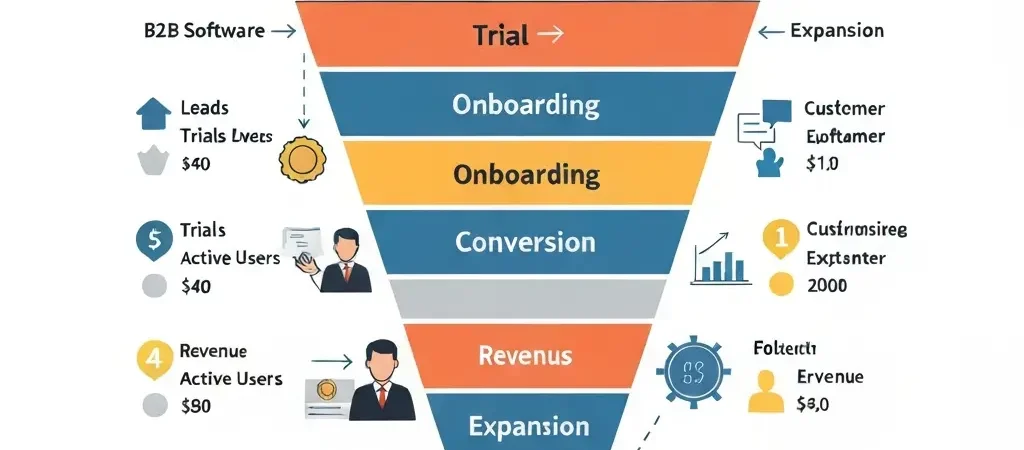
This playbook covers the five stages of SaaS marketing automation that compound on each other: trial onboarding, activation sequencing, churn prediction and intervention, expansion revenue automation, and re-engagement. Each section includes the specific workflows, triggers, and benchmarks your team needs to implement a system that grows revenue without proportionally growing headcount.
Why SaaS Teams Need Marketing Automation in 2026
The economics of SaaS make manual marketing unsustainable at any meaningful scale. Monthly churn rates for SMB-focused SaaS average 3–7%, which means a company with $1M ARR is losing $30,000–$70,000 every month just to attrition. Net revenue retention (NRR) is the metric that determines whether a SaaS business compounds — or stagnates. The 2026 median NRR for B2B SaaS sits at 106%, but top performers exceed 130%, largely because they’ve automated the expansion and retention workflows that most teams run manually or not at all.
The trial funnel is equally unforgiving. PLG companies convert about 2.5% of website visitors to trials. Of those trials, the average conversion to paid hovers between 18–25% — but AI-powered personalization lifts that number by approximately 25%. Over a year, the compounding effect of a 5-point improvement in trial-to-paid conversion can add hundreds of thousands in ARR for a mid-stage SaaS company.
Marketing automation creates the infrastructure for these improvements. See our broader analysis of whether marketing automation increases revenue for the full data picture across industries.
Stage 1: Trial Onboarding and Activation
Trial onboarding is the single highest-leverage automation in SaaS. The window between signup and activation — reaching the “aha moment” where users experience core product value — is typically 24–72 hours. Users who don’t activate within the first week rarely convert. Your onboarding sequence must accelerate this activation window with urgency, guidance, and social proof.
The 7-Email Trial Onboarding Sequence
| Timing | Purpose | Key CTA | |
|---|---|---|---|
| Welcome | Immediate | Confirm signup, set expectations | Complete setup step 1 |
| Day 1 — Activation nudge | 24 hours (if no activation) | Drive first key action | Complete [core feature] |
| Day 3 — Social proof | 72 hours | Reduce anxiety, build trust | Read case study |
| Day 5 — Feature spotlight | Day 5 | Deepen product adoption | Try [feature] |
| Day 7 — Halfway check-in | Day 7 | Surface friction, offer help | Reply with questions |
| Day 10 — ROI preview | Day 10 | Pre-sell the upgrade | See pricing |
| Day 13 — Trial expiry | Day 13 (1 day before) | Urgency + conversion | Upgrade now |
Critical: branch this sequence based on activation status. Users who have completed your core activation step receive different emails than those who haven’t. Non-activators get more hand-holding and lower-friction CTAs (video walkthroughs, live demo invitations). Activators get feature-depth and social proof to accelerate conversion. This branching alone typically lifts conversion rates by 8–12 percentage points.
Stage 2: Trial-to-Paid Conversion
The trial-to-paid window is the most commercially important automation trigger in SaaS. At Day 12–13 of a 14-day trial, high-intent users are making a buying decision. Your automation needs to be present, persuasive, and low-friction at this exact moment.
Effective trial conversion automation uses three levers simultaneously:
- Email: Expiry countdown with clear upgrade path and pricing. Address the most common objections (contracts, cancellation, implementation time).
- In-app notification: Banner or modal on login during Days 12–14 with upgrade CTA. Personalized with the user’s usage data (“You’ve sent 47 campaigns in 14 days — don’t lose your progress”).
- Sales touchpoint (for high-usage trials): Automated alert to your sales team when a trial user exceeds a usage threshold. High-usage trials close at 2–3x the rate of average trials when a human follows up within 24 hours.
For companies without a sales team, the in-app + email combination with personalized usage data is the gold standard. Marketing automation makes this personalization scalable — a single workflow handles hundreds of simultaneous trials with individualized data pulled from product usage APIs.
Stage 3: Churn Prevention and Early Warning
Churn prevention automation is most effective when it acts on leading indicators rather than lagging ones. By the time a customer cancels, the decision was made weeks earlier. The signals that predict churn are behavioral: login frequency dropping, feature usage declining, support tickets increasing, NPS scores falling.
Building a Churn Prediction Workflow
- Define your health score: Combine login frequency (last 14 days), feature usage breadth, and support sentiment into a numerical score (0–100).
- Set alert thresholds: Health score drop of 20+ points in 14 days triggers the intervention sequence.
- Layer the intervention: Email with personalized check-in → no response in 3 days → SMS → no response in 5 days → automated CSM notification for high-ARR accounts.
- Measure and iterate: Track intervention-to-churn rate. The goal is to reduce churn rate per intervention cohort by 25%+ over baseline.
B2B SaaS annual churn of 3.5% (2.6% voluntary + 0.9% involuntary) sounds manageable, but at $1M ARR it represents $35,000 leaving every year. Reducing that by 25% through automation saves $8,750 in ARR per cycle — far exceeding the cost of the automation platform. For involuntary churn specifically (failed payments), an automated payment retry and dunning sequence typically recovers 0.4–0.8% of ARR annually.
Stage 4: Expansion Revenue Automation
Expansion revenue — upsells, cross-sells, and seat additions — is where best-in-class SaaS companies generate NRR above 110%. The median B2B SaaS NRR of 106% in 2026 means the average company grows existing customer revenue by 6% annually without any new acquisition spend. Top performers exceeding 130% NRR grow their existing customer base faster than they churn it.
Expansion automation triggers on product usage milestones:
- Usage approaching plan limits (e.g., 80% of contact limit reached) → upgrade prompt
- Features used heavily that are only available on higher tiers → contextual upgrade email
- Team size growth detected (new user invitations) → team plan promotion
- Annual renewal window (60, 30, 14 days before renewal) → annual pre-payment discount offer
The expansion sequence differs fundamentally from acquisition: these users already trust your product. The messaging focuses on ROI unlocked, not product education. A well-timed expansion email to a user consistently hitting their workflow limit has a 12–18% conversion rate — far exceeding cold acquisition sequences.
Stage 5: Re-Engagement and Win-Back
Users who haven’t logged in for 21+ days and free users who never converted are both targets for automated re-engagement. The win-back window is typically 90 days post-cancellation for paid accounts — after that, the probability of recovery drops below 5%.
A three-touch win-back sequence for cancelled accounts:
- Day 7 post-cancellation: “Did we get something wrong?” Survey with 3 options. Each option routes to a different follow-up.
- Day 21: Product update — what’s new since they left. Lead with the features or fixes most relevant to their cancellation reason (if captured).
- Day 60: Special return offer. A limited-time discount or extended trial to re-activate the account.
Win-back campaigns for SaaS average 5–15% recovery rates. For a company with 20 cancellations per month and $100 ARPU, recovering even 10% means $200 in monthly recovered revenue — which compounds significantly at scale. Pair this with data from our marketing automation statistics to benchmark your own performance.
SaaS Automation Metrics and Benchmarks 2026
| Metric | Industry Average | Top Quartile | Automation Lift |
|---|---|---|---|
| Trial-to-paid conversion | 18–25% | 40–56% (PLG+AI) | +25% |
| Monthly churn (SMB) | 3–7% | 1–2% | –25% with intervention |
| Net Revenue Retention | 106% (median) | 130%+ | Expansion automation |
| Win-back rate (cancelled) | 5–10% | 15% | 3-touch sequence |
| Onboarding email open rate | 42–55% | 65%+ | Personalization |
Choosing the Right Platform for SaaS
SaaS marketing automation has specific requirements that not all platforms meet: webhook-based triggers from product usage data, behavioral branching logic, multi-channel delivery (email + push + SMS + in-app), and deep integration with your CRM and product database. Most enterprise platforms (HubSpot, Marketo, Pardot) check these boxes but cost $800–$3,000/month before any integration work.
For early-stage and growth-stage SaaS companies, open-source alternatives provide professional-grade automation at a fraction of the cost. Self-hosted marketing automation gives SaaS teams full control over data pipelines, webhook handling, and multi-channel delivery without per-contact pricing that penalizes growth.
Key evaluation criteria for SaaS use cases:
- Webhook support for product event triggers (essential)
- Branching workflow logic based on contact properties
- Multi-channel delivery: email, SMS, push notification
- API access for custom data sync
- No per-contact pricing (critical at scale)
Compare the full landscape in our marketing automation platform comparison.
How CampaignOS Handles the Full SaaS Funnel
CampaignOS is an open-source marketing automation platform built on Next.js, with a visual workflow builder, multi-channel delivery (email, SMS, push, WhatsApp, Telegram), and webhook-based trigger support. It is deployable on Vercel and self-hostable for teams that need full data control.
For SaaS automation specifically, CampaignOS handles:
- Inbound webhooks from your product to trigger workflows on signup, activation, usage milestones, and cancellation events
- Behavioral branching: different email sequences for activated vs. non-activated trials
- Multi-channel delivery: trial emails + push notifications + SMS for high-value conversion moments
- n8n integration for complex data transformations between your product database and contact properties
There are no contact limits, no per-email fees, and no monthly SaaS subscription. For a growing SaaS company with 10,000 trial contacts per month, this saves $500–$2,000/month compared to equivalent enterprise automation platforms. Start free at app.campaignos.site.
Frequently Asked Questions
What is SaaS marketing automation?
SaaS marketing automation uses behavior-triggered workflows to communicate with prospects and customers based on their product usage, trial status, and lifecycle stage. This includes automated trial onboarding sequences, churn prevention interventions triggered by declining usage, expansion revenue emails when users approach plan limits, and win-back campaigns for cancelled accounts. Unlike general email marketing, SaaS automation connects directly to product event data via webhooks to make workflows fully responsive to user behavior.
What is a good trial-to-paid conversion rate for SaaS in 2026?
The industry average trial-to-paid conversion rate in 2026 is 18–25%, varying by vertical (CRM: 29%, HR: 22.7%, cybersecurity: 21.9%, enterprise: 18.6%). AI-native PLG companies with systematized automation achieve 40–56% conversion at scale. A well-structured 7-email onboarding sequence with behavioral branching typically lifts conversion by 8–12 percentage points above a flat sequence.
How do you reduce SaaS churn with marketing automation?
SaaS churn reduction automation works on leading indicators: login frequency drops, feature usage declines, and support ticket sentiment. Build a customer health score that combines these signals. When the score drops by a threshold (e.g., 20 points in 14 days), trigger an automated intervention sequence — a personalized check-in email, followed by an SMS if no response, followed by an automated alert to a CSM for high-ARR accounts. This approach reduces voluntary churn by 20–25% compared to reactive cancellation-only workflows.
What is net revenue retention (NRR) and how does automation affect it?
Net revenue retention measures the percentage of recurring revenue retained from existing customers, including expansion (upsells/cross-sells) minus churn and contraction. The 2026 median NRR for B2B SaaS is 106%. Marketing automation improves NRR by reducing churn through early intervention workflows and increasing expansion revenue through usage-triggered upsell sequences. Companies that systematize both achieve NRR of 115–130%+, meaning existing customer revenue compounds without additional acquisition spend.
What marketing automation platform is best for SaaS?
The best marketing automation platform for SaaS depends on team size and budget. Enterprise teams with $1M+ ARR and a sales team benefit from HubSpot or Marketo’s CRM integration. Early-stage and growth-stage SaaS teams get better ROI from open-source platforms like CampaignOS, which provides webhook-based product event triggers, visual workflow automation, multi-channel delivery, and no per-contact fees. This keeps automation costs flat as the contact list grows — critical when a SaaS company is scaling trials aggressively.