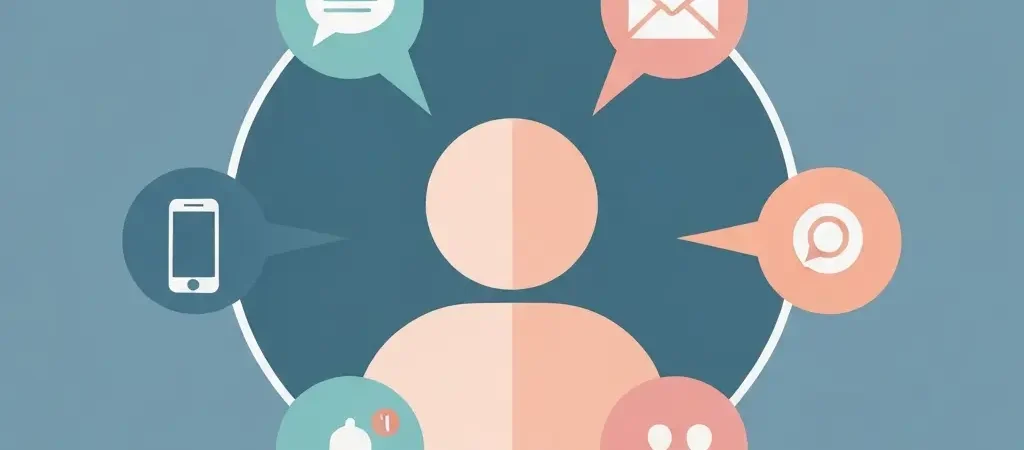
What Is a Customer Engagement Platform?
A customer engagement platform (CEP) is software that orchestrates real-time, personalized interactions across every customer touchpoint — email, SMS, push notifications, in-app messaging, and web — from a unified data layer. Unlike a CRM (which records what has happened) or standalone marketing automation (which executes pre-planned campaigns), a CEP responds dynamically to customer behavior as it happens, delivering relevant experiences throughout the entire customer lifecycle.
What exactly is a customer engagement platform?
A customer engagement platform is the operational layer that sits between a business’s data (behavioral, transactional, demographic) and every customer-facing communication channel. It ingests data from multiple sources — website activity, app events, purchase history, support tickets — builds a unified customer profile, and uses that profile to determine what message to send, on which channel, and at what moment.
The defining characteristic of a CEP is real-time responsiveness. Traditional marketing tools run scheduled campaigns. A CEP runs behavior-driven campaigns: a customer opens the mobile app for the first time and immediately receives an onboarding message; a customer whose usage has dropped below a retention threshold receives a re-engagement offer before they churn; a customer who just made their fifth purchase receives a loyalty upgrade notification within seconds of completing the transaction.
The concept emerged from the recognition that customers interact with businesses across many channels simultaneously and expect coherent experiences across all of them. A customer who contacts support via chat and later opens a marketing email should not receive a promotional offer on a product they already complained about. A CEP maintains the context of every interaction and coordinates communications accordingly — a capability that no single-channel tool can replicate.
What features does a customer engagement platform include?
Customer engagement platforms share a core feature set, though depth and implementation vary significantly across vendors. The table below identifies the essential capabilities and what each delivers:
| Feature | What it does |
|---|---|
| Unified customer profiles | Merges behavioral, transactional, and demographic data into a single contact record updated in real time |
| Omnichannel orchestration | Manages email, SMS, push notifications, in-app messages, and web personalization from one workflow engine |
| Behavioral segmentation | Creates dynamic audience groups based on actions taken (or not taken) — updated automatically as behavior changes |
| Event-triggered automation | Sends messages in response to specific customer actions — app opens, purchases, feature activations, support resolutions |
| Personalization engine | Dynamically inserts relevant content, product recommendations, and offers based on individual customer context |
| Journey mapping | Visual tools for designing multi-step, multi-channel customer experiences with conditional branching |
| Analytics and attribution | Measures engagement, conversion, and retention across all channels with attribution modeling |
| A/B and multivariate testing | Tests message variants, send times, and channel combinations to optimize engagement automatically |
How is a customer engagement platform different from a CRM?
A CRM is a record-keeping system for sales and account management. It stores what has happened in each customer relationship: calls logged, deals closed, support cases resolved. Its primary users are sales reps and account managers who manage individual relationships manually. CRM automation is typically limited to reminders and task assignments.
A customer engagement platform is an execution engine for marketing and customer success. It does not just record what happened — it determines and executes what should happen next for every customer in real time. Its primary users are marketing teams and customer success teams managing thousands or millions of customers simultaneously. The automation is behavioral and event-driven, not reminder-based.
The practical difference: when a customer has been inactive for 30 days, the CRM might generate a task for the account manager to call them. The CEP automatically sends a re-engagement email with personalized content based on what the customer previously engaged with, no human action required. For a full breakdown of CRM vs marketing automation (the closest related comparison), see What Is the Difference Between CRM and Marketing Automation?
How is a customer engagement platform different from marketing automation?
Marketing automation primarily focuses on the acquisition funnel — generating leads, nurturing prospects, and handing them off to sales. Customer engagement platforms extend this capability across the entire customer lifecycle, including post-purchase: onboarding, adoption, retention, loyalty, and re-engagement. A CEP treats every interaction as an opportunity for engagement, not just pre-sale marketing touchpoints.
The data architecture is also different. Marketing automation platforms typically track campaign engagement (email opens, clicks, form submissions). Customer engagement platforms track every product interaction — in-app events, feature usage, session frequency, support interactions — giving a far richer picture of actual customer behavior.
CEPs also have stronger real-time execution requirements. A marketing automation platform sending a nurture email can tolerate a few hours’ delay. A CEP sending an onboarding message when a customer first logs into a product needs to fire within seconds. This real-time requirement drives the underlying technical architecture of true customer engagement platforms. For a full explanation of marketing automation fundamentals, see What Is Marketing Automation and How Does It Work?
What are real-world examples of customer engagement platform results?
Documented outcomes from customer engagement platform deployments demonstrate consistent patterns across industries. Five Below, a US retail chain, unified customer data across email, mobile, and web using a customer engagement platform. Automated, personalized campaigns delivered a 22% lift in digital sales, with their abandoned cart email achieving a 41% open rate and 21% conversion rate from click to purchase (Braze, 2024).
Ent Credit Union deployed a CEP to unify member data and build cross-channel journeys. Audience segmentation time dropped from two weeks to minutes, enabling the lean marketing team to launch campaigns faster. The result: a 32% increase in member engagement and a 259% lift in campaign conversions (Braze, 2024).
These results are consistent with broader data: companies using behavioral automation report 77% higher conversion rates compared to broadcast campaigns, and 76% see positive ROI within the first year of deployment. The performance gap between segmented, behavior-triggered messaging and generic batch-and-blast campaigns continues to widen as AI optimization becomes standard in CEP platforms.
Who needs a customer engagement platform?
Businesses that benefit most from a customer engagement platform share three characteristics: a customer base large enough that manual 1:1 communication is impossible, a multi-channel presence where customers interact through more than one touchpoint, and a product or service with a meaningful post-purchase lifecycle (subscription, repeat purchase, or ongoing usage).
SaaS companies are a primary use case: their customers sign up, onboard, use the product daily, and may churn — all without ever speaking to a human. A CEP automates every stage of this lifecycle with relevant, timely communications. E-commerce companies use CEPs for the full purchase cycle: browse abandonment, cart abandonment, post-purchase follow-up, and replenishment reminders. Media companies use them for content recommendation and re-engagement of lapsed subscribers.
Small businesses and startups benefit too, though simpler platforms often suffice. A company with 5,000 contacts and a single product can capture most of the value of a CEP with a modern marketing automation platform that includes post-purchase automation and behavior-triggered messaging — without the cost and complexity of enterprise CEP solutions. See Is Marketing Automation Worth It for Small Business? for the ROI analysis.
How does CampaignOS function as a customer engagement platform?
CampaignOS provides the core capabilities of a customer engagement platform — unified contact profiles, behavioral segmentation, multi-channel automation, and real-time event triggers — in a platform accessible to businesses of any size. The visual workflow builder supports full lifecycle automation from lead capture through post-purchase retention.
CampaignOS tracks contact behavior across email, web, and integrated third-party data sources. Dynamic segments update automatically as behavioral data changes. Workflows can trigger on any event — form submission, email click, page visit, webhook from an external system — enabling the real-time responsiveness that defines customer engagement platforms. For omnichannel capabilities specifically, see What Is Omnichannel Marketing Automation?
CampaignOS is free to start and designed to scale. It provides an accessible entry point for small and mid-sized businesses implementing customer engagement for the first time, and the depth of automation capability to serve growing teams without requiring platform migration as contact volume and workflow complexity increase. Learn more and compare at Authenova’s Guide to Choosing a Marketing Automation Platform.
Frequently Asked Questions
What is the simplest definition of a customer engagement platform?
A customer engagement platform is software that manages how a business communicates with customers across every channel and lifecycle stage — from first contact through purchase, onboarding, and retention. It uses real-time behavioral data to trigger personalized messages at the right moment, ensuring that every customer interaction is relevant and consistent regardless of which channel it occurs on.
What are examples of customer engagement platforms?
Well-known customer engagement platforms include Braze, Salesforce Marketing Cloud, HubSpot, Intercom, Klaviyo (e-commerce focused), Iterable, and CampaignOS. These platforms differ in their primary use case: Braze and Iterable focus on mobile-first and in-app engagement; Klaviyo specializes in e-commerce; HubSpot spans marketing, sales, and service. CampaignOS provides full-lifecycle engagement automation accessible to businesses without enterprise budgets.
How does a customer engagement platform use behavioral data?
A customer engagement platform collects behavioral events — page visits, app sessions, feature usage, purchase completions — and uses them to update customer profiles in real time. These updated profiles drive segmentation (grouping customers by behavior pattern) and workflow triggers (sending a specific message when a behavior occurs). For example, a customer who views a pricing page three times in one week is identified by the platform as high-intent and automatically enters a decision-stage nurture sequence.
What is the difference between a customer engagement platform and a CDP?
A Customer Data Platform (CDP) is a data management system that collects, unifies, and stores customer data from all sources into persistent profiles — but it does not send messages or execute campaigns. A customer engagement platform uses that unified data to execute communications. The two are complementary: many businesses feed data from a CDP into a customer engagement platform for campaign execution. Some modern platforms (Segment, Twilio) combine CDP and engagement capabilities in one product.
What channels does a customer engagement platform manage?
Customer engagement platforms manage email, SMS, mobile push notifications, in-app messages, web push notifications, and in some cases WhatsApp and social media direct messages. The defining capability is orchestration across these channels from a single workflow — so a customer does not receive the same message on three channels simultaneously, and the platform can choose the optimal channel for each customer based on their engagement history.
How much does a customer engagement platform cost?
Pricing for customer engagement platforms varies widely. Enterprise platforms like Braze and Salesforce Marketing Cloud typically cost $60,000–$300,000+ per year. Mid-market platforms like Iterable and Klaviyo range from $500–$5,000/month based on contact volume. CampaignOS is free to start and scales affordably with contact database size, making CEP-level automation accessible for small and mid-sized businesses without enterprise budget requirements.
What is omnichannel customer engagement?
Omnichannel customer engagement means delivering consistent, coordinated customer experiences across every channel — email, mobile, web, in-app, and support — from a unified customer data layer. The customer experiences a single, coherent conversation with the brand regardless of which channel they use, because every channel has access to the same behavioral and interaction history. This is the core value proposition of a customer engagement platform. For more detail, see What Is Omnichannel Marketing Automation?
How does a customer engagement platform reduce churn?
Customer engagement platforms reduce churn by identifying at-risk customers early and triggering retention interventions before they cancel. Risk signals include declining usage frequency, missed renewal milestones, and low engagement with product features. When a customer matches a churn-risk pattern, the platform automatically triggers a retention sequence — a check-in email, a product tips campaign, a discount offer — without waiting for a human to notice the risk. This automated, timely intervention significantly outperforms manual retention processes.
What is customer lifecycle marketing?
Customer lifecycle marketing is the practice of tailoring marketing communications to the stage a customer is at in their relationship with a business: awareness, consideration, purchase, onboarding, adoption, retention, and advocacy. A customer engagement platform makes lifecycle marketing executable at scale by automatically moving customers between lifecycle stages based on their behavior and triggering the appropriate communication for each stage.
Can a small business use a customer engagement platform?
Yes. While enterprise CEPs like Braze are designed for large-scale deployments, modern marketing automation platforms like CampaignOS deliver the core value of customer engagement — behavioral segmentation, event-triggered automation, and multi-channel orchestration — at a price point and complexity level accessible to small businesses. A small business does not need a $100,000/year enterprise contract to implement abandoned cart automation, post-purchase sequences, and churn prevention workflows.
Deliver Consistent Customer Engagement with CampaignOS
CampaignOS provides unified customer profiles, behavioral segmentation, and multi-channel automation to orchestrate every stage of the customer lifecycle — from first touch to long-term retention. Free to start, no credit card required.