What Is the Difference Between CRM and Marketing Automation?
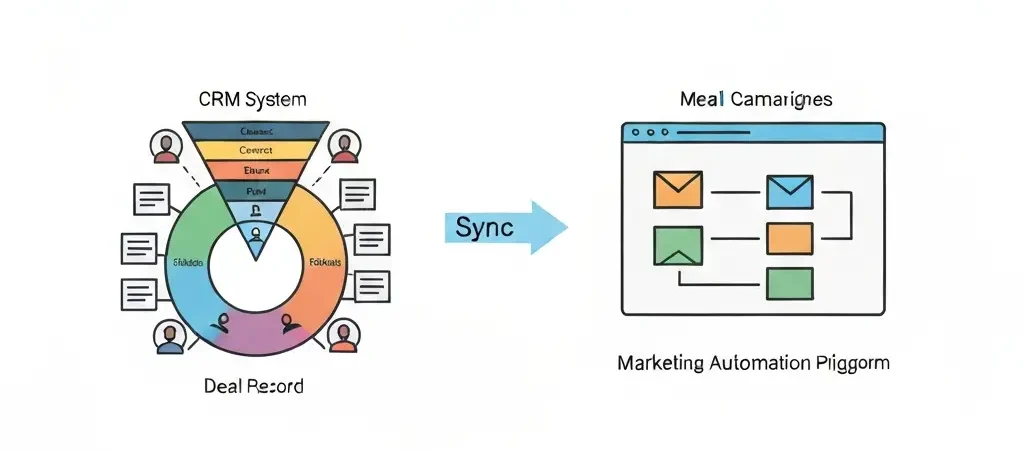
A CRM (Customer Relationship Management system) manages existing customer and prospect relationships — it is the system of record for sales teams tracking deals, contacts, calls, and pipeline stages. Marketing automation manages campaign execution, lead nurturing, and behavioral messaging for marketing teams. The two tools operate on different parts of the buyer journey and serve different users, but they are most powerful when integrated.
What does a CRM do?
A CRM is a database and workflow tool that organizes all information about your customers and prospects in one place. Core CRM functions include: contact and account management, deal and pipeline tracking, activity logging (calls, meetings, emails), task assignment, and customer support ticketing. CRM data answers the question: what is the current state of every relationship the company has?
CRMs are built around the sales rep’s workflow. When a salesperson makes a call, they log notes in the CRM. When a deal progresses from “proposal sent” to “negotiation,” they update the pipeline stage. When a contract is signed, the CRM marks the deal as closed-won and notifies the account management team. The CRM is the authoritative record of what has happened in each customer relationship.
Popular CRM platforms include Salesforce, HubSpot CRM, Zoho CRM, Pipedrive, and Microsoft Dynamics 365. Most modern CRMs include some light marketing functionality — like basic email sequences — but these features are designed to help sales reps follow up with warm leads, not to run full-scale marketing campaigns to cold audiences.
What does marketing automation do?
Marketing automation is a campaign execution engine. It collects behavioral data from every digital touchpoint — website visits, email interactions, ad clicks, content downloads — and uses that data to deliver the right message to the right person at the right time without manual intervention. Marketing automation answers the question: how do we scale personalized outreach to thousands of prospects simultaneously?
Core marketing automation functions include: email nurture sequences, behavioral segmentation, lead scoring, A/B testing, landing page management, multi-channel campaign execution, and marketing analytics. These are tools designed for marketers managing large audiences — not sales reps managing individual relationships.
Marketing automation operates at the top and middle of the funnel. It captures leads, educates them through automated sequences, scores them based on engagement, and hands them off to sales once they meet a qualification threshold. For a full explanation of how these workflows function, see What Is Marketing Automation and How Does It Work?
What are the key differences between CRM and marketing automation?
The table below maps the functional differences between CRM and marketing automation across six critical dimensions:
| Dimension | CRM | Marketing Automation |
|---|---|---|
| Primary user | Sales reps, account managers | Marketing teams, campaign managers |
| Funnel stage | Bottom of funnel (qualified leads → closed deals) | Top and middle of funnel (awareness → lead qualification) |
| Core data | Contact records, deal stages, call logs | Behavioral data, engagement scores, campaign metrics |
| Automation type | Task reminders, follow-up alerts | Multi-step nurture workflows, behavioral triggers |
| Scale | Hundreds to thousands of contacts managed individually | Tens of thousands to millions of contacts |
| Output | Closed deals, renewal tracking, customer retention | Marketing qualified leads (MQLs) handed to sales |
Where do CRM and marketing automation overlap?
CRM and marketing automation overlap in three areas: contact data management, email functionality, and sales handoff processes. Both systems store contact records, though CRM records are richer in relationship history while marketing automation records are richer in behavioral data. Both can send emails, though CRM emails are typically 1:1 sales outreach while marketing automation emails are scaled campaign messages.
The sales handoff is the key integration point. Marketing automation scores leads and, when they cross a threshold, passes them to the CRM with a full behavioral history — what content they consumed, what pages they visited, what emails they opened. The sales rep in the CRM can see this history and immediately understand where the prospect is in their decision process without making a cold call.
Some platforms deliberately blur the line. HubSpot markets itself as a combined CRM and marketing automation platform. Salesforce offers both Salesforce CRM and Salesforce Marketing Cloud as separate (and separately priced) products. CampaignOS functions as a standalone marketing automation platform that integrates with major CRMs via native connectors and webhooks.
Do you need both CRM and marketing automation?
Most B2B businesses with a sales team and an active lead generation program need both. The two systems solve fundamentally different problems: marketing automation scales lead generation; CRM manages the conversion of those leads into revenue. Using only a CRM means your marketing team is sending manual emails and maintaining spreadsheets. Using only marketing automation means your sales team has no system to manage qualified leads after handoff.
B2C businesses with high transaction volume and no traditional sales team (e-commerce, subscription apps) often need marketing automation far more than a traditional CRM, because their “sales process” is fully automated. A customer who abandoned a cart does not need a sales rep to call them — they need an automated email with a well-timed discount.
Small businesses starting out can often begin with marketing automation alone and add CRM capabilities as their sales team grows. Platforms like CampaignOS include contact management features that serve basic CRM needs until a dedicated CRM is warranted. For a detailed ROI analysis of automation for small businesses, see Is Marketing Automation Worth It for Small Business?
How do CRM and marketing automation integrate?
CRM and marketing automation integration works through bidirectional data sync. The marketing automation platform sends lead data (behavioral scores, engagement history, contact details) to the CRM when a lead reaches sales-ready status. The CRM sends deal outcome data back to marketing automation so campaigns can suppress active deals and trigger post-sale onboarding sequences.
Native integrations are available between most major platforms: CampaignOS integrates with Salesforce, HubSpot, Zoho CRM, and Pipedrive. Custom integrations use webhooks or API connections. The most important data points to sync are lead score, last activity date, campaign source, and lifecycle stage — these give the sales rep the context they need to have a relevant first conversation.
A clean integration eliminates the most common sales-marketing friction: leads falling through the cracks between systems, sales receiving leads without context, and marketing not knowing which leads actually converted. Well-integrated CRM and marketing automation creates a closed-loop system where marketing attribution is visible all the way to closed revenue.
How does CampaignOS relate to CRM?
CampaignOS is a marketing automation platform, not a CRM. It manages the campaign and nurture side of the funnel: behavioral segmentation, automated email sequences, lead scoring, and multi-channel campaign execution. CampaignOS includes contact management features sufficient for marketing-centric use cases, but it is designed to complement, not replace, a dedicated CRM.
For teams using Salesforce, HubSpot, or Pipedrive, CampaignOS syncs lead data bidirectionally through native integrations. Marketing qualified leads are pushed to the CRM with full engagement context. Post-deal data from the CRM flows back into CampaignOS to suppress active customers from lead nurture sequences and trigger customer onboarding workflows instead. CampaignOS is free to start and scales with your contact volume. See how it compares to other platforms in the CampaignOS vs ActiveCampaign comparison and the CampaignOS vs Brevo comparison.
Frequently Asked Questions
Can a CRM replace marketing automation?
No. Most CRMs include basic email functionality — typically 1:1 sequences for sales outreach — but they cannot execute the behavioral trigger campaigns, audience segmentation, and multi-channel automation that marketing automation platforms handle. A CRM manages relationships with known contacts. Marketing automation converts unknown visitors into known contacts and nurtures them until they are sales-ready. The two tools have fundamentally different architectures and purposes.
Can marketing automation replace a CRM?
Marketing automation cannot replace a CRM for sales pipeline management. Marketing automation lacks deal stage tracking, sales activity logging, forecasting, and the 1:1 relationship management tools that sales teams need. Some marketing automation platforms include light CRM features (CampaignOS, HubSpot), but businesses with an active sales team managing multiple deals in parallel need a dedicated CRM.
What is a marketing qualified lead (MQL)?
A marketing qualified lead (MQL) is a contact that marketing automation has determined is likely to become a customer based on their behavior and engagement — typically defined by reaching a specific lead score threshold. When a lead becomes an MQL, they are handed off to the sales team and entered into the CRM for active follow-up. The MQL definition is a joint agreement between marketing and sales teams and is configured in the lead scoring rules of the marketing automation platform.
Which comes first, CRM or marketing automation?
For most businesses, marketing automation should come first — because its job is to generate and qualify the leads that then need to be managed in a CRM. Many companies start with a CRM because it serves the immediate sales need, then add marketing automation as the marketing team grows and needs to scale lead generation. The ideal sequence is to deploy both simultaneously so the handoff process is built correctly from the start.
What is a combined CRM and marketing automation platform?
A combined CRM and marketing automation platform provides both capabilities in a single product. HubSpot is the most well-known example, offering CRM (free) alongside paid marketing, sales, and service hubs. Salesforce offers both Salesforce CRM and Salesforce Marketing Cloud, though they are separate products with separate pricing. Combined platforms reduce integration complexity but may sacrifice depth in one or both capabilities compared to best-in-class standalone tools.
How does marketing automation improve CRM data quality?
Marketing automation enriches CRM records with behavioral context that sales reps cannot collect manually. When a lead is passed from marketing automation to CRM, the record includes a complete history: which emails they opened, which pages they visited, what content they downloaded, and their current lead score. This context allows sales reps to personalize their outreach and prioritize follow-up based on actual buying signals rather than just demographic data.
Is Salesforce a CRM or marketing automation?
Salesforce is primarily a CRM. It also offers Salesforce Marketing Cloud (formerly ExactTarget) as a separate marketing automation platform, and Salesforce Account Engagement (formerly Pardot) as a B2B marketing automation product. These are distinct products with distinct pricing. Using “Salesforce” often means using only the CRM component; full marketing automation requires purchasing a separate Salesforce product.
What is the cost difference between CRM and marketing automation?
Both categories range from free to enterprise pricing. Free CRM options include HubSpot CRM, Zoho CRM Free Edition, and Bitrix24. Free marketing automation options include CampaignOS and Mautic (self-hosted). Paid CRM pricing typically ranges from $15–$300/user/month. Paid marketing automation pricing typically ranges from $50–$5,000+/month based on contact volume. The total cost for a business deploying both can range from $0 (using free tiers) to over $10,000/month for enterprise deployments.
What is the difference between CRM and customer engagement platform?
A CRM focuses on managing sales relationships and pipeline. A customer engagement platform (CEP) focuses on delivering cross-channel customer experiences — combining marketing automation, customer support, and personalization in one system. CEPs are designed for businesses where the customer experience after the sale is as important as the acquisition process. See our dedicated guide at What Is a Customer Engagement Platform? for a full comparison.
Add Marketing Automation to Your Stack with CampaignOS
CampaignOS integrates with your existing CRM to complete the full funnel. Generate leads, score and nurture them with automated sequences, and pass them to sales with full behavioral context — all free to start.