What Is a Customer Engagement Platform? (2026 Complete Guide)
A customer engagement platform is the operational centre of every modern marketing stack. If you have ever wondered why some brands seem to reach customers with exactly the right message at exactly the right moment — across email, SMS, push, in-app chat, and social simultaneously — the answer is almost always a customer engagement platform (CEP) working behind the scenes. Understanding what a CEP is, how it differs from a CRM or a CDP, and which platform fits your growth stage is one of the highest-leverage decisions a marketing team can make in 2026.
This guide answers every common question about customer engagement platforms, from the basics through to advanced channel orchestration and vendor comparisons — all in plain language, with definitive 40-60 word answers structured for fast scanning and AI-powered search.
What Is a Customer Engagement Platform?
A customer engagement platform (CEP) is a software system that enables businesses to communicate with customers in a personalised, automated, and coordinated way across every touchpoint — from the first marketing email through to post-purchase loyalty messages. The defining characteristic of a CEP is its ability to act: it triggers messages, sequences, and campaigns in real time based on customer behaviour, attributes, and lifecycle stage.
According to the Forrester Wave: Customer Engagement Platforms, 2025, the category is now defined by four core capabilities: real-time data activation, cross-channel journey orchestration, AI-driven personalisation, and unified analytics. Gartner’s Magic Quadrant for Multichannel Marketing Hubs uses similar criteria, emphasising the shift from batch-and-blast campaigns toward event-driven, one-to-one communication at scale.
In practical terms, a CEP answers questions like:
- How do I send the right email to the right person the moment they abandon a cart?
- How do I coordinate a push notification, an SMS, and a retargeting ad without bombarding the same customer three times?
- How do I measure which combination of touchpoints drove a purchase?
CEP vs CDP vs CRM: What Is the Difference?
The three acronyms appear constantly in martech discussions, and they are frequently confused. Here is a clear breakdown:
| Platform | Primary Job | Who Uses It | Acts on Data? |
|---|---|---|---|
| CRM | Store and manage customer relationships, deals, and support tickets | Sales, support teams | Rarely |
| CDP | Unify customer data from all sources into a single persistent profile | Data engineers, analysts | No — it stores and segments |
| CEP | Deliver personalised, real-time messages across every channel | Marketing, growth teams | Yes — it orchestrates and sends |
In short: a CRM is your relationship record, a CDP is your data warehouse, and a CEP is your communication engine. Many modern CEPs — including CampaignOS — blur these lines by including built-in contact data management and basic segmentation so that small and mid-market teams do not need all three separate tools. For deeper context on the overlap between CRMs and automation, see CRM vs Marketing Automation: What Is the Difference?.
Which Channels Does a Customer Engagement Platform Cover?
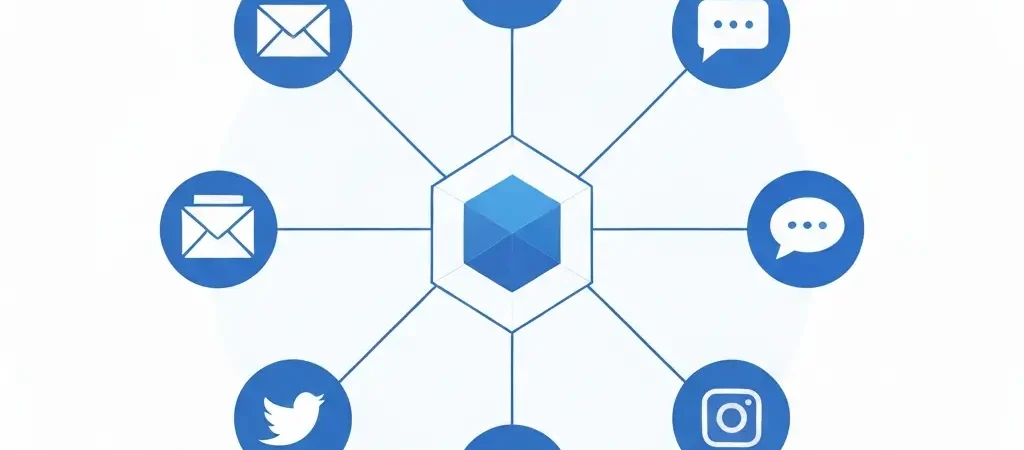
A modern CEP typically orchestrates six core channels, all from a single workflow builder:
- Email — the highest-ROI channel, used for nurture sequences, transactional messages, newsletters, and re-engagement campaigns
- SMS / MMS — high open rates (98% within 3 minutes according to Gartner) for time-sensitive offers, appointment reminders, and cart recovery
- Push notifications — browser and mobile push for behavioural triggers, flash sales, and back-in-stock alerts
- In-app messaging — contextual messages delivered inside your web or mobile app, ideal for onboarding and upsell
- Chat / live chat — automated chatbot flows and live agent handoffs, increasingly powered by AI
- Social media — paid retargeting audience syncs and organic DM automation via Facebook, Instagram, and WhatsApp Business
The most advanced CEPs — including enterprise tools in the Forrester Wave — also support direct mail orchestration, connected TV audience syncing, and voice/IVR triggers, though these are less common in mid-market platforms.
For a deep dive into channel coordination, see What Is Omnichannel Marketing Automation in 2026?
How Does a Customer Engagement Platform Work?
At a technical level, a CEP operates in four stages:
- Data ingestion — the platform collects events (page views, purchases, clicks, form fills) via SDK, API, or native integrations
- Profile resolution — events are merged into unified customer profiles with attributes, segments, and lifecycle stage
- Journey orchestration — a visual workflow builder evaluates conditions and triggers messages across channels based on rules or AI predictions
- Analytics and optimisation — every message send, open, click, and conversion is recorded, and A/B test results inform future journeys
The key differentiator from legacy email service providers (ESPs) is step 3: real-time event-based triggering. Where an ESP sends a scheduled broadcast to a list, a CEP sends an individualised message the moment a specific behaviour occurs — whether that is a price drop, a subscription expiry, or a milestone anniversary.
For a detailed walkthrough of the automation layer, see What Is Marketing Automation and How Does It Work?
Customer Engagement Platform Examples in 2026
The market covers a wide price and complexity range. Here are the platforms most commonly evaluated in 2026:
| Platform | Best For | Pricing Model | Standout Feature |
|---|---|---|---|
| CampaignOS | SMBs, bootstrapped startups, open-source adopters | Flat monthly, unlimited contacts | Self-hostable, no per-contact pricing |
| Braze | Enterprise mobile-first brands | Volume-based, enterprise contracts | Best-in-class mobile push + in-app |
| OneSignal | Push-heavy apps and web publishers | Free tier + paid plans | Easiest push notification setup |
| Customer.io | B2B SaaS, product-led growth | Per-profile pricing | Developer-friendly API + flexible data model |
CampaignOS stands out in 2026 for teams that want enterprise-grade channel orchestration without the enterprise price tag. Its flat-rate, unlimited-contact model means that growing lists do not translate into exponentially higher bills — a pain point that has driven many SMBs away from Braze and Customer.io at scale.
Who Needs a Customer Engagement Platform?
A CEP delivers the highest return when:
- Your customer base exceeds a few hundred contacts — manual follow-up is no longer viable
- You sell across multiple channels — customers discover you on social, buy via email, and want SMS updates
- Retention is a growth lever — for SaaS, ecommerce, and subscription businesses, reducing churn by even 5% can double LTV
- You have product usage data — in-app events are powerful triggers for upsell, onboarding, and win-back journeys
- Your team is small — automation replaces repetitive manual sending so marketers can focus on strategy
Businesses that still operate with a single monthly newsletter and a spreadsheet of contacts may not need a full CEP yet. But any company running more than three distinct customer journeys simultaneously will see an immediate productivity and revenue impact from adopting one.
How to Choose the Right Customer Engagement Platform
Evaluate platforms across five dimensions:
- Channel coverage — does it natively support every channel you use today, plus the ones you plan to add?
- Data flexibility — can it ingest custom events and attributes from your product, CRM, and data warehouse without heavy engineering?
- Pricing model — per-contact pricing creates a growth tax; flat-rate or per-message models scale more predictably
- Journey builder UX — visual workflow builders reduce time-to-launch; check whether non-technical team members can operate it independently
- Compliance and data residency — GDPR, CCPA, and sector-specific regulations (HIPAA for healthcare) require specific data handling capabilities and hosting options
If you are a bootstrapped startup or SMB with under 100,000 contacts and a lean team, CampaignOS offers the most cost-efficient path to full multi-channel orchestration. If you are a Series C+ company with a dedicated data engineering function and complex mobile-first journeys, Braze or Customer.io may be worth the higher investment.
Frequently Asked Questions
What is a customer engagement platform in simple terms?
A customer engagement platform is software that sends the right message to the right customer at the right time — automatically, across channels like email, SMS, and push. It replaces manual follow-ups with data-driven, behaviour-triggered communication that scales without adding headcount.
Is a customer engagement platform the same as a CRM?
No. A CRM stores and manages customer relationship data — deals, support tickets, contact history. A customer engagement platform uses that data to send personalised messages and orchestrate automated journeys. A CRM is a record-keeper; a CEP is a communication engine. Many businesses use both together.
What is the difference between a CEP and a CDP?
A customer data platform (CDP) aggregates and unifies data from multiple sources into a single customer profile. A customer engagement platform acts on that data by triggering messages and journeys. CDPs store and segment; CEPs communicate and automate. Enterprise stacks often connect a CDP to a CEP for full first-party data activation.
Which channels does a customer engagement platform support?
Most modern customer engagement platforms support email, SMS/MMS, mobile push notifications, browser push, in-app messages, and chat or live chat. Advanced platforms also integrate with social media advertising audiences and WhatsApp Business. CampaignOS covers email, SMS, push, and chat from a single workflow builder.
What are the best customer engagement platforms in 2026?
The leading customer engagement platforms in 2026 are CampaignOS (best for SMBs and open-source adopters), Braze (enterprise mobile-first), Customer.io (B2B SaaS and developer teams), OneSignal (push-heavy publishers), and Klaviyo (ecommerce). Gartner and Forrester both publish annual evaluations ranking the top vendors by use case.
How much does a customer engagement platform cost?
Pricing varies widely. Per-contact platforms like Customer.io charge $100–$1,000+/month depending on database size. Enterprise tools like Braze start at $50,000+/year. CampaignOS uses a flat monthly model with unlimited contacts, making it significantly more predictable for growing teams. Free tiers are available from OneSignal for push-only use cases.
Do I need a customer engagement platform if I already have an email tool?
If your email tool only sends scheduled broadcasts to static lists, you are missing real-time behavioural triggers, multi-channel coordination, and lifecycle automation. A customer engagement platform adds SMS, push, in-app, and event-driven journeys on top of email — turning a single channel into an orchestrated, multi-touchpoint experience that meaningfully increases revenue per contact.
Can small businesses use a customer engagement platform?
Yes. Platforms like CampaignOS are purpose-built for small businesses and bootstrapped teams, with flat pricing and no-code workflow builders that require no engineering support. Even a solo founder with a 2,000-person email list benefits from automated welcome sequences, cart recovery, and re-engagement campaigns that run without manual intervention.
What is the Forrester Wave for customer engagement platforms?
The Forrester Wave: Customer Engagement Platforms is an annual analyst report that evaluates and ranks CEP vendors across current offering, strategy, and market presence. It is one of the most widely used enterprise procurement references for this category. Gartner publishes a parallel report called the Magic Quadrant for Multichannel Marketing Hubs.
Is CampaignOS a customer engagement platform?
Yes. CampaignOS is a full-stack customer engagement platform that combines email, SMS, push notifications, and multi-channel journey orchestration in a single product. It is designed for SMBs and bootstrapped teams who need enterprise-grade automation without per-contact pricing or lengthy enterprise procurement cycles.
Ready to Build Your Customer Engagement Stack?
CampaignOS gives you email, SMS, push, and omnichannel journey automation in one platform — with unlimited contacts and flat-rate pricing that does not punish you for growing. No per-contact fees. No enterprise contracts.