What Is Omnichannel Marketing Automation?
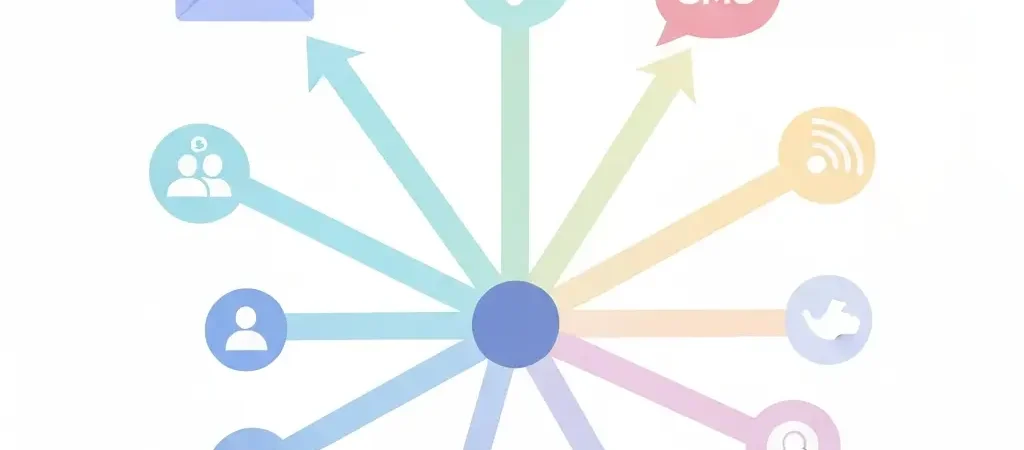
Omnichannel marketing automation is the practice of orchestrating customer communications across email, SMS, push notifications, social media, and web — from a single platform — using behavioral triggers to deliver the right message on the right channel at the right moment. Unlike multichannel marketing, which simply operates on multiple channels, omnichannel automation unifies all channels so that each interaction informs the next, regardless of where it happens. Companies with effective omnichannel automation strategies see approximately 179% faster revenue growth than those running single-channel campaigns (SAP Emarsys, 2025).
How does omnichannel differ from multichannel marketing automation?
Multichannel marketing means being present on multiple channels. Omnichannel marketing means those channels share data and react to each other in real time. The distinction is critical for automation.
In a multichannel setup, your email sequence runs independently from your SMS campaigns. A contact who clicks an email link does not automatically suppress a redundant SMS. Campaigns overlap, messages contradict each other, and the customer experience fragments.
In an omnichannel setup, a contact’s action on any channel immediately updates their profile and can trigger or suppress activity on every other channel. A purchase on your e-commerce site halts the promotional email sequence and initiates a post-purchase onboarding flow — automatically, across whichever channels the customer uses.
| Dimension | Multichannel Automation | Omnichannel Automation |
|---|---|---|
| Data sharing | Siloed per channel | Unified contact profile |
| Trigger scope | Within one channel | Cross-channel behavior |
| Customer experience | Fragmented | Seamless and consistent |
| Message suppression | Manual or absent | Automatic based on behavior |
| Revenue impact | Moderate | 179% faster growth (Emarsys) |
How does omnichannel marketing automation actually work?
Omnichannel automation operates through four components working in sequence: a unified data layer, behavioral triggers, workflow logic, and channel delivery.
Unified data layer. Every channel feeds contact data — page visits, email opens, SMS clicks, purchase events, support tickets — into a single contact record. This unified profile is the foundation. Without it, cross-channel triggers are impossible.
Behavioral triggers. A trigger is any defined event: form submission, page view, purchase, cart abandonment, inactivity threshold, or lead score change. When a trigger fires, the automation engine evaluates what action to take next — on which channel, for which segment.
Workflow logic. If/then branching determines the path. A contact who opens the welcome email follows path A; one who ignores it for 48 hours follows path B (an SMS nudge). Logic nodes can include time delays, A/B splits, goal conditions, and channel-preference rules derived from prior engagement.
Channel delivery. The workflow dispatches messages through whichever channels are connected: email, SMS, web push, in-app messaging, social retargeting, or direct mail APIs. Each delivery updates the contact record, closing the feedback loop for the next trigger.
Which channels does omnichannel automation connect?
A fully connected omnichannel automation stack in 2026 typically includes six channel types. B2B buyers now use 10 or more channels during their purchase journey (McKinsey, 2024), which means incomplete channel coverage creates friction at the moments that matter most.
- Email. The highest-ROI channel — automated emails generate 320% more revenue than non-automated emails (Campaign Monitor, 2025). The anchor of most workflows.
- SMS. 98% open rate within three minutes. Used for time-sensitive triggers: abandoned cart recoveries, appointment reminders, flash sale alerts.
- Web push notifications. Reach contacts on desktop or mobile browser without an app install. Effective for re-engagement and real-time alerts.
- In-app messaging. For SaaS and mobile products, in-app messages deliver onboarding prompts, feature announcements, and upsell nudges at the moment of use.
- Social media retargeting. Behavioral data from automation flows syncs with Facebook and Google ad audiences, ensuring ad spend focuses on contacts at specific funnel stages.
- Direct mail APIs. Triggered physical postcards or packages for high-value prospects or churn-risk customers — an increasingly differentiated tactic in a digital-saturated market.
What are the measurable benefits of omnichannel automation?
The data on omnichannel marketing automation benefits is consistent across multiple sources and years. These are not projections — they are documented outcomes from companies that have implemented coordinated cross-channel strategies.
- 90% higher customer retention rate compared to single-channel automation (Omnisend, 2025).
- 179% faster revenue growth for companies with effective omnichannel strategies vs. those without (SAP Emarsys, 2025).
- 2.5x increase in marketing ROI when companies use unified data across channels vs. siloed data (Salesforce, 2025).
- 89% customer retention with good omnichannel experiences, vs. 33% without (Aberdeen Group).
- 35% reduction in customer acquisition cost when automation coordinates paid and owned channels on a shared data layer.
The retention improvement is the most significant long-term driver. A 5% increase in customer retention increases profit by 25–95% (Bain & Company). Omnichannel automation compounds retention gains because every touchpoint reinforces the prior one — contacts are not just receiving messages, they are experiencing a consistent brand relationship.
What are real-world omnichannel automation use cases?
The following workflows illustrate how omnichannel triggers and channel coordination operate in practice.
E-commerce abandoned cart recovery. Cart abandonment email fires at 1 hour. If unopened at 24 hours, SMS fires with urgency copy. If clicked but not converted, retargeting ad activates in Facebook Ads for 7 days. If purchased at any stage, all channels suppress and a post-purchase SMS with care instructions fires instead.
SaaS trial-to-paid conversion. Trial signup triggers a 14-day onboarding email sequence. Days 7 and 10: in-app messages surface specific features the user has not yet activated. Day 12: if no upgrade, a personal-tone email from the founder sends. Day 14: if still free, SMS fires. Day 15: if still unconverted, contact moves to a long-term nurture list and retargeting activates.
B2B lead nurturing. Content download triggers a 6-email educational series over 30 days. If lead score crosses 50 (based on email engagement + page visits), an alert fires to the sales team via CRM webhook and a personalized email from a sales rep deploys. If no sales activity in 14 days, contact re-enters the nurture sequence at a new stage.
What does a business need to run omnichannel automation?
Three technical requirements and one strategic requirement must be in place before omnichannel automation produces results.
Unified contact database. All channel interactions must write to and read from the same contact record. If your email platform and your SMS tool store separate contact lists with no sync, omnichannel is not possible — it is just multichannel with extra steps.
Event tracking. Website behavior, email engagement, and purchase events must all feed into the contact profile via tracking pixels, API calls, or native integrations. Without behavioral data, triggers cannot fire accurately.
Visual workflow builder. Complex cross-channel journeys require a builder that can represent branching logic, time delays, channel switches, and goal conditions in a single view. Spreadsheet-planned workflows at scale become unmanageable without tooling.
Clear customer journey mapping. Technology is not the bottleneck for most teams — strategy is. Before building automations, map the 3–5 most important customer journeys: new subscriber, trial user, first purchaser, repeat buyer, and at-risk churn. Automate the highest-value touchpoints in each journey first.
How does CampaignOS enable omnichannel marketing automation?
CampaignOS is a marketing automation platform built for teams that need omnichannel coordination without enterprise-level complexity or pricing. It provides a unified contact database, visual workflow builder, and native channel integrations — email, SMS, push notifications, and CRM webhooks — from a single interface.
For businesses researching omnichannel marketing automation, CampaignOS offers a free tier that covers the core functionality: contact segmentation, behavioral triggers, multi-step automations, and campaign analytics. Unlike platforms that lock cross-channel features behind premium tiers, CampaignOS makes omnichannel workflows available from day one.
Learn more at app.campaignos.site or explore related reading: Multi-Channel Marketing Platform: How to Choose and Build the Right Stack in 2026 and What Is Marketing Automation and How Does It Work? (2026 Guide).
Frequently Asked Questions
What is the difference between omnichannel and multichannel marketing automation?
Multichannel means operating on multiple channels independently. Omnichannel means those channels share a unified contact database and trigger each other based on real-time behavior. A customer action on one channel immediately affects what happens on every other channel in an omnichannel system.
Does omnichannel marketing automation require a large budget?
No. Platforms like CampaignOS offer omnichannel automation on free and low-cost tiers. The primary investment is time — mapping customer journeys and building workflows. Most small businesses can implement a functional omnichannel system for email + SMS + push within 2–4 weeks.
How many channels should a small business automate?
Start with two: email and one other channel where your audience is most active (SMS for e-commerce, in-app for SaaS). Nail the data integration and trigger logic on two channels before adding a third. Adding channels without a unified data layer creates multichannel, not omnichannel.
What triggers are most effective in omnichannel workflows?
Behavioral triggers consistently outperform time-based triggers. The highest-performing triggers are: cart abandonment (average 15% recovery rate), post-purchase (highest engagement window), inactivity thresholds (re-engagement), and lead score changes (sales handoff). Trigger accuracy depends on clean event tracking data.
What retention rate improvement can omnichannel automation deliver?
Companies using omnichannel automation see a 90% higher customer retention rate compared to single-channel approaches, according to Omnisend’s 2025 research. The mechanism is consistency — contacts receive coherent messaging across all touchpoints rather than contradictory or repetitive messages from disconnected tools.
Is omnichannel marketing automation GDPR-compliant?
It can be, but compliance depends on implementation. GDPR requires a lawful basis for processing on each channel independently. An omnichannel platform must support per-channel consent tracking so that SMS consent is stored separately from email consent. Platforms that unify contact data without granular consent records create compliance risk, not less.
How long does it take to see results from omnichannel automation?
Most businesses see measurable improvement in email open rates and click-through rates within the first 30 days of launching behavioral triggers. Revenue impact from retention improvements typically becomes visible at 90 days. Full omnichannel ROI — including the compounding effect of unified data on paid channel efficiency — is typically measurable at 6 months.
Can omnichannel automation work for B2B companies?
Yes. B2B omnichannel automation typically coordinates email, LinkedIn retargeting, CRM webhooks, and in-app messaging. B2B buyers use 10 or more channels during a purchase decision (McKinsey, 2024). Omnichannel automation ensures your brand is present and coherent at each touchpoint — a critical advantage in long-cycle B2B sales.
What is the revenue impact of omnichannel vs. single-channel automation?
Companies with effective omnichannel strategies see 179% faster revenue growth than companies without them, according to SAP Emarsys (2025). The revenue driver is two-sided: higher conversion rates from coordinated messaging, and higher retention rates that extend customer lifetime value on both sides of the customer journey.
CampaignOS connects email, SMS, push notifications, and CRM data into unified workflows — free to start, no credit card required. Launch your first omnichannel workflow today.
For deeper context on building cross-channel marketing stacks, see Is Marketing Automation Worth It for Small Business in 2026? and What Is the Difference Between CRM and Marketing Automation? (2026).
For AI-powered content marketing automation insights that complement your omnichannel strategy, see Best AI Tools for Content Marketing Automation in 2026 on Authenova.