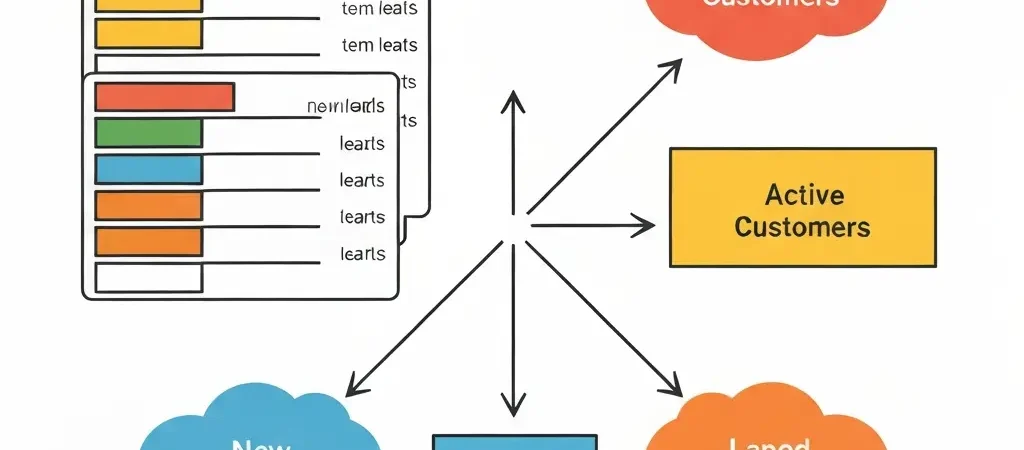
Audience Segmentation Tool: Building Targeted Campaigns That Convert in 2026
Generic marketing is expensive marketing. When you send the same email to everyone on your list — from first-time visitors to loyal five-year customers — you pay full price for a campaign that’s relevant to maybe 20% of recipients. The other 80% see a message that doesn’t apply to them, and they either ignore it or, worse, unsubscribe. An audience segmentation tool changes the economics entirely: instead of paying to blast and then hoping, you pay to send precisely, to exactly the right people, with exactly the right message.
The data is unambiguous. Segmented email campaigns generate 760% more revenue than non-segmented campaigns. Click-through rates are 100% higher on segmented sends. And in 2026, with AI-powered dynamic segmentation, the segments update automatically as behavior changes — no manual list management required.
This guide covers the segmentation models that actually move conversion metrics, how to build dynamic audiences that update in real time, and how to implement audience segmentation in CampaignOS.
Why Audience Segmentation Is Your Highest-Leverage Tactic
Most marketing teams treat segmentation as an advanced tactic to implement after they’ve mastered the basics. This gets the priority exactly backwards. Segmentation is foundational — it’s the prerequisite for every other tactic to work correctly. A welcome sequence that doesn’t differentiate between B2B and B2C leads, or between small businesses and enterprises, will underperform a segmented version by a factor of 2–4x.
The case for starting with segmentation is practical: your contact list is already heterogeneous. The people on it have different jobs, different buying stages, different problems. Sending them identical content isn’t neutral — it’s a deliberate choice to ignore those differences, and that choice has measurable revenue consequences.
The 5 Segmentation Models That Drive Results
1. Lifecycle Stage Segmentation
The most universally applicable segmentation model divides contacts by where they are in their relationship with your brand: new leads, active prospects, first-time buyers, repeat customers, loyal customers, and lapsed customers. Each stage deserves different content, frequency, and messaging. A loyal customer sent a “here’s 20% off your first purchase” email feels ignored. A lapsed customer sent a “here’s what’s new” update might re-engage.
2. Purchase Behavior Segmentation
For ecommerce and subscription businesses, purchase history is the most predictive data you have. Segment by: total orders, order frequency, average order value, last product category, and last purchase date. A customer who buys in the “outdoor gear” category exclusively should receive outdoor gear promotions — not kitchenware.
3. Engagement Level Segmentation
Segment by email engagement: highly engaged (opened 3+ emails in last 30 days), moderately engaged (opened 1–2 in last 90 days), at-risk (no open in 90+ days). Send your best content to highly engaged segments, re-engagement sequences to at-risk, and nothing (or sunset) to unengaged contacts older than 180 days.
4. Demographic Segmentation
Job title, company size, industry, and geography drive relevance for B2B campaigns. A “marketing director at a 50-person SaaS company” needs different content than a “solo founder at a 2-person startup.” Demographic segments are most valuable when combined with behavioral data — an engaged marketing director is a more useful segment than all marketing directors.
5. Source / Acquisition Channel Segmentation
Contacts who found you through a specific landing page, lead magnet, or campaign have revealed something about their interest and pain point. Maintain the original source tag and use it to personalize nurture sequences — a contact who downloaded a “productivity tips” guide is in a different headspace than one who downloaded a “team management” template.
Dynamic Segments: The 2026 Standard
Static segments require manual updates — you define the segment once and add or remove people by hand. Dynamic segments update automatically when a contact meets or stops meeting the segment criteria. In 2026, dynamic segmentation is the standard because it’s the only approach that scales without creating manual workload.
Example dynamic segment: “Contacts in US, job title contains ‘marketing’, lead score above 40, last email open in last 30 days.” This segment updates in real time. When a contact’s lead score drops below 40, they leave automatically. When a new contact in the US marketing role reaches 40 points, they enter automatically. CampaignOS’s audience segmentation tool supports dynamic segments with real-time updates.
RFM Model: Segmenting by Recency, Frequency, Monetary
The RFM (Recency, Frequency, Monetary) model is the gold standard for ecommerce segmentation and works well for any business with transactional history. Each contact gets a score on three dimensions:
| Dimension | What It Measures | Campaign Implication |
|---|---|---|
| Recency (R) | How recently they purchased | High R = upsell window open |
| Frequency (F) | How often they purchase | High F = VIP treatment |
| Monetary (M) | How much they spend | High M = protect with retention focus |
High-R, High-F, High-M contacts are your champions — treat them as VIPs. Low-R, Low-F, Low-M contacts are at-risk churners — send a reactivation sequence before they lapse entirely. Medium-R, Low-F contacts are “promising” — they like you but haven’t committed to repeat buying yet. Target with a loyalty incentive.
Behavioral Segmentation: What People Do Beats Who They Are
Demographics tell you who someone is. Behavior tells you what they want right now. Behavioral segmentation is the most powerful form because it’s forward-looking — someone browsing pricing pages is showing purchase intent regardless of their job title.
Key behavioral segments to build: pricing page visitors (high intent — trigger sales follow-up), feature page visitors (evaluating a specific use case — send relevant case study), blog readers only (awareness stage — send lead magnet offer), trial users (product-qualified — send activation nudge), and churned users (send win-back campaign). For each of these, the segment membership is dynamic and the triggered message is immediate.
Designing Campaigns for Each Segment
Segmentation only delivers ROI when the campaign content is actually different for each segment. Many teams go to the effort of segmenting but then send nearly identical content to each segment with a different subject line. True segmentation means different angles, different use cases, different proof points.
| Segment | Campaign Angle | CTA |
|---|---|---|
| New leads | Problem/solution framing | Download guide / start trial |
| Active prospects | Social proof + ROI data | Book a demo / upgrade |
| First-time buyers | Onboarding + success tips | Leave review / refer friend |
| VIP customers | Exclusive access + appreciation | Early access / upsell |
| At-risk customers | Re-engagement + value reminder | Come back discount |
Case Study: B2C Subscription Box — 47% Revenue Lift
Before: Single monthly newsletter to the entire list. 18% open rate, 2.3% CTR.
After: CampaignOS RFM segments — champions, loyal, at-risk, and lapsed — each with a different campaign theme. Champions received early access to new boxes. At-risk received “what’s inside next month” preview. Lapsed received a win-back with a free first box offer.
Result: Overall revenue up 47% in 90 days. Lapsed customer reactivation recovered $31,000 in annual subscription value. Open rates increased from 18% to 34% across all segments.
For the lead scoring that works in tandem with audience segments to route leads to sales, see lead scoring software guide. For how segmentation powers ecommerce automation workflows, see the ecommerce marketing automation playbook. For content automation that generates the SEO traffic filling your segments, Authenova’s WordPress SEO automation guide is a complementary resource.
Frequently Asked Questions
What is an audience segmentation tool?
An audience segmentation tool lets you divide your contact list into groups based on shared attributes (demographics, behavior, purchase history) and then send targeted messages to each group. Modern tools like CampaignOS support dynamic segmentation — segments that update automatically as contact behavior changes, without manual list management.
How many audience segments should I create?
Start with 4–6 core segments covering lifecycle stage (new, active, lapsed) and engagement level (high, medium, low). Add more segments only when you have the content to actually differentiate them — there’s no benefit to creating 20 segments if 18 receive the same campaign. Quality of differentiation matters more than quantity of segments.
What’s the difference between static and dynamic audience segments?
Static segments are lists you manually curate and update. Dynamic segments update automatically based on defined rules — when a contact meets the criteria, they enter; when they no longer meet it, they exit. Dynamic segments are the 2026 standard because they require no manual maintenance and ensure every contact is always in the correct segment based on their current behavior.
What’s the RFM model and how does it help with segmentation?
RFM stands for Recency, Frequency, and Monetary value. It scores customers on three dimensions: how recently they bought, how often they buy, and how much they spend. High scores across all three identify your best customers (champions). Low scores identify at-risk or lapsed customers. RFM is the most widely validated segmentation model for businesses with transactional customer data.
How much does audience segmentation improve email performance?
Segmented email campaigns generate 760% more revenue than non-segmented campaigns. Click-through rates are approximately 100% higher on segmented sends. Open rates improve 20–40% when segments are well-defined and content is genuinely differentiated. The performance gap is largest at the extremes — highly engaged VIP segments vs. re-engagement campaigns for lapsed contacts.
Build Smarter Audience Segments with CampaignOS
CampaignOS’s audience segmentation tool lets you create dynamic segments, automate targeted campaigns, and track revenue by segment — all on a free plan.