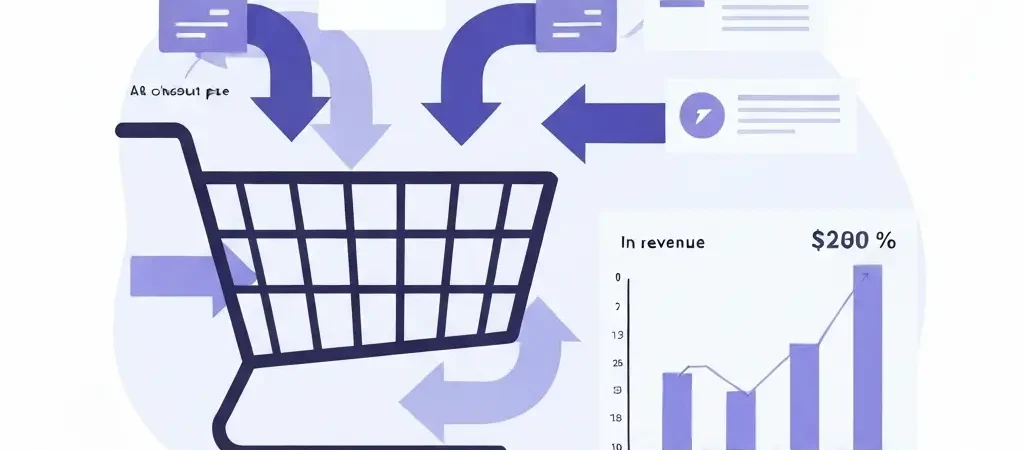
Marketing Automation for Ecommerce: The Revenue Playbook for 2026
Seventy percent of online shoppers who add items to their cart abandon it before purchasing. On mobile, that number climbs to 85%. For an ecommerce store doing $500K in annual revenue, that’s potentially $350K walking out the door every year — and most of it is recoverable. Marketing automation for ecommerce is the mechanism that brings those customers back, turns first-time buyers into repeat customers, and compounds revenue without adding headcount.
In 2026, ecommerce automation has matured well beyond the basic “forgot something in your cart?” email. The best stores run multi-channel sequences across email, SMS, and push notifications that adapt to individual customer behavior, segment by purchase history, and personalize by product category. The result? Companies using automated messages report 52% better open rates, 332% higher click rates, and 2,361% improved conversion rates compared to standard batch campaigns.
This playbook covers every major ecommerce automation workflow — the mechanics, the copy angles, the timing, and the revenue impact — with specific CampaignOS setup guidance for each.
Abandoned Cart Recovery: The $260 Billion Opportunity
The Baymard Institute estimates $260 billion in annual revenue is recoverable through better checkout and follow-up processes. Abandoned cart automation is the most direct path to capturing that revenue. A well-structured 3-message sequence — sent at 1 hour, 24 hours, and 72 hours — converts an average of 10.7% of abandoned carts back into purchases.
The 3-Message Abandoned Cart Sequence
Critical rules: never lead with a discount (it trains customers to abandon intentionally), always show the actual product image, and include one-click cart restoration. With CampaignOS, you can trigger this sequence on cart abandonment events via webhook integration with your ecommerce platform.
SMS Abandoned Cart: Higher Urgency, Higher Conversion
SMS messages have a 98% open rate and are read within 90 seconds. Adding an SMS touch to your abandoned cart sequence — a short message with a direct link to the cart — lifts overall recovery rates by 5–10 percentage points. CampaignOS handles both email and SMS from the same automation workflow, so you can coordinate timing without managing separate platforms.
Browse Abandonment: Capturing Pre-Cart Intent
Most visitors browse product pages without adding anything to their cart. These are warmer leads than cold traffic but cooler than cart abandoners — and they’re almost universally ignored. A browse abandonment trigger fires when a contact views a product page but doesn’t add to cart within 30 minutes.
The browse abandonment email should feel like a helpful recommendation, not surveillance. “Thinking about [product name]? Here’s what other customers said” converts at 3–5% — modest compared to cart recovery, but applied across all product page visitors, it adds up to meaningful incremental revenue. Keep it to a single email with zero pressure.
Welcome Series: Converting First Visitors into Buyers
The welcome series is your highest-leverage long-term investment. New subscribers are 5x more likely to engage than existing subscribers. A 4-email welcome series for an ecommerce brand typically runs over 14 days:
- Email 1 (immediate): Welcome + your brand story + best-sellers. This is where you set the tone and explain why someone should buy from you specifically.
- Email 2 (day 3): Social proof showcase. Customer photos, reviews, UGC. Let your customers make the case for you.
- Email 3 (day 7): Category or product spotlight based on signup source or initial browse behavior. This is where segmentation pays off — someone who signed up via a “summer sale” popup should see summer products.
- Email 4 (day 14): First-time buyer offer. A modest discount (10–15%) or free shipping to convert the hesitant. This email alone typically generates 40–60% of the welcome series’ total revenue.
Post-Purchase Automation: Turning One-Time Buyers into Loyalists
Acquiring a new customer costs 5–7x more than retaining an existing one. Post-purchase automation is how you protect that acquisition investment. The window between first and second purchase is critical — customers who make a second purchase within 90 days have a dramatically higher lifetime value.
The Post-Purchase Sequence Architecture
| Timing | Message Type | Goal | Avg. Conversion |
|---|---|---|---|
| Immediate | Order confirmation + thank you | Trust + expectation setting | N/A (transactional) |
| Day 3–5 | Product usage tips | Reduce returns, build confidence | Reduces returns 8% |
| Day 10–14 | Review request | Social proof generation | 15–25% review rate |
| Day 21–30 | Cross-sell recommendation | Second purchase | 8–15% purchase rate |
| Day 45 | Referral ask | Word-of-mouth acquisition | 3–5% referral rate |
Win-Back Campaigns: Reactivating Lapsed Customers
A customer who bought 6–12 months ago but hasn’t returned is a win-back candidate. These contacts are dramatically cheaper to reactivate than acquiring new customers. A 3-message win-back sequence converts 10–15% of lapsed customers and cleans your list of truly disengaged contacts (improving overall deliverability).
Win-back sequence structure: (1) “We miss you” with a reminder of what you offer, (2) your best new products since they last bought, (3) a final offer with a time-limited discount. Contacts who don’t engage with all three should be suppressed from future campaigns to protect deliverability scores.
VIP Segmentation and Loyalty Automation
Your top 20% of customers typically generate 80% of revenue. Identifying and automating VIP treatment for these contacts is one of the highest-leverage moves in ecommerce automation. Set a threshold — for example, customers with 3+ orders or $500+ lifetime value — and automatically add them to a VIP segment.
VIP automation touchpoints include: early access to new product launches (triggers before public release), exclusive discount tier (automatically applied via personalization), birthday campaigns, and a personal note from the founder or brand team at anniversary milestones. VIP customers report 60% higher satisfaction scores and refer 3x more new customers than standard segments.
For the audience segmentation mechanics behind these workflows, see our audience segmentation tool guide. For lead scoring to prioritize your highest-value customers, see lead scoring software guide.
Case Study: DTC Brand — 28% Revenue Increase in 90 Days
Challenge: High cart abandonment (74%), no post-purchase sequence, and a flat repeat purchase rate of 18%.
Solution: CampaignOS with abandoned cart (3-email + SMS), post-purchase 5-step sequence, and win-back campaign for 6-month lapsed customers.
Result: 28% revenue increase in 90 days. Cart recovery rate improved from 0% (no automation) to 13.4%. Repeat purchase rate increased from 18% to 29%.
The brand’s most surprising finding: their SMS abandoned cart message outperformed their email sequence by nearly 40% on conversion rate. “We didn’t expect SMS to work that well for skincare,” the founder noted. “But the recovery rate on that first SMS within an hour was almost 22%. It’s now the core of our cart recovery strategy.” CampaignOS’s unified workflow let them coordinate email and SMS timing without overlap or double-messaging.
Multi-Channel Strategy: Email + SMS + Push
Single-channel ecommerce automation leaves revenue on the table. Customers engage on different channels at different times, and a customer who ignores an email might convert on a push notification. The key is coordination — not sending the same message three times, but designing channel-specific messages that work together.
| Channel | Best Use Case | Avg. Open Rate | Best Timing |
|---|---|---|---|
| Nurture, promotions, reviews | 20–25% | Morning / early afternoon | |
| SMS | Urgent recovery, flash sales | 98% | Within 1 hour of trigger |
| Push | Back-in-stock, price drops | 7–15% | Afternoon / evening |
For push notification strategy in depth, see push notification marketing guide. For managing multi-channel contact data, see our contact management software guide.
Frequently Asked Questions
What is the best marketing automation for ecommerce?
The best ecommerce marketing automation platform depends on your store size and channel needs. CampaignOS is ideal for stores that want multi-channel automation (email, SMS, push) in a single free platform. It handles abandoned cart, post-purchase, and win-back workflows with visual workflow builders and audience segmentation built in.
What percentage of abandoned carts can be recovered with automation?
A well-structured 3-message abandoned cart sequence (email + optional SMS) recovers an average of 10–15% of abandoned carts. The first message sent within 1 hour has the highest conversion rate at 20.3%. Top-performing stores with multi-channel sequences recover 15–30% of abandoned carts.
Should I offer a discount in abandoned cart emails?
No — not in the first email. Leading with a discount trains customers to abandon intentionally to receive deals. Use the first 1–2 messages as simple reminders with social proof. Reserve a discount (10–15%) for the third message only if the customer hasn’t converted, and make it time-limited.
How does ecommerce marketing automation integrate with Shopify?
Most platforms integrate via webhook or native app connection. CampaignOS connects to Shopify and other ecommerce platforms via webhooks, receiving cart abandonment events, purchase confirmations, and customer data updates in real time. This triggers the relevant automation workflows automatically without any manual steps.
How many emails should be in an abandoned cart sequence?
Three emails is the standard best practice: one at 1 hour (urgency + cart reminder), one at 24 hours (social proof), and one at 72 hours (urgency + optional offer). Adding a fourth email beyond 72 hours typically shows diminishing returns and higher unsubscribe rates. For SMS, one message at the 1-hour mark is usually sufficient.
What’s the average ROI of ecommerce marketing automation?
Ecommerce businesses using marketing automation report an average revenue increase of 15–28% within 90 days of implementing core workflows. Companies see an average return of $5.44 per $1 spent on automation. For email specifically, the ROI is $36–$40 per dollar spent, making it one of the highest-return marketing channels available.
Start Recovering Revenue Today
CampaignOS gives ecommerce stores abandoned cart recovery, post-purchase sequences, SMS, push notifications, and audience segmentation — all free to start.