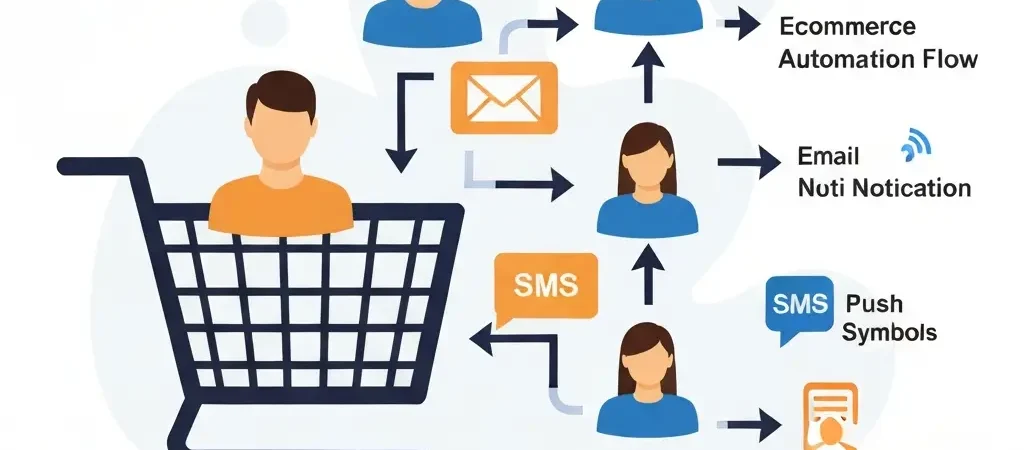
Best Klaviyo Alternative for Ecommerce Email Marketing in 2026: 8 Tools Compared
Klaviyo dominates ecommerce email marketing for good reasons: its Shopify and WooCommerce integrations are deep, its revenue attribution is best-in-class, and its pre-built flows for cart abandonment, win-back, and post-purchase are remarkably well-designed. But teams searching for a Klaviyo alternative for ecommerce in 2026 are typically doing so because Klaviyo’s pricing — which combines contact count and email send volume — becomes extremely expensive as stores scale.
At 10,000 contacts, Klaviyo is $150/month. At 50,000 contacts, it’s $700/month. At 100,000 contacts, you’re looking at $1,400+/month. For DTC brands with razor-thin margins or multi-brand operations, these costs are a meaningful line item that competing alternatives can dramatically reduce. This guide gives you 8 honest Klaviyo alternatives with ecommerce-specific assessments.
Klaviyo’s Real Strengths
Any honest comparison of Klaviyo alternatives has to start with what makes Klaviyo worth its price for some stores:
- Revenue attribution accuracy: Klaviyo’s attribution model tracks email-driven revenue at the order level — a capability few alternatives match precisely.
- Pre-built ecommerce flows: Cart abandonment, browse abandonment, win-back, post-purchase, and product review request flows ship pre-configured with Shopify and WooCommerce data.
- Predictive analytics: Predicted customer lifetime value, churn risk scores, and next order dates are calculated automatically from purchase history.
- SMS + email in one platform: Klaviyo SMS and email share segmentation logic, making cross-channel coordination genuinely easier than stitching two tools together.
- Ecommerce community: The Klaviyo ecosystem of templates, community support, and certified experts is large and well-developed.
The Klaviyo Cost Problem at Scale
Klaviyo’s pricing model charges for both active profiles (contacts with any activity in 90 days) and email send volume above a threshold. This double-variable pricing creates unpredictable cost growth for scaling stores:
| Active Profiles | Klaviyo Email | Omnisend | Brevo | CampaignOS |
|---|---|---|---|---|
| 5,000 | $100/mo | $59/mo | $25/mo | $0 |
| 10,000 | $150/mo | $115/mo | $35/mo | $0 |
| 50,000 | $700/mo | $450/mo | $65/mo | $0 |
| 100,000 | $1,400/mo | $800/mo | ~$130/mo | ~$30 (server+SES) |
Ecommerce Email Marketing Tools: Full Comparison
| Platform | Shopify Native | Multi-Channel | Ecom Flows | Open Source | Free Tier |
|---|---|---|---|---|---|
| Omnisend | Yes | Email, SMS, Push | Pre-built | No | 500 emails/mo |
| Klaviyo | Yes (deep) | Email + SMS | Pre-built | No | 250 contacts |
| Drip | Yes | Email, SMS (basic) | Strong | No | No |
| CampaignOS | Via webhook/n8n | Email, SMS, Push | Customizable | Yes | Fully free |
| Brevo | Plugin | Email, SMS, WhatsApp | Templates available | No | 300 emails/day |
| Shopify Email | Native | Email only | Pre-built | No | 10k emails/mo |
| Mailchimp | Yes | Email (SMS add-on) | Templates | No | 500 contacts |
| ActiveCampaign | Plugin | Email, SMS | Good | No | No |
1. Omnisend — Best Ecommerce-Native Klaviyo Alternative
Best for: Ecommerce stores that want Klaviyo’s pre-built flow approach at significantly lower cost.
Omnisend is the most direct Klaviyo competitor on features and ecommerce focus. It has native Shopify, WooCommerce, and BigCommerce integrations, pre-built automation flows for cart abandonment, product browsing, post-purchase, and win-back, and multi-channel support for email, SMS, and push notifications. At every contact tier, it’s 25–40% cheaper than Klaviyo. The trade-off: Omnisend’s revenue attribution and predictive analytics are less mature than Klaviyo’s.
2. Drip — Best Klaviyo Alternative for DTC Brands
Best for: DTC brands focused on email-first revenue attribution and complex automation workflows.
Drip positions itself as the “ecommerce CRM” and has invested heavily in automation depth and revenue-centric reporting. Starting at $39/month for 2,500 contacts, it’s cheaper than Klaviyo at equivalent list sizes and has excellent WooCommerce and Shopify integrations. The visual workflow builder is strong, though its SMS capabilities are limited compared to Klaviyo or Omnisend.
3. CampaignOS — Best Open-Source Multi-Channel Alternative
Best for: Technical ecommerce teams that want to eliminate Klaviyo’s pricing entirely and build custom ecommerce integrations.
CampaignOS doesn’t have Klaviyo’s native Shopify integration out of the box — but it connects to Shopify or WooCommerce via n8n webhooks, which can trigger automation flows based on any order, cart, or customer event. The key advantage: zero licensing cost regardless of contact count. For a 100k-contact DTC brand paying $1,400/month for Klaviyo, switching to CampaignOS + n8n + SES reduces that cost to roughly $30/month in infrastructure.
The honest limitation: building ecommerce event triggers via n8n requires technical setup that Klaviyo handles automatically. This is the right trade-off for technical teams; not the right trade-off for teams without developer resources.
For multi-channel context, see our guide on how to automate customer engagement across channels. For the broader self-hosted setup, see the self-hosted marketing automation setup guide.
4. Brevo — Best for High-Volume Ecommerce Senders
Best for: High-frequency ecommerce senders who want transactional email + marketing email in one tool at volume-based pricing.
Brevo’s volume-based pricing (pay per email send, not per contact) is structurally advantageous for ecommerce stores with large lists but irregular campaign frequency. At 100k contacts sending 4 monthly campaigns, Brevo’s total annual cost is roughly $1,500 vs Klaviyo’s $16,800. Brevo also handles transactional email (order confirmations, shipping updates) in the same platform. For a comparison of Brevo and CampaignOS specifically, see CampaignOS vs Brevo.
5. MailerLite — Best Budget Alternative for Smaller Stores
Best for: Smaller ecommerce stores (under 10k contacts) that don’t need complex cart abandonment triggers but want solid email automation at low cost.
MailerLite’s ecommerce plan ($9/month for 500 subscribers) includes Shopify and WooCommerce integrations, basic automation, and a very clean email editor. It won’t match Klaviyo’s ecommerce analytics depth, but for stores in early growth stages sending newsletters and simple abandoned cart emails, it’s a reasonable entry point.
6. ActiveCampaign — Best if You Need CRM + Ecommerce Email
Best for: Ecommerce businesses that want both marketing automation and a sales pipeline for wholesale or B2B channels.
ActiveCampaign’s Shopify integration and Deep Data connections allow purchase-based automation triggers. Its CRM is stronger than Klaviyo’s for managing wholesale accounts or hybrid B2B+B2C operations. At list sizes above 25k, ActiveCampaign becomes more expensive than Brevo but less expensive than Klaviyo. See our full ActiveCampaign alternatives comparison.
7. Shopify Email — Best for Shopify-Only Stores
Best for: Shopify stores that want native email marketing without leaving the Shopify admin.
Shopify Email is built directly into the Shopify admin and includes 10,000 free emails/month, basic automations (abandoned cart, welcome series, win-back), and product blocks that pull catalog data automatically. It’s not a Klaviyo feature replacement — the automation depth is much simpler — but for small Shopify stores that want zero additional tool cost, it’s worth using as a starting point before upgrading to a dedicated tool.
8. Mailchimp — Most Familiar Ecommerce Alternative
Best for: Stores that want name-brand familiarity and straightforward Shopify/WooCommerce connections.
Mailchimp’s ecommerce integrations cover Shopify, WooCommerce, BigCommerce, and Magento. Abandoned cart emails, product recommendation blocks, and purchase-based segments are available on paid plans. Free tier is limited (500 contacts), and the contact-based pricing becomes expensive at scale. For teams considering both Klaviyo and Mailchimp alternatives simultaneously, see our open-source Mailchimp alternatives guide.
When Klaviyo Is Still Worth Paying For
Klaviyo remains the right choice when:
- Revenue attribution accuracy directly drives major marketing budget decisions and you need Klaviyo’s attribution precision.
- Your predictive CLV and churn models rely on Klaviyo’s ML features.
- You manage a large Klaviyo template/flow library built over years that would be costly to migrate.
- Your agency or retention team is deeply Klaviyo-certified and retraining on a new tool isn’t economical.
Frequently Asked Questions
What is the best ecommerce alternative to Klaviyo in 2026?
Omnisend is the best ecommerce-native Klaviyo alternative in 2026 for stores wanting a direct feature replacement at lower cost. CampaignOS is the best option for technical teams wanting to eliminate Klaviyo’s contact-based fees entirely. Drip is the strongest alternative for DTC brands focused on email-led revenue attribution.
Why is Klaviyo so expensive compared to alternatives?
Klaviyo uses a double-variable pricing model (active profiles + email volume) that compounds with growth. At 100k active profiles, Klaviyo costs $1,400+/month — 4–10x more expensive than alternatives like Omnisend ($800/month), Brevo ($130/month), or CampaignOS ($30/month for infrastructure). The premium is justified for stores where Klaviyo’s predictive analytics and deep attribution directly improve ROI.
Can I use CampaignOS for Shopify email automation?
Yes. CampaignOS integrates with Shopify via n8n webhooks — Shopify order events (new order, abandoned cart, customer signup) trigger CampaignOS automation workflows. This requires n8n setup but is a one-time configuration that runs automatically afterward. The technical investment is meaningful but eliminates Klaviyo’s ongoing per-contact costs.
Does Omnisend have the same abandoned cart features as Klaviyo?
Yes. Omnisend’s abandoned cart automation includes multi-step email sequences, SMS follow-ups, and push notification recovery — comparable to Klaviyo’s cart abandonment flows. Omnisend’s revenue attribution for cart recovery is slightly less granular than Klaviyo’s, but for most ecommerce stores the difference is not material to business decisions.
What is the cheapest Klaviyo alternative for a large ecommerce list?
CampaignOS (open-source, self-hosted) is the cheapest for large lists — approximately $30/month in infrastructure at 100k contacts vs Klaviyo’s $1,400/month. Brevo is the cheapest hosted alternative at volume-based pricing of roughly $130/month for 100k contacts. Both require technical setup compared to Klaviyo’s plug-and-play approach.
Is there a free Klaviyo alternative for small ecommerce stores?
Yes. Omnisend’s free tier (500 emails/month with full automation) and Shopify Email (10,000 free emails/month for Shopify stores) are the best free alternatives for small ecommerce stores. CampaignOS is also free with no contact limits. Klaviyo’s free tier is limited to 250 contacts and 500 email sends.
Stop Paying Klaviyo’s Scaling Fees
CampaignOS is an open-source multi-channel marketing platform that scales with your ecommerce store at zero licensing cost. Email, SMS, and push automation — all on your terms.