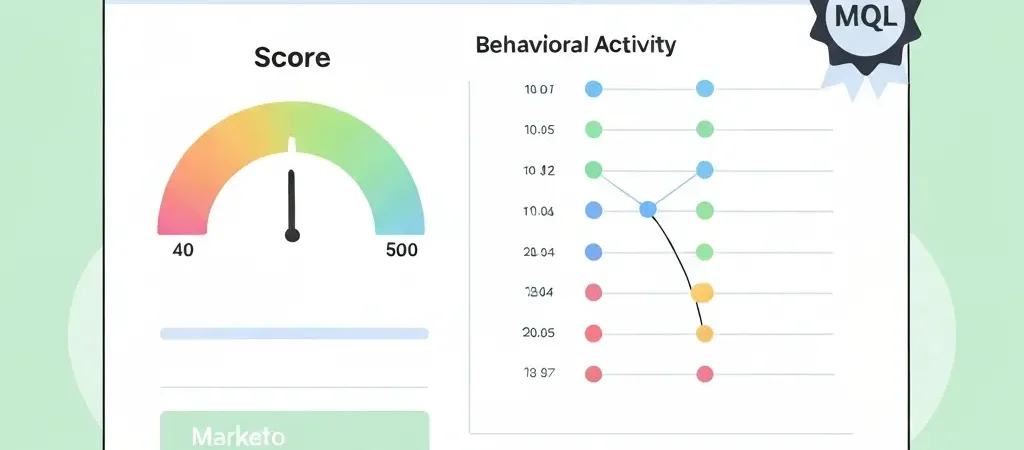
Lead Scoring Software in 2026: How to Automatically Identify Your Most Sales-Ready Prospects
Lead scoring software automatically assigns numeric values to contact behaviors and demographic attributes — page visits, email opens, job titles, company size — to produce a composite score that identifies which prospects are most likely to convert. In 2026, organizations using lead scoring reduce SDR time-to-qualified-contact by 40–60% and increase marketing-to-sales handoff efficiency by eliminating manual qualification from both teams’ workflows.
What Is Lead Scoring Software?
Lead scoring software is a module within a marketing automation or CRM platform that assigns numeric point values to contact records based on two categories of signals: explicit data (what the contact tells you) and implicit behavioral data (what the contact does). The sum of these values produces a lead score that serves as a proxy for purchase intent and sales readiness.
The business problem lead scoring solves: sales teams at most B2B and mid-market B2C companies receive more inbound leads than they can personally qualify. Without scoring, sales reps either call every lead (inefficient) or use informal judgment (inconsistent). Lead scoring creates a systematic, data-driven prioritization layer that surfaces the right leads at the right time.
According to research from multiple marketing automation vendors, companies using lead scoring experience a 77% lift in lead generation ROI compared to companies without a formal scoring model. Marketing automation that generates $5.44 ROI per dollar spent — cited by Nucleus Research for multi-year marketing automation programs — consistently includes behavioral lead scoring as a core component. For context on how this fits into a broader marketing automation strategy, see our what is marketing automation guide.
Lead Scoring Models: Explicit vs Behavioral Scoring
Explicit (Demographic) Scoring
Explicit scoring assigns points based on what the contact has told you about themselves. These signals reflect fit — how closely the contact matches your Ideal Customer Profile (ICP):
- Job title / seniority: VP or Director = +15 pts; Manager = +10 pts; Individual contributor = +5 pts; Student = -20 pts
- Company size: 100–500 employees = +15 pts; 50–100 = +10 pts; 1–10 = +5 pts; 500+ = varies by product
- Industry: matches your top verticals = +15 pts; adjacent = +5 pts; non-target industry = 0 pts
- Geography: target market countries = +10 pts; non-target = 0 pts
- Company type: SaaS = +10; ecommerce = +8; agency = +5; nonprofit = varies
Behavioral (Implicit) Scoring
Behavioral scoring assigns points based on what the contact does — signals of engagement and intent:
- Pricing page visit: +25 pts (highest intent signal for SaaS)
- Demo request form fill: +50 pts (direct hand-raise)
- Email open: +2 pts (low signal; easily inflated by Apple MPP)
- Email click: +8 pts (meaningful engagement)
- Case study download: +15 pts (solution evaluation stage)
- Webinar attendance: +20 pts (invested time = high intent)
- Site visit (3+ pages in session): +10 pts
- 30-day inactivity: -15 pts (score decay prevents stale high scores)
Negative Scoring
Negative scores are as important as positive ones. They prevent false positives from inflating scores of low-fit contacts. Key negative scoring events:
- Unsubscribed from email: -50 pts (or immediate disqualification)
- Competitor company domain: -100 pts
- Student or academic email domain: -30 pts
- Job title includes “intern” or “student”: -20 pts
- 30+ day email inactivity: -10 pts (score decay)
How to Set Up a Lead Scoring System in 5 Steps
- Define your MQL threshold. Work with your sales team to agree on what lead score constitutes a Marketing Qualified Lead (MQL) — the point at which a lead should be handed to sales. This threshold varies by business but is typically 50–75 points for most SMB-focused products. Base this on historical data if possible: look at closed-won deals and check what behaviors preceded conversion.
- Build your explicit scoring criteria. Map your ICP attributes to point values. The cleaner your ICP definition, the more accurate your explicit scoring. If you sell to mid-market SaaS companies, every VP+ at a 100–500 person SaaS company should score high on demographics alone.
- Identify your highest-intent behavioral signals. For SaaS, pricing page and demo request are the highest intent signals. For ecommerce, product page visits and abandoned carts are highest intent. Identify the 3–5 actions that most strongly correlate with purchase in your business and weight them heavily.
- Configure score decay. A prospect who visited your pricing page 6 months ago and has been inactive since is not as valuable as one who visited yesterday. Configure automatic score decay (e.g., -5 points for every 30 days of inactivity) to prevent stale high scores from flooding sales queues.
- Build the MQL trigger workflow. When a contact crosses your MQL threshold, the lead scoring software should automatically: notify the assigned sales rep (email + Slack), create a CRM task, enroll the contact in a high-intent email sequence while sales follows up, and log all high-intent behavioral events for the sales rep’s context. CampaignOS supports all of these actions within a single trigger workflow connected to its lead scoring module.
Lead Scoring Software Comparison 2026
| Platform | Lead Scoring | Behavioral Triggers | Score Decay | Price |
|---|---|---|---|---|
| CampaignOS | Yes — full rule-based | Yes — all events | Yes | Free (open source) |
| ActiveCampaign | Yes — advanced | Yes | Yes | $49+/mo |
| HubSpot | Yes — predictive (Pro+) | Yes | Yes | $800+/mo (Marketing Hub Pro) |
| Mautic | Yes — rule-based | Yes | Limited | Free (open source) |
| Mailchimp | No | Limited | No | $13+/mo |
Lead Scoring by Industry and Use Case
SaaS and B2B software: Pricing page visits and demo requests are the two highest-intent triggers. Score these events at 2–3x the value of general content engagement. Build a separate scoring track for free trial users — trial activation, feature usage, and team member invitations are the strongest conversion predictors.
Ecommerce: Behavioral scoring centers on product page depth, cart value, and visit frequency. A visitor who has browsed 5+ products in a category on 3 separate visits in a week is a high-intent buyer. Combine this with abandoned cart workflows for maximum revenue recovery. For a full ecommerce automation strategy, see our ecommerce marketing automation playbook.
Professional services and agencies: Explicit scoring (job title, company size) matters more than in transactional businesses. A Director at a 200-person company who has downloaded two case studies and attended a webinar is a highly qualified lead. Score these signals heavily and build a direct human outreach trigger at the MQL threshold.
Nonprofits and membership organizations: Lead scoring applies to donor engagement — recurring donation history, volunteer interest form fills, event attendance, and email engagement are all scoreable signals. High-scoring contacts are candidates for major gift outreach or volunteer leadership programs. See our nonprofit marketing automation guide for donor engagement workflow examples.
Common Lead Scoring Mistakes
- Setting the MQL threshold too low. If every contact with a score of 10 triggers a sales notification, your sales team drowns in unqualified leads and loses trust in the system. Calibrate the threshold against your historical closed-won data before launch.
- Weighting email opens too heavily. Apple Mail Privacy Protection (MPP) pre-fetches email content and registers opens without the recipient actually viewing the email. Open rates are inflated; email clicks are a far more reliable intent signal.
- No negative scoring. Without negative scores, a competitor’s employee who subscribes to your newsletter for competitive intelligence can accumulate a high score and waste sales resources.
- No score decay. A prospect who visited your pricing page 8 months ago and has been completely inactive is not sales-ready today. Score decay keeps the system current.
- Building scoring before defining your ICP. Lead scoring is only as accurate as your ICP definition. If you have not clearly defined what a good-fit customer looks like demographically and behaviorally, any scoring model you build will produce noisy results.
FAQ
What is lead scoring software?
Lead scoring software is a marketing automation module that assigns numeric point values to contact records based on demographic attributes (job title, company size, industry) and behavioral signals (page visits, email clicks, demo requests). The resulting composite score ranks contacts by purchase intent and sales readiness, enabling marketing teams to pass only high-scoring leads to sales and trigger automated high-intent nurture sequences at the right moment.
How does lead scoring work?
Lead scoring works by assigning positive or negative point values to each contact event and attribute. Positive events (pricing page visit: +25 pts, demo request: +50 pts) increase the score. Negative events (competitor domain: -100 pts, 30-day inactivity: -10 pts) decrease it. When a contact’s total score crosses a defined MQL threshold, the lead scoring system automatically triggers a sales notification or workflow enrollment.
What is a good lead score threshold for MQL?
A good MQL threshold depends on your scoring model and business type, but most B2B SaaS companies use 50–75 points as the MQL handoff threshold. The threshold should be calibrated by analyzing your historical closed-won deals: look at the average score those contacts reached before they converted, and set your threshold at a point that captures 80%+ of eventual buyers while excluding the majority of low-intent contacts.
What is the difference between explicit and implicit lead scoring?
Explicit lead scoring assigns points based on data the contact has self-reported — job title, company size, industry, geography. It measures fit: how closely the contact matches your ICP. Implicit lead scoring assigns points based on behavioral signals — page visits, email clicks, form fills, content downloads. It measures intent: how much the contact is engaging with your brand and showing purchase interest. The most effective lead scoring models combine both to produce a fit-times-intent composite score.
Is lead scoring worth it for small businesses?
Lead scoring is worth implementing for small businesses as soon as they have a defined sales process and are generating more leads than their sales team can personally follow up on. A simple two-dimensional model (3–5 explicit criteria + 3–5 behavioral signals) can be set up in under 2 hours and immediately reduces the manual qualification burden. The minimum viable lead scoring model for a small B2B business: job title fit (+10), company size fit (+10), email click (+5), pricing page visit (+20), demo request (+50) — threshold at 40.
{
“@context”: “https://schema.org”,
“@type”: “FAQPage”,
“mainEntity”: [
{
“@type”: “Question”,
“name”: “What is lead scoring software?”,
“acceptedAnswer”: {
“@type”: “Answer”,
“text”: “Lead scoring software assigns numeric point values to contact records based on demographic attributes and behavioral signals to rank contacts by purchase intent and sales readiness.”
}
},
{
“@type”: “Question”,
“name”: “What is the difference between explicit and implicit lead scoring?”,
“acceptedAnswer”: {
“@type”: “Answer”,
“text”: “Explicit scoring measures fit using self-reported data (job title, company size). Implicit scoring measures intent using behavioral signals (page visits, email clicks). Effective models combine both.”
}
},
{
“@type”: “Question”,
“name”: “What is a good lead score threshold for MQL?”,
“acceptedAnswer”: {
“@type”: “Answer”,
“text”: “Most B2B SaaS companies use 50–75 points as the MQL threshold. Calibrate against historical closed-won data to find the score that captures 80%+ of eventual buyers.”
}
}
]
}