Marketing Automation for Ecommerce in 2026: The Complete Playbook
Ecommerce teams that do not have marketing automation for ecommerce fully deployed in 2026 are leaving a statistically documented revenue gap on the table. Abandoned cart emails alone recover 3–15% of abandoned sessions when sent within one hour, according to Klaviyo’s 2025 benchmarks. Post-purchase sequences drive 40% higher repeat purchase rates compared to one-off blast campaigns. Win-back automations bring back 8–12% of dormant buyers without a single manual touchpoint. None of these results require a large team — they require the right automation infrastructure and a playbook to deploy it systematically.
This guide is that playbook. It covers the complete lifecycle of ecommerce automation: the flows every store needs running before anything else, the segmentation logic that separates high-converting stores from average ones, the tools worth evaluating in 2026, and five real industry case studies that show what automation looks like in practice at different revenue scales. Whether you are running a Shopify store with 5,000 customers or a mid-market operation with 200,000 SKUs, the frameworks here apply.
Why Ecommerce Automation Matters More in 2026
Three converging trends have made marketing automation more critical for ecommerce in 2026 than at any previous point:
Rising customer acquisition costs
Meta CPMs increased approximately 25% between 2023 and 2025 according to WordStream data. Google Shopping CPCs rose similarly. For stores relying primarily on paid acquisition, the unit economics of the first purchase are under pressure — making automation-driven repeat purchase rates the primary lever for profitable growth.
Privacy changes and first-party data
iOS privacy updates reduced third-party cookie tracking effectiveness by 30–40% for most email platforms that previously relied on pixel-based attribution. Stores that invest in first-party data collection — preference centres, post-purchase surveys, browse and purchase history — now have a structural advantage in segmentation accuracy over those relying on third-party signals.
AI-enhanced personalisation at scale
In 2026, platforms including Klaviyo, ActiveCampaign, and CampaignOS have incorporated predictive product recommendations and send-time optimisation using per-subscriber machine learning. Stores that were previously limited by team capacity to manually curate segments can now deploy personalisation at 100,000+ subscriber scale.
The 7 Core Automation Flows Every Ecommerce Store Needs
1. Abandoned Cart Recovery
The single highest-ROI automation for most ecommerce stores. A three-email sequence (1 hour, 24 hours, 72 hours post-abandonment) recovers significantly more revenue than a single email. Best practice in 2026:
- Email 1 (1 hour): Cart reminder with product images. No discount — preserve margin and test purchase intent.
- Email 2 (24 hours): Social proof — reviews of abandoned items, “others are viewing this” signals if inventory allows.
- Email 3 (72 hours): Time-limited incentive — 10% off or free shipping for first-time purchasers only.
Average abandoned cart recovery rate across well-optimised sequences: 5–15% of abandoned sessions. Stores with personalised product recommendations in the cart email outperform generic templates by 30–50% in click-to-purchase rate.
2. Welcome Series
New subscriber welcome sequences are the highest-engagement automation by open rate (typically 45–60% for Email 1). A five-email welcome series over 10 days converts subscribers into first-time buyers at 2–4x the rate of no welcome automation. The structure that consistently outperforms:
- Email 1: Immediate confirmation + brand story + “what to expect”
- Email 2 (Day 2): Your best-selling or highest-rated products
- Email 3 (Day 4): Social proof — UGC, reviews, press mentions
- Email 4 (Day 7): Category education — help the subscriber understand your full range
- Email 5 (Day 10): First-purchase incentive with urgency
3. Post-Purchase Onboarding
The period immediately after a first purchase is the highest-intent window for repeat purchase education. Post-purchase sequences that focus on product usage, complementary recommendations, and loyalty programme onboarding see 30–40% of first-time buyers making a second purchase within 90 days, versus 15–20% for stores without this flow.
4. Browse Abandonment
Triggered when a subscriber views a product page but does not add to cart. Lower purchase intent than cart abandonment, but the volume is typically 3–5x higher. Browse abandonment emails work best when they are sent 4–6 hours after the browsing session, show the specific product viewed, and include closely related alternatives to widen the purchase path.
5. Win-Back (Re-engagement)
Targeting subscribers who have not purchased in 90–180 days (depending on your purchase frequency norms). A three-email win-back sequence sent over 2 weeks recovers 8–12% of dormant buyers when it includes a meaningful offer. Equally important: win-back sequences identify unresponsive subscribers for list suppression, which improves deliverability for active segments.
6. Replenishment Reminders
Relevant for consumable products — supplements, skincare, pet food, cleaning supplies. Triggered by purchase date plus average product lifespan. Replenishment emails sent at the right interval (typically 85–90% of product lifespan) achieve purchase rates of 20–30%, making them among the highest-converting automations per send. Stores in the health and wellness space particularly benefit from this flow — more on that in the Health and Wellness section.
7. VIP and Loyalty Tier Automation
Triggered when a customer crosses a spending or order-frequency threshold. VIP segment automation — exclusive previews, early access, dedicated support — reduces churn in the top 10% of buyers, who typically generate 40–60% of total store revenue. Identifying and automating communication with this segment is disproportionately high-value.
Segmentation Strategy: How to Target the Right Customers
Effective marketing automation for ecommerce depends on accurate segmentation. The RFM model (Recency, Frequency, Monetary Value) remains the foundational framework because it combines three independent purchase signals into a scoring matrix that predicts future behaviour with high accuracy. For a deep dive into segmentation mechanics and how to build dynamic conditions, see our guide on how to segment your audience for email marketing in 2026.
RFM Segmentation in Practice
| Segment | RFM Profile | Recommended Automation | Send Frequency |
|---|---|---|---|
| Champions | High R, High F, High M | VIP exclusives, early access, referral | 2–3x/week |
| Loyal Customers | High F, High M | Loyalty rewards, upsell, replenishment | 1–2x/week |
| Potential Loyalists | Recent purchasers, 1–2 orders | Post-purchase onboarding, cross-sell | 1x/week |
| At Risk | Previously frequent, now lapsing | Win-back sequence, survey | 3 emails over 2 weeks |
| Hibernating | Low R, Low F | Final win-back then suppress | 1 final email |
Behavioural Segmentation Layers
Layer these signals on top of RFM for higher-precision automation triggers:
- Category affinity: If a customer has purchased from skincare three times and apparel once, skincare campaigns should be the primary channel, not a generic “new arrivals” email.
- Price point preference: Customers who consistently buy at the $50–$80 range are poor targets for $200+ product launches. Segment accordingly.
- Channel engagement: Email-engaged customers may ignore SMS; SMS-engaged customers who rarely open email should shift proportion to text-based automations.
Platform Comparison: Best Marketing Automation Tools for Ecommerce
| Platform | Ecommerce Native | SMS | Product Recs | Starting Price | Best Scale |
|---|---|---|---|---|---|
| CampaignOS | Yes (API) | Yes | Via webhook | $29/mo | SMB to Mid-market |
| Klaviyo | Yes (Shopify native) | Yes | AI-powered | Free / $45/mo | SMB to Enterprise |
| ActiveCampaign | Via integrations | Yes | Limited | $15/mo | SMB to Mid-market |
| Omnisend | Yes (ecom-first) | Yes | Yes | Free / $16/mo | SMB |
| Drip | Yes (ecom-first) | Via integration | Yes | $39/mo | SMB to Mid-market |
CampaignOS’s multi-channel architecture — combining email, SMS, and push in a single automation workflow — makes it particularly well suited for ecommerce teams that want to move beyond email-only automation without adopting separate SMS platforms. For a broader platform comparison including open-source options, see our ranking of the best open-source marketing automation tools for 2026 and the lead scoring software guide for deeper platform analysis. For ecommerce teams specifically evaluating AI-native email platforms, the full AI email marketing platforms comparison for 2026 covers features, pricing, and open-source alternatives side by side.
5 Industry Case Studies
Case Study 1: DTC Supplements Brand (Health and Wellness)
A direct-to-consumer supplements brand with 45,000 active customers and a 28-day average purchase cycle implemented a four-flow automation stack: welcome series, post-purchase education sequence, 25-day replenishment reminder, and a 90-day win-back campaign.
Results after 6 months:
- Repeat purchase rate increased from 22% to 34% (54% improvement)
- Email revenue as a share of total revenue increased from 18% to 31%
- Replenishment emails drove a 27% repurchase rate among customers who received them vs. 11% for those who did not
- Win-back campaign recovered 9.4% of dormant customers in the first 90 days
Case Study 2: Mid-Market Fashion Retailer (2,200 SKUs)
A UK-based fashion retailer migrated from a basic email service provider to a full marketing automation platform, implementing browse abandonment, category-affinity segmentation, and a post-purchase styling series.
Results after 4 months:
- Browse abandonment emails (4 hours post-visit) generated 3.2% conversion rate vs. 0.8% from generic retargeting ads for the same audience
- Category-segmented campaigns outperformed all-list broadcasts by 41% in revenue per send
- Post-purchase styling series increased average order value on second purchase by 18%
Case Study 3: Shopify Pet Food Brand (Subscription + One-Off)
A pet food brand offering both subscription and one-off purchase models used automation to convert one-off buyers into subscription customers through a targeted sequence sent between purchase 2 and purchase 3.
Results:
- Subscription conversion rate from one-off buyers increased from 8% to 19% within the targeted automation window
- Customer lifetime value for subscription customers was 3.8x higher than one-off buyers
- Total subscription revenue grew 28% over 6 months without increasing ad spend
Case Study 4: B2B Office Supplies Ecommerce (100,000+ business accounts)
A B2B ecommerce operation used marketing automation to implement an account-based sequence targeting business accounts that had not reordered within 45 days of their typical replenishment window.
Results:
- Proactive replenishment outreach recovered 14% of at-risk accounts before they switched to a competitor
- Automated onboarding for new business accounts reduced time-to-second-order by 11 days
- Account managers reported 60% reduction in manual check-in emails, freeing capacity for high-value account development
Case Study 5: Home Goods DTC Brand (Social-First Acquisition)
A home goods brand that drove 70% of traffic through Instagram and TikTok used post-click automation to convert social visitors who signed up for a discount but did not immediately purchase.
Results:
- 5-email welcome + education series converted 12% of social sign-ups to first purchase within 14 days (up from 4% with a single welcome email)
- Abandoned cart sequence converted an additional 8% within 72 hours
- Combined, automation sequences reduced payback period on social ad spend from 47 days to 29 days
Multi-Channel Automation: Email, SMS, and Push in 2026
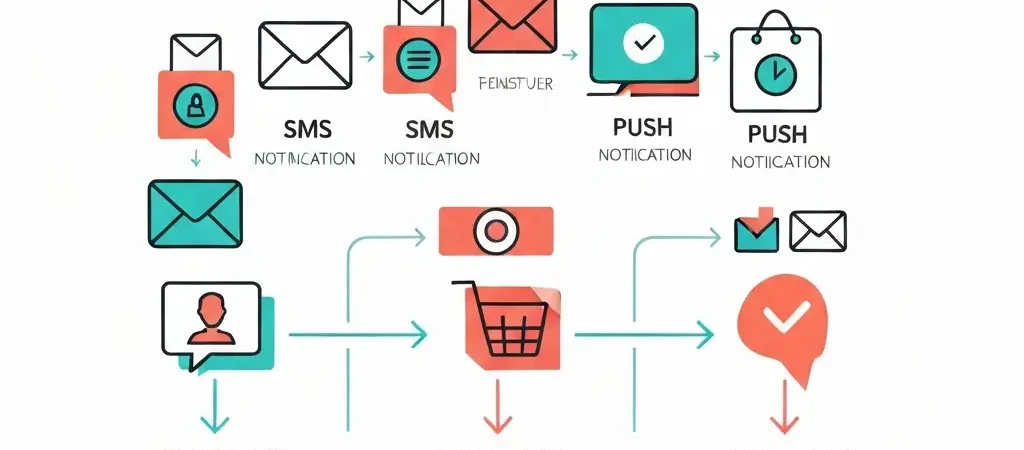
Email remains the highest-ROI channel in ecommerce automation ($36–$42 return per dollar spent according to DMA data), but the most effective ecommerce automation stacks in 2026 treat it as one channel in a coordinated multi-channel approach.
When to use SMS in automation
SMS achieves open rates of 90%+ but carries higher per-message costs and subscriber tolerance for irrelevance is low. Best ecommerce SMS automation use cases:
- Abandoned cart final reminder (when email cart sequence has not converted after 72 hours)
- Flash sale or time-limited offer alerts where open speed matters
- Shipping notifications and delivery confirmation
- VIP customer access notifications for new drops or inventory restocks
When to use push notifications
Web push and app push work best for re-engagement scenarios where email deliverability may be degraded (spam folder placement for inactive subscribers). Push opt-in rates are typically 10–15% of visitors, making the audience smaller but highly intentional. Use for: browse abandonment (paired with email), back-in-stock alerts, and personalised product recommendations for app users.
KPIs and Benchmarks: What Good Looks Like
| Flow | Average Open Rate | Average Click Rate | Conversion Rate | Revenue per Email |
|---|---|---|---|---|
| Welcome Series (Email 1) | 45–60% | 12–18% | 3–8% | $0.80–$2.50 |
| Abandoned Cart (Email 1) | 40–55% | 15–25% | 5–15% | $4–$12 |
| Post-Purchase (Email 1) | 55–70% | 10–18% | 4–10% | $2–$6 |
| Browse Abandonment | 25–40% | 8–14% | 1–4% | $1–$3 |
| Win-Back Sequence | 18–28% | 5–10% | 2–6% | $1.50–$4 |
| Replenishment Reminder | 40–55% | 15–22% | 18–28% | $8–$20 |
To understand how these ecommerce-specific metrics compare to broader engagement benchmarks, see our customer engagement metrics and benchmarks guide, which includes industry-by-industry data on open rates, NPS, and retention.
Health and Wellness Ecommerce: Automation Considerations
Health and wellness is among the fastest-growing ecommerce segments, and it has specific automation considerations that generic ecommerce guides miss. Products in this category — supplements, fitness equipment, health tracking devices, quit-support tools — carry higher repurchase cycles and higher customer education requirements than average ecommerce products.
Three automation elements that are particularly high-value for health and wellness ecommerce:
- Results-based sequencing: Customers who purchase a 30-day supplement supply should receive a “how are you feeling at Day 14?” check-in, with educational content about what changes to expect. This dramatically increases 30-day reorder rates.
- Behaviour change reinforcement: Customers using apps or trackable devices benefit from automated milestone celebration emails that reinforce progress and reduce churn. The same psychology applies to fitness tracking, weight loss programs, and any health journey with measurable milestones.
- Compliance and safety reminders: For products with usage instructions (dosage schedules, contraindications), automated education sequences reduce returns, support tickets, and negative reviews simultaneously.
For small businesses deploying ecommerce automation for the first time, the AI-powered marketing automation for small business playbook covers the full 90-day implementation plan with AI-native workflows sized for lean teams and modest budgets.
90-Day Implementation Roadmap
Days 1–30: Foundation
- Select and configure your marketing automation platform
- Connect your ecommerce store (Shopify, WooCommerce, or custom API)
- Implement welcome series for all new subscribers
- Launch abandoned cart sequence (3 emails minimum)
- Configure DKIM, DMARC, and SPF for your sending domain
- Set up basic RFM segmentation using 90-day purchase history
Days 31–60: Core Revenue Flows
- Launch post-purchase onboarding sequence for new buyers
- Implement browse abandonment trigger (4–6 hour delay)
- Configure replenishment reminders for consumable products
- Set up basic SMS capture and a parallel SMS abandoned cart flow
- A/B test subject lines on highest-volume flows
Days 61–90: Optimisation and Expansion
- Launch win-back sequence for subscribers inactive 90+ days
- Implement VIP tier identification and dedicated VIP flow
- Add product recommendation blocks to post-purchase and replenishment emails
- Review metrics against benchmarks and identify lowest-performing flows for redesign
- Evaluate push notification integration for browse abandonment
Frequently Asked Questions
What is the best marketing automation platform for ecommerce in 2026?
The best platform depends on your store platform and scale. Klaviyo is the market leader for Shopify stores due to its native integration and AI-powered product recommendations. CampaignOS is the strongest option for teams that want multi-channel automation (email, SMS, push) in a single platform without Klaviyo’s price scale. Omnisend is best for smaller stores wanting ecommerce-first automation at a lower price point. ActiveCampaign is preferred for stores with complex B2B or hybrid ecommerce models.
How much revenue can marketing automation add to an ecommerce store?
Well-implemented automation typically adds 20–35% to total email revenue through automated flows alone, with the abandoned cart and replenishment sequences generating the highest returns. For stores previously relying only on broadcast campaigns, implementing the full automation stack (welcome, cart recovery, post-purchase, win-back) commonly delivers a 40–80% increase in total email channel revenue within 6 months.
What is the most important ecommerce automation to set up first?
Abandoned cart recovery should be the first automation deployed, as it has the highest immediate ROI per email sent. The combination of high purchase intent, proven conversion rates (5–15%), and direct revenue impact means even a basic one-email abandoned cart setup pays for the platform subscription within weeks for most stores. After abandoned cart, the welcome series should be the second priority.
How do I avoid over-emailing customers in my automation stack?
Implement global frequency caps — most platforms allow you to set a maximum number of automated emails per subscriber per 7-day window. Typical best practice is no more than 3–4 automated emails per week for active buyers, including both triggered flows and broadcast campaigns. Additionally, exclude active automation recipients from broadcast campaigns to avoid double-sending, and suppress subscribers who have received a win-back or re-engagement sequence until 30 days after the last send.
Does marketing automation work for small ecommerce stores?
Yes — automation scales down effectively. A store with 2,000 customers can see significant impact from a three-email abandoned cart sequence and a welcome series with a first-purchase incentive. Most platforms have free tiers or low starting prices that make automation viable before you reach significant revenue scale. The ROI is often proportionally higher for small stores because every recovered cart and every retained customer has a more visible impact on total revenue.
How do I integrate marketing automation with Shopify?
Klaviyo has the deepest native Shopify integration — it installs directly from the Shopify app store and automatically pulls customer data, purchase history, and browse events. CampaignOS, Omnisend, Drip, and Brevo all offer Shopify integrations via the app store or API. WooCommerce users have fewer native options; ActiveCampaign and CampaignOS both offer robust WooCommerce API connections.
What is the difference between email marketing and marketing automation for ecommerce?
Email marketing refers to manually scheduled broadcast campaigns sent to a list — newsletters, promotional emails, sale announcements. Marketing automation refers to behaviour-triggered, data-driven flows that send automatically based on customer actions: adding to cart, making a purchase, visiting a product page, or lapsing in activity. The key difference is intent-alignment — automated flows send the right message at the moment of highest relevance, rather than on a calendar schedule.
How long does it take to see results from ecommerce marketing automation?
Abandoned cart and welcome series results are visible within days of launch, because they trigger immediately on customer actions. Post-purchase and replenishment flows show meaningful data within 30–45 days as customers progress through their purchase cycles. Win-back campaigns and VIP tier automation typically take 60–90 days to generate statistically reliable performance data. Full optimisation of a complete automation stack takes 4–6 months.
Ready to Build Your Ecommerce Automation Stack?
CampaignOS gives ecommerce teams a full multi-channel automation platform — email, SMS, and push — in a single workflow builder, with no infrastructure complexity and pricing that scales from your first 1,000 contacts to your first million.
Start free with CampaignOS — connect your store and have your abandoned cart flow running today.