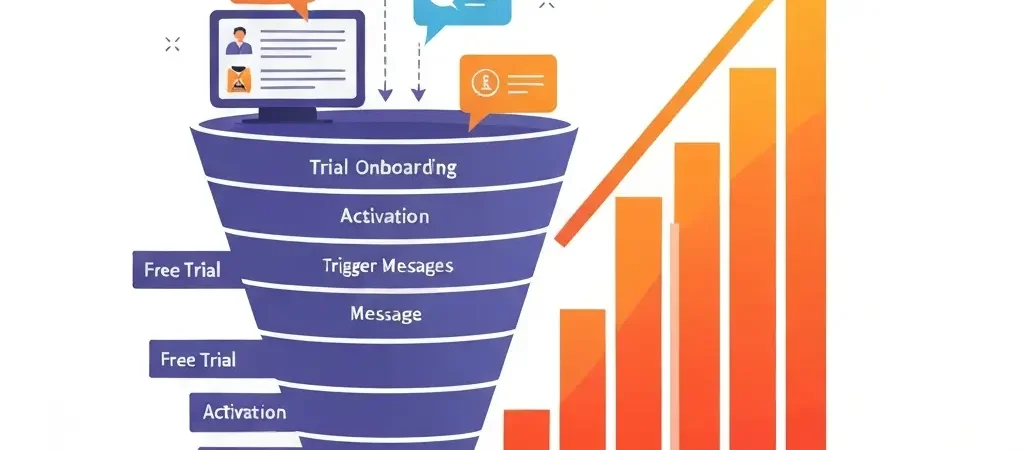
SaaS Marketing Automation: The Growth Guide for 2026
SaaS growth has a unique challenge that product-led teams understand intimately: you can acquire thousands of trial signups, but if your onboarding experience doesn’t guide users to their “aha moment” quickly enough, they churn before they ever see the value. Manual onboarding at scale is impossible — and that’s exactly why SaaS marketing automation is the highest-leverage investment a growth team can make. Done right, it shortens time-to-value, increases trial-to-paid conversion, reduces churn, and identifies expansion revenue opportunities — all without proportionally scaling headcount.
In 2026, AI-driven automation has pushed SaaS conversion benchmarks significantly higher. Teams deploying behavioral trigger sequences — messages that fire based on actual in-app actions, not just timers — see conversion rates 30–40% higher than time-based drip sequences. The gap between SaaS teams doing automation well and those sending generic onboarding emails is now measurable in months of runway.
This guide covers the five essential SaaS automation workflows, how to instrument them for a product-led growth (PLG) model, key metrics to track, and real case studies from SaaS companies that used automation to break through conversion plateaus.
Why SaaS Teams Can’t Scale Without Automation
The SaaS business model creates a specific tension: customer acquisition cost (CAC) is front-loaded, while revenue arrives monthly over the lifetime of the subscription. Every churned trial, every user who never finds value, every expansion opportunity missed — these directly erode the unit economics that make SaaS viable. At small scale, a founder can manually guide each trial user. At 500+ monthly signups, that’s impossible.
Marketing automation solves the scaling problem by treating every user as if they had a personal success manager — one that tracks their in-app behavior, sends relevant help at the right moment, escalates to a human when needed, and never forgets to follow up. AI lead nurturing in 2026 delivers 25% conversion increases within six months by reading behavior patterns across every touchpoint and adapting message timing and content dynamically.
The Activation Problem
Most SaaS churn happens before the first renewal. Users who don’t reach an activation milestone — completing a key action that demonstrates core value — within their first 7 days are far less likely to convert or renew. Automation’s first job is to shrink the time to that milestone.
Trial Onboarding Sequences: Getting Users to Activation
A behavioral onboarding sequence fires messages based on what users have and haven’t done in your product — not just how many days since they signed up. This distinction matters enormously. A time-based sequence sends “tip 3” on day 3 regardless of whether the user has completed steps 1 and 2. A behavioral sequence sends “tip 3” only after steps 1 and 2 are done.
The Activation-Gated Onboarding Model
| User Action | Trigger | Message Sent |
|---|---|---|
| Signed up, no action in 24h | Inactivity trigger | “Here’s the one thing to do first” |
| Completed step 1 | Event trigger | “Great start — next: [step 2]” |
| Completed step 2, not step 3 | Partial completion | Step 3 tutorial + video walkthrough |
| Reached activation milestone | Activation event | Celebration + upgrade prompt |
| Trial expires, not activated | Expiry trigger | Trial extension offer or success call |
CampaignOS handles this via webhook-triggered automation — your SaaS product sends an event (e.g., “user_completed_setup”) and CampaignOS fires the corresponding message within seconds. No polling, no delays, no missed triggers.
Trial-to-Paid Conversion: The Critical Window
The last 3 days of a trial are the highest-leverage window for conversion. Users who haven’t converted at day 7 of a 14-day trial typically need one of three things: a feature they haven’t discovered, a pricing question answered, or a push past the “I’ll do this later” inertia. Automation handles all three.
The Trial-End Conversion Sequence
- Day 11 (3 days before expiry): “Your trial ends in 3 days — here’s what you’ll lose.” A concrete list of active features the user has used. Personalized to their actual usage data.
- Day 13 (1 day before expiry): Social proof + objection handling. Customer stories from similar company types. Address the most common conversion objection for your category.
- Day 14 (expiry day): Final push with a limited offer (annual plan discount, extra month free) and a clear “upgrade now” CTA. Keep this email short and direct.
- Day 15 (1 day after expiry, for non-converters): “We saved your data — here’s how to pick up where you left off.” Removes friction from late converters who didn’t act on expiry day.
Churn Prevention: Detecting and Reversing Decline
Churn prevention automation requires a usage signal — a definition of what “at-risk” looks like in your product. Common signals include: login frequency drops by 50%+, key feature usage stops, team members are deactivated, or billing email bounces. When these signals fire, automation intervenes before the customer consciously decides to cancel.
Churn Prevention Playbook
Action: Email from Customer Success with a specific use case they might be missing. Subject: “Quick question about [product name].” Offer a 15-minute check-in call. This message has a 45–60% open rate because it feels personal, not automated.
Action: Immediate email + SMS dunning sequence. Message 1 (immediate): gentle “update payment method” with a direct link. Message 2 (3 days later): urgency + account suspension warning. Message 3 (6 days): final notice with a deadline. Multi-channel dunning recovers 20–35% of failed payments that would otherwise churn.
Action: Pause the downgrade for 48 hours (if possible) and trigger an automation: personalized email from a senior team member offering to walk through ROI calculation or unlock a feature they might not know exists. Saves 15–25% of downgrade requests.
Expansion Revenue Automation
Expansion revenue — upgrades, seat additions, and add-on purchases from existing customers — is the most profitable revenue in SaaS. Net Revenue Retention (NRR) above 100% means you can grow without any new customer acquisition. Automation identifies expansion signals and acts on them faster than any sales team.
Key expansion triggers to automate: approaching a plan limit (contacts, sends, users, API calls), adding team members who need their own seats, using a feature that’s only available on a higher tier, or asking a support question that indicates a need for an add-on. Each of these is an in-context upgrade prompt — not a cold upsell, but a helpful “you’ve outgrown your current plan” notification.
PLG Model: Automating Product-Led Growth
In a product-led growth (PLG) model, the product itself drives acquisition, conversion, and expansion. Automation’s role is to accelerate the journey from free to paid and from individual to team. The PLG automation stack differs from a traditional SaaS stack in one key way: triggers are almost entirely product events, not time-based.
High-impact PLG automations include: viral loop triggers (when a user invites a collaborator, automate a welcome sequence for the invitee), usage milestone celebrations (when a user hits a significant usage milestone, trigger an upgrade prompt), and team expansion detection (when multiple teammates use a shared workspace, trigger a team plan upsell).
For the audience segmentation layer that makes these triggers work at scale, see audience segmentation tool guide. For lead scoring to prioritize which trial users get human outreach, see lead scoring software guide.
Case Study: B2B SaaS — Trial-to-Paid Conversion from 8% to 21%
Challenge: Users were signing up, doing the first two onboarding steps, and then going quiet. The team had no visibility into who was at risk until they’d already churned.
Solution: CampaignOS with behavioral onboarding triggers, activation-gated messages, and a 3-email trial-end sequence personalized by activation status.
Result: Trial-to-paid conversion increased from 8% to 21% over 3 months. Time-to-activation dropped by 40%. Churn prevention automation recovered 18% of at-risk accounts.
The single biggest change was sending different messages to activated vs. non-activated users in the final 3 days of the trial. Activated users got a ROI summary and a simple upgrade prompt. Non-activated users got a “we can still make this work” message with a trial extension offer and a link to a 10-minute getting-started video. The trial extension message alone converted 12% of non-activated users into activated ones — and 60% of those went on to convert to paid.
SaaS Automation Metrics: What to Track
| Metric | Definition | Benchmark |
|---|---|---|
| Trial-to-paid conversion | % of trials that become paid | 15–25% (good automation) |
| Time to activation | Days to first activation event | Target < 3 days |
| Monthly churn rate | % of MRR lost per month | Target < 2% |
| Net Revenue Retention | MRR from existing customers including expansion | Target > 110% |
| Payment recovery rate | % of failed payments recovered by dunning | 20–35% |
For deeper guidance on SaaS content strategy that feeds your automation funnel, Authenova’s AI SEO content guide covers how to align content production with lifecycle stages. Also see the email marketing automation strategy guide for complementary workflow architecture.
Frequently Asked Questions
What is SaaS marketing automation?
SaaS marketing automation is the use of software to send behavioral-triggered messages (emails, SMS, in-app notifications) based on user actions within a SaaS product. It covers the full customer lifecycle: trial onboarding, trial-to-paid conversion, churn prevention, expansion revenue, and win-back — all without manual intervention at each step.
What’s a good trial-to-paid conversion rate for SaaS?
Industry benchmarks vary by model: freemium products typically convert 2–5% of free users to paid; free trial models see 15–25% with good onboarding automation. If your trial-to-paid rate is below 10%, behavioral onboarding automation is usually the fastest fix — especially activation-gated messaging and trial-end sequences.
How do you reduce SaaS churn with marketing automation?
Churn prevention automation works in three stages: (1) detect usage signals that predict churn (login frequency drop, feature abandonment), (2) trigger proactive outreach before the customer decides to cancel, (3) automate dunning sequences for failed payments. Together, these recover 15–25% of customers who would otherwise churn passively.
What’s the difference between time-based and behavioral SaaS automation?
Time-based automation sends messages on a fixed schedule (day 1, day 3, day 7) regardless of user behavior. Behavioral automation fires messages when specific in-app events occur (completed setup, invited a teammate, went 7 days without login). Behavioral automation consistently outperforms time-based by 30–40% on conversion because messages are always contextually relevant.
Which marketing automation platform is best for SaaS startups?
CampaignOS is an excellent choice for SaaS startups because it’s free to start, supports multi-channel delivery (email, SMS, push), and handles webhook-triggered behavioral automation without enterprise pricing. For early-stage teams that need behavioral triggers without the cost of Intercom or Customer.io, CampaignOS provides the core functionality at a fraction of the price.
How does PLG (product-led growth) automation differ from traditional SaaS automation?
PLG automation relies almost entirely on product usage events rather than time-based triggers. The product signals readiness (activation milestone reached, team expanding, usage limit approaching) and automation responds in real time. Traditional SaaS automation is more calendar-driven with human sales involvement. PLG automation scales conversion without proportionally scaling sales headcount.
Automate Your SaaS Growth Stack
CampaignOS handles behavioral onboarding, trial-to-paid conversion, and churn prevention — all in one free platform. No per-seat pricing, no enterprise contracts.