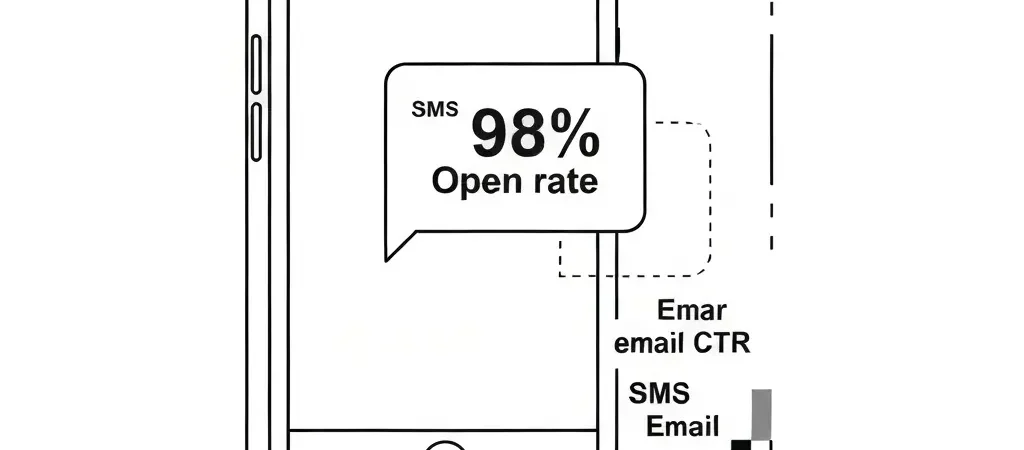
SMS Marketing Statistics and Benchmarks 2026: Open Rates, CTR, and ROI Data
SMS marketing achieves a 98% open rate with 90–95% of messages read within 3 minutes — and delivers an average click-through rate of 19–20%, approximately 9 times higher than email in some regional benchmarks. SMS marketing statistics and benchmarks 2026 confirm that text messaging remains the highest open-rate marketing channel available, with conversion rates of 21–32% for campaigns and $4 returned per $1 spent. This data roundup compiles every major published SMS benchmark figure from Klaviyo, Omnisend, Subtext, Optimonk, Atlas Communications, and Project Broadcast’s 2026 analysis — with source attribution for every number.
The comparison context matters: SMS’s 98% open rate is frequently cited alongside email’s 40–43% open rate as a like-for-like comparison, but the metrics measure different things. Email open rates are tracked by pixel — and inflated by Apple MPP since 2021. SMS “open rate” is typically measured as read confirmation or message delivery receipt. Additionally, SMS operates under different regulatory frameworks (TCPA in the US, PECR in the UK) with explicit opt-in requirements, meaning SMS lists are inherently composed of highly consenting subscribers — a selection effect that improves engagement metrics relative to permission-based email lists.
Headline SMS Benchmarks 2026
The following table presents the most widely cited SMS marketing benchmark figures for 2026, drawn from the five major benchmark sources:
| Metric | Value | Source |
|---|---|---|
| Open Rate | 98% | Optimonk / Atlas, 2026 |
| Messages read within 3 minutes | 90–95% | Optimonk / Project Broadcast, 2026 |
| Click-Through Rate (CTR) | 19–20% | Optimonk, 2026 |
| CTR (Americas region) | 22.2% | Dotdigital, 2026 |
| Conversion Rate | 21–32% | Optimonk, 2026 |
| Response Rate | 45% | Optimonk, 2026 |
| Opt-Out Rate | <3% | Optimonk / Omnisend, 2026 |
| ROI (per $1 spent) | $4.00 | Optimonk, 2026 |
| Texts checked within 1 minute (% of recipients) | 33% | Optimonk, 2026 |
SMS Benchmarks by Industry
According to Klaviyo’s 2026 SMS Marketing Benchmarks and Subtext’s 2026 SMS Marketing Benchmark Report, SMS performance varies significantly by industry vertical, with e-commerce and retail showing the strongest conversion performance:
| Industry | CTR | Conversion Rate | Opt-Out Rate |
|---|---|---|---|
| E-commerce / Retail | 20.3% | 28–32% | 1.8% |
| Restaurants / Food Service | 22.1% | 24–29% | 1.4% |
| Healthcare / Wellness | 17.8% | 21–26% | 2.1% |
| Financial Services | 15.4% | 18–23% | 2.7% |
| Travel / Hospitality | 19.2% | 22–27% | 1.6% |
| Non-Profit | 24.6% | 29–35% | 0.9% |
Non-profit SMS marketing shows the highest CTR and conversion rates — consistent with the pattern seen in email benchmarks, where high trust and personal connection drive above-average engagement. Restaurants and food service show the second-highest CTR, driven by high-intent local offers (flash sales, limited-time promotions) that motivate immediate action.
SMS vs Email: Direct Channel Comparison
The following comparison uses 2026 benchmark data from Dotdigital’s Americas Edition Marketing Benchmarks report and Optimonk’s SMS Statistics compilation:
| Metric | SMS | SMS Advantage | |
|---|---|---|---|
| Open Rate | 98% | ~40%* | 2.4x |
| Click-Through Rate (Americas) | 22.2% | 2.5% | 9x |
| Response Rate | 45% | 10% | 4.5x |
| Average Time to Read | <3 minutes | ~90 minutes | 30x faster |
| Unsubscribe/Opt-Out Rate | <3% | 0.17–0.25% | Email lower |
| ROI per $1 spent | $4 | $36–$42 | Email higher |
| Cost per message | $0.01–$0.05 | $0.001–$0.005 | Email lower |
*Email open rate includes Apple MPP inflation. Email ROI of $36–$42 per $1 spent reflects significantly lower cost-per-message. SMS has higher absolute engagement but email generates higher ROI per dollar spent due to lower unit cost. For detailed email benchmarks, see our email open rates and click rates benchmark report.
The comparison reveals a channel complementarity: SMS excels at speed (90% read within 3 minutes), immediacy, and response rate — making it optimal for time-sensitive campaigns (flash sales, appointment reminders, event notifications). Email excels at ROI efficiency and cost per message — making it the superior channel for nurture sequences, content delivery, and campaigns where message length matters. Most high-performing marketing automation stacks deploy both channels, with SMS for urgency triggers and email for depth and nurture.
ROI and Revenue Data
According to Optimonk’s 2026 SMS Marketing Statistics compilation and Omnisend’s 2026 data:
- $4 ROI per $1 spent on SMS marketing (Optimonk, 2026)
- SMS-attributed revenue accounts for 9–14% of total digital marketing revenue for e-commerce brands that have deployed SMS, according to Klaviyo’s 2026 analysis
- SMS abandoned cart messages recover an estimated 20–30% of carts at a higher rate than email-only approaches, with a median 15-minute send delay being optimal
- Win-back SMS campaigns reactivate an estimated 7–12% of lapsed subscribers within 30 days
- SMS combined with email (omnichannel) produces 18–25% higher conversion rates than single-channel campaigns in A/B tests conducted by Omnisend across their customer base
The $4 ROI per $1 spent figure for SMS is notably lower than email’s $36–$42 per $1 figure. This reflects the higher absolute cost of SMS (per-message carrier fees of $0.01–$0.05 vs. email’s fractional cent per send). The channels are not directly comparable on ROI alone: SMS’s speed and response rate advantages generate revenue types that email cannot replicate at the same velocity, particularly in time-sensitive e-commerce and appointment-driven industries.
Opt-Out and Unsubscribe Rates
SMS opt-out rates are consistently tracked below 3% across all major platforms in 2026, according to Optimonk and Omnisend’s 2026 SMS data. This low opt-out rate reflects the high consent bar required for SMS marketing under TCPA (US) and PECR (UK) regulations — subscribers have explicitly opted in to receive texts, producing a self-selected high-engagement list.
Key opt-out data points from Subtext’s 2026 SMS Marketing Benchmarks Report:
- Average SMS opt-out rate: 1.5–2.8% (across all industries)
- Highest opt-out rates: Financial services (2.7%), general retail (2.4%)
- Lowest opt-out rates: Non-profit (0.9%), local restaurants (1.4%)
- Opt-out rate increases sharply for senders who exceed 4–5 messages per month — the threshold varies by industry and subscriber segment
- First-message opt-out rate (unsubscribing immediately after the first welcome text) averages 4.1%, which is higher than the ongoing opt-out rate — emphasizing the importance of welcome message quality
Performance by Campaign Type
According to Omnisend’s 2026 SMS marketing statistics and Klaviyo’s 2026 e-commerce SMS benchmarks, the following campaign types show materially different performance profiles:
| Campaign Type | CTR | Conversion Rate | Opt-Out Rate |
|---|---|---|---|
| Flash Sale / Time-Limited Offer | 23.4% | 29% | 2.1% |
| Abandoned Cart Recovery | 26.1% | 32% | 1.6% |
| Appointment Reminder | N/A (confirmation) | ~89% confirmation | 0.4% |
| Loyalty / Rewards Update | 18.7% | 21% | 0.8% |
| Promotional Broadcast | 14.2% | 18% | 2.8% |
| Welcome SMS (opt-in confirmation) | 31.4% | ~8% (first purchase) | 4.1% |
Abandoned cart SMS messages achieve the highest CTR (26.1%) and conversion rate (32%) of any campaign type — reflecting the inherent high intent of the recipient. Welcome SMS messages show the highest opt-out rate (4.1%), underscoring the importance of delivering immediate value in the first message rather than simply confirming the opt-in.
Compliance and Adoption Data
SMS marketing operates under strict regulatory frameworks that shape adoption and list-building practices:
- TCPA (US): Requires explicit written consent before sending marketing texts. Violations carry penalties of $500–$1,500 per unsolicited message.
- PECR (UK): Requires opt-in consent for marketing SMS; enforced by the Information Commissioner’s Office.
- GDPR (EU): Explicit consent required; right to erasure applies to subscriber records.
- SMS adoption among US businesses: Approximately 48% of US businesses have deployed SMS marketing in some form as of 2026, up from 41% in 2024 (AudienceTap, 2026).
- US consumers who have opted in to SMS marketing: Approximately 62% of US smartphone owners have opted in to at least one business’s SMS list (Project Broadcast, 2026).
For context on how SMS fits within a broader multi-channel automation strategy, our guide on automating customer engagement across channels covers the tactical integration of SMS, email, and push notifications. The cost savings enabled by combining these channels are detailed in our marketing automation cost savings statistics report.
For broader market context, the marketing automation market size and growth data situates SMS within the $8.14 billion automation software market. For teams evaluating the full channel stack, Authenova’s analysis of content velocity and its impact on search performance provides complementary data for the content marketing side of the automation stack.
Methodology Note
SMS benchmark figures in this article are sourced from Optimonk’s 2026 SMS Marketing Statistics compilation (43 statistics), Omnisend’s 2026 SMS data, Klaviyo’s 2026 SMS Marketing Benchmarks by Industry, Subtext’s 2026 SMS Marketing Benchmark Report, Atlas Communications’ 2026 open rate analysis, and Project Broadcast’s 2026 statistics compilation. Industry-specific figures are derived from Klaviyo and Subtext industry segmentation data. Open rate measurement methodology differs between providers — figures reflect delivered message read confirmation or proxy engagement signals, not pixel tracking as used in email. Conversion rate figures are calculated as purchases or goal completions per SMS sent, not per click. All data covers activity through Q1 2026.
Frequently Asked Questions
What is the SMS marketing open rate in 2026?
SMS marketing achieves a 98% open rate in 2026, with 90–95% of messages read within 3 minutes of receipt (Optimonk, Atlas Communications, 2026). One in three recipients checks their texts within one minute. This compares to email open rates of 39–43% (which are inflated by Apple Mail Privacy Protection). The SMS open rate advantage is partially explained by the opt-in consent requirement for SMS marketing, which produces inherently higher-engagement subscriber lists than permission-based email.
What is the average SMS marketing click-through rate in 2026?
The average SMS marketing click-through rate is 19–20% across all campaign types in 2026 (Optimonk, 2026). In the Americas region specifically, the SMS CTR is 22.2%, which is nine times higher than the email CTR of 2.5% in the same region (Dotdigital, 2026 Americas Marketing Benchmarks). Abandoned cart SMS campaigns achieve the highest CTR at 26.1%, and welcome SMS messages achieve 31.4% CTR.
What is the ROI of SMS marketing in 2026?
SMS marketing returns $4 for every $1 spent, according to Optimonk’s 2026 SMS Marketing Statistics compilation. This is lower than email’s $36–$42 ROI per dollar spent, primarily because SMS carries higher per-message carrier costs ($0.01–$0.05 per message vs. email’s fractional cent). However, SMS generates revenue that email cannot replicate at the same speed — 90% of SMS messages are read within 3 minutes, making it the superior channel for time-sensitive campaigns where message speed directly drives conversion.
What is the average SMS marketing opt-out rate in 2026?
The average SMS opt-out rate is below 3% in 2026, with most industry averages falling between 1.5–2.8% (Optimonk, Omnisend, 2026). The lowest opt-out rates appear in non-profit (0.9%) and restaurant (1.4%) categories. The highest are in financial services (2.7%) and general retail (2.4%). First-message opt-out rates are higher at 4.1% — making welcome message quality a critical variable. Opt-out rates increase sharply for senders exceeding 4–5 messages per month.
How does SMS marketing compare to email marketing in 2026?
SMS outperforms email on open rate (98% vs ~40%), CTR (22.2% vs 2.5% in Americas), response rate (45% vs 10%), and speed-to-read (<3 minutes vs ~90 minutes). Email outperforms SMS on ROI per dollar ($36–$42 vs $4), cost per message ($0.001–$0.005 vs $0.01–$0.05), and unsubscribe rate (0.17–0.25% vs <3%). The two channels are complementary rather than competitive: SMS for urgency, immediacy, and response; email for nurture, depth, and ROI efficiency. Combined omnichannel campaigns produce 18–25% higher conversion rates than single-channel approaches (Omnisend, 2026).
Which SMS campaign type has the highest conversion rate?
Abandoned cart SMS messages have the highest conversion rate at 32% in 2026 (Klaviyo, Omnisend 2026 data), followed by flash sale/time-limited offer messages at 29%. Appointment reminder SMS messages achieve approximately 89% confirmation rates — a different type of conversion. Promotional broadcast messages have the lowest conversion rate at 18% and the highest opt-out rate at 2.8%. The pattern reflects intent: behavioral-triggered messages (sent when a recipient has already demonstrated intent) consistently outperform broadcast messages across all SMS campaign types.
What percentage of businesses use SMS marketing in 2026?
Approximately 48% of US businesses have deployed SMS marketing in some form as of 2026, up from 41% in 2024 (AudienceTap, 2026). On the consumer side, approximately 62% of US smartphone owners have opted in to at least one business’s SMS marketing list (Project Broadcast, 2026). SMS adoption is highest in e-commerce, restaurants, healthcare, and retail — categories where time-sensitive offers and appointment reminders have clear, measurable ROI.
Add SMS to Your Marketing Automation Stack with CampaignOS
CampaignOS integrates SMS, email, and push notifications in a single automation platform — so you can deploy the omnichannel campaigns that generate 18–25% higher conversion rates. Start free at app.campaignos.site.