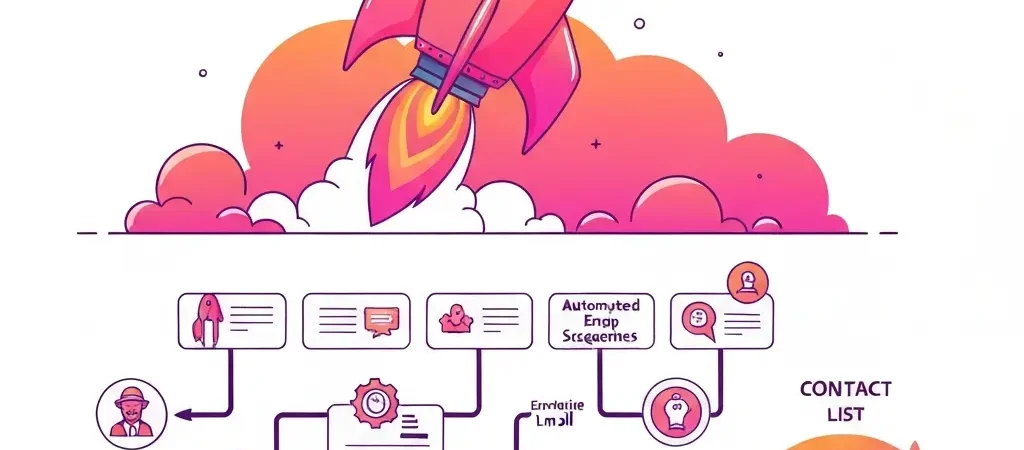
Marketing Automation for Startups: Zero to First 1,000 Leads in 2026
Every startup faces the same early-stage paradox: you need marketing to grow, but you don’t have a marketing team. The founder is doing sales, product, support, and marketing simultaneously — and something always gets dropped. Marketing automation for startups isn’t about replacing a marketing team you don’t have yet. It’s about making a two-person operation punch like a ten-person one, by automating the touchpoints that would otherwise fall through the cracks.
Getting to 1,000 qualified leads is a meaningful milestone for most startups. It’s enough to run meaningful conversion tests, identify your best-fit customer profile, and start seeing predictable revenue. The fastest path there in 2026 isn’t paid advertising — it’s building an automated acquisition engine that captures, nurtures, and qualifies leads continuously, even while the founder sleeps. AI lead nurturing delivers 25% conversion increases within six months, and the best bootstrapped startups are applying this to their earliest lead funnels.
This guide walks through the exact automation stack that takes a startup from zero to 1,000 leads, with specific workflow instructions and the metrics to track along the way.
Building a Lead Magnet Engine
The fastest way to build a startup’s first 1,000 leads is a lead magnet: a piece of free value (template, guide, calculator, tool) that’s compelling enough to trade an email address for. In 2026, the highest-converting startup lead magnets are interactive tools (calculators, assessments) and tactical templates — not generic ebooks.
High-Converting Lead Magnet Formats
- ROI calculator: Lets prospects estimate the value of your product before committing. Converts at 30–45% of visitors who engage.
- Swipe file or template pack: Pre-made assets they can use immediately. Converts at 25–40%.
- Assessment or quiz: “What’s your [X] score?” — highly shareable, high completion rate, and pre-qualifies leads by segment.
- Free audit: “We’ll review your [thing] for free.” High-touch but high-intent. Best for B2B with $1,000+ ACV.
The lead magnet alone gets you emails. What you do in the 7 days after signup determines whether those emails become customers or unsubscribers.
Welcome + Nurture Sequence Architecture
The moment someone downloads your lead magnet is the highest-attention moment you’ll ever have with that prospect. Most startups waste it by sending a single “here’s your [thing]” email and nothing else. A properly architected welcome + nurture sequence turns that download into a 6-email journey that qualifies, educates, and converts.
The 6-Email Startup Nurture Sequence
| Timing | Content | Goal | |
|---|---|---|---|
| 1 | Immediate | Deliver lead magnet + founder intro | Build trust |
| 2 | Day 2 | Problem narrative — amplify the pain | Create urgency |
| 3 | Day 4 | Solution overview (not a sales pitch — a POV) | Position expertise |
| 4 | Day 7 | Customer success story (even if just 1 customer) | Social proof |
| 5 | Day 10 | Objection handling (address the top 3 hesitations) | Remove friction |
| 6 | Day 14 | Direct offer — trial, call, or free tier | Convert |
Referral Automation: Making Leads Generate Leads
Referral automation compounds your lead generation without compounding your work. Once a lead has been in your nurture sequence for 14+ days (and especially after they’ve converted to a trial or customer), they’re warm enough to refer others. A simple automated referral ask — “know anyone who’d find this useful?” with a pre-written share message — generates 3–5x more referrals than hoping your product is shareworthy.
For startups, the mechanics are simple: trigger a referral ask at day 14 of the nurture sequence for engaged leads (those who’ve clicked 2+ emails), and again at day 3 post-trial-start. Use a simple referral link that tracks who referred whom. CampaignOS handles the trigger and message delivery; you just need to set up the referral link mechanism.
Automating Cold Outreach at Scale
Cold outreach automation is different from marketing automation — it’s the use of personalized sequences to reach prospects who haven’t opted in yet. For B2B startups targeting a specific ICP (ideal customer profile), automated cold outreach can add 200–400 targeted leads per month without paid advertising.
The rules in 2026 are strict: personalization is mandatory (generic blasts don’t work and hurt your domain), volume caps protect deliverability (50–80 emails per domain per day maximum), and opt-outs must be honored instantly. Focus on LinkedIn outreach paired with email sequences for the best B2B results.
Lead Qualification: Identifying Your Best Prospects
Not all 1,000 leads are equal. A startup that reaches 1,000 leads but can’t identify the 50 who are genuinely ready to buy has actually created a noise problem, not a sales pipeline. Lead scoring automation solves this by automatically tagging and ranking leads based on engagement behavior.
Basic startup lead scoring rules: +5 points for email open, +10 for link click, +20 for pricing page visit, +15 for reply to any email, +25 for trial signup. Leads above 60 points get tagged “hot lead” and trigger an immediate personal outreach notification to the founder. This focus ensures the founder’s limited sales time goes to the highest-probability conversations.
For a deeper dive into lead scoring mechanics, see lead scoring software guide. For audience segmentation strategies to separate your ICP leads from general signups, see audience segmentation tool guide.
Case Study: B2B SaaS Startup — 0 to 1,200 Leads in 60 Days
Starting point: 0 email subscribers, no marketing budget, founder doing all sales manually.
Approach: Created a free “Remote Engineering Team Playbook” (PDF + Notion template). Promoted organically on Reddit, Hacker News, and LinkedIn. All signups entered CampaignOS nurture sequence. 6-email drip + lead scoring to identify hot leads.
Result: 1,200 leads in 60 days. 14% trial conversion from the nurture sequence. 8 enterprise conversations initiated by hot lead trigger. $22,000 MRR within 90 days of launch.
The founder’s take: “We had no budget for ads. The playbook cost us a weekend to write. But the CampaignOS sequence meant every lead got a personal-feeling 6-email sequence, and I only talked to people who had already been warmed up. My close rate on those conversations was 70%. The automation did the first 90% of the sales job.”
The Startup Automation Stack for Under $50/Month
| Function | Tool | Cost |
|---|---|---|
| Email automation + CRM | CampaignOS | Free |
| Landing page + lead capture | Webflow / Framer | $0–$14/mo |
| Form builder | Typeform / Tally | Free tier |
| Lead magnet delivery | CampaignOS automation | Free |
| Analytics | Plausible / Umami | $0–$9/mo |
For bootstrapped startup alternatives to expensive tools, see best marketing automation for bootstrapped startups. For the full guide on SaaS-specific automation after you’ve hit your first 1,000 leads, see SaaS marketing automation growth guide.
Frequently Asked Questions
Can a startup use marketing automation with no marketing team?
Yes — that’s the primary use case. Marketing automation for startups is specifically designed to let a 1–2 person team maintain consistent, high-quality touchpoints with hundreds or thousands of leads simultaneously. Platforms like CampaignOS have visual workflow builders that require no technical expertise and no dedicated marketing staff to operate.
How long does it take a startup to reach 1,000 leads?
With a strong lead magnet and organic distribution (community posts, SEO, social), most B2B startups reach 1,000 leads within 60–90 days. With paid acquisition, the timeline can compress to 2–3 weeks. The more important metric is the quality of those leads — a 14% nurture-to-trial conversion rate on 1,000 leads is 140 trials, which is a meaningful pipeline for early-stage SaaS.
What’s the best lead magnet for a B2B startup?
The highest-converting B2B lead magnets in 2026 are interactive tools (calculators, assessments) and tactical templates that prospects can use immediately. Ebooks and guides still work but convert lower than actionable assets. The best lead magnet directly solves a micro-problem your ICP faces and positions your product as the logical next step.
How does lead scoring help startups prioritize sales time?
Lead scoring assigns points to leads based on engagement behavior — email opens, clicks, page visits, trial signups. Leads above a threshold (e.g., 60 points) are flagged for immediate founder outreach. This ensures the founder’s limited sales time goes to the highest-probability conversations instead of working the full cold list. Founders using lead scoring report 2–3x higher close rates because they’re only talking to pre-qualified leads.
Is CampaignOS free for startups?
Yes. CampaignOS offers a free tier that includes email automation, contact management, audience segmentation, and multi-channel workflows. It’s designed specifically for budget-conscious teams — startups, small businesses, and bootstrapped founders — who need enterprise-grade automation without enterprise pricing.
Build Your First 1,000 Leads with CampaignOS
Set up your lead magnet sequence, nurture drip, and lead scoring in one afternoon. Free to start — no credit card required.